
Keep or Replace Working Solar Panels? Check Before an Early Upgrade
Working solar panels deserve an assessment before removal. Compare retaining, expanding and replacing a system, and separate recycling proposals from current charges.
Working solar panels deserve an assessment before removal. Compare retaining, expanding and replacing a system, and separate recycling proposals from current charges.

A newer solar panel on the market is not, by itself, a reason to remove a working system. Start with the condition of what you own and the extra energy you actually need.
There are valid reasons to replace panels, including damage, faults, roof work or a better whole-system design. There are also cases where retaining the existing array deserves serious consideration.
This guide was checked on 3 November 2026. It discusses assessment and current policy information, not an inspection of your roof or a guarantee that older equipment should stay.
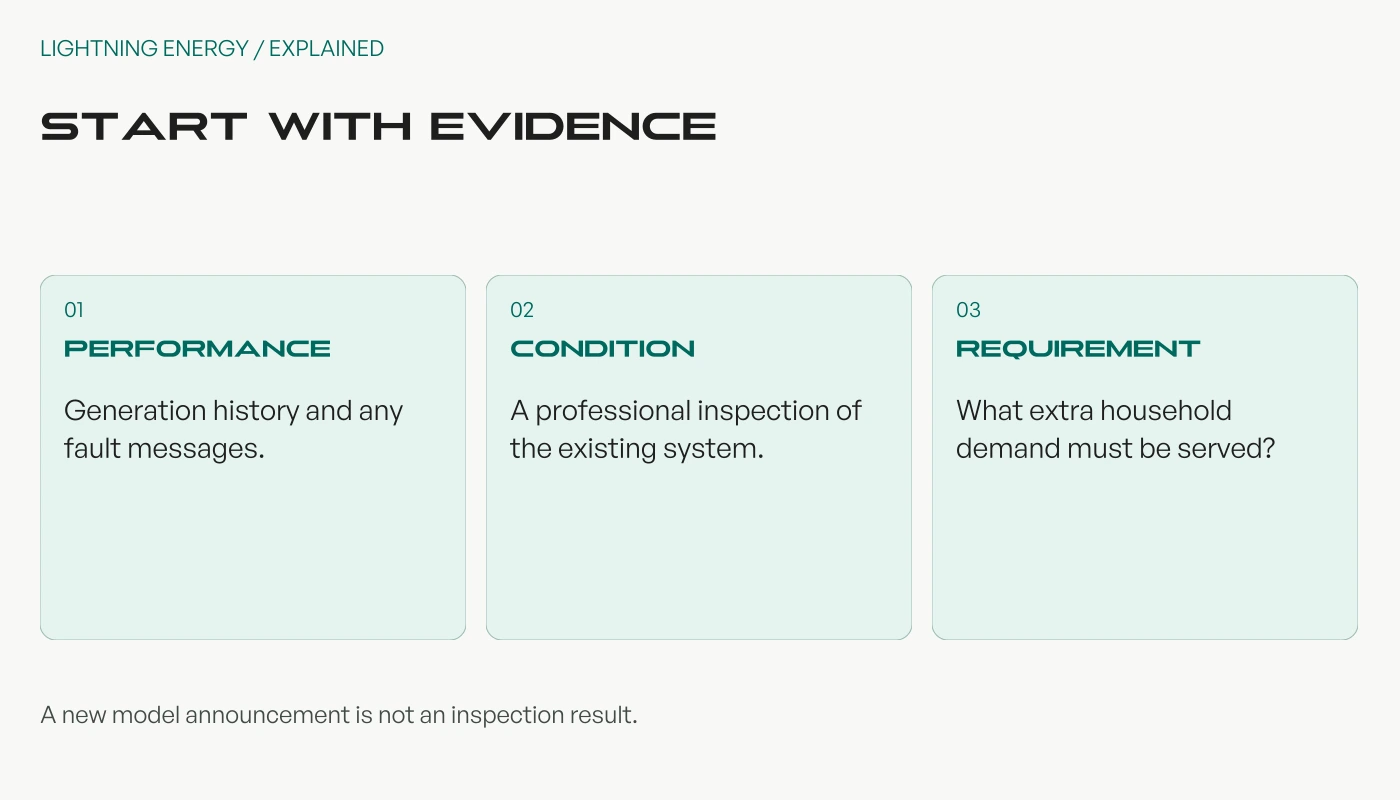
Bring the installer generation records, fault messages, system age and model details. Compare seasonal performance rather than using one cloudy month as proof that the panels have failed.
Ask whether reduced output points to the panels, shading, an inverter issue or another cause. Request the reasoning behind a replacement recommendation.
A professional assessment matters before anyone removes or reconnects equipment. Do not climb onto the roof or handle solar wiring to investigate performance yourself.
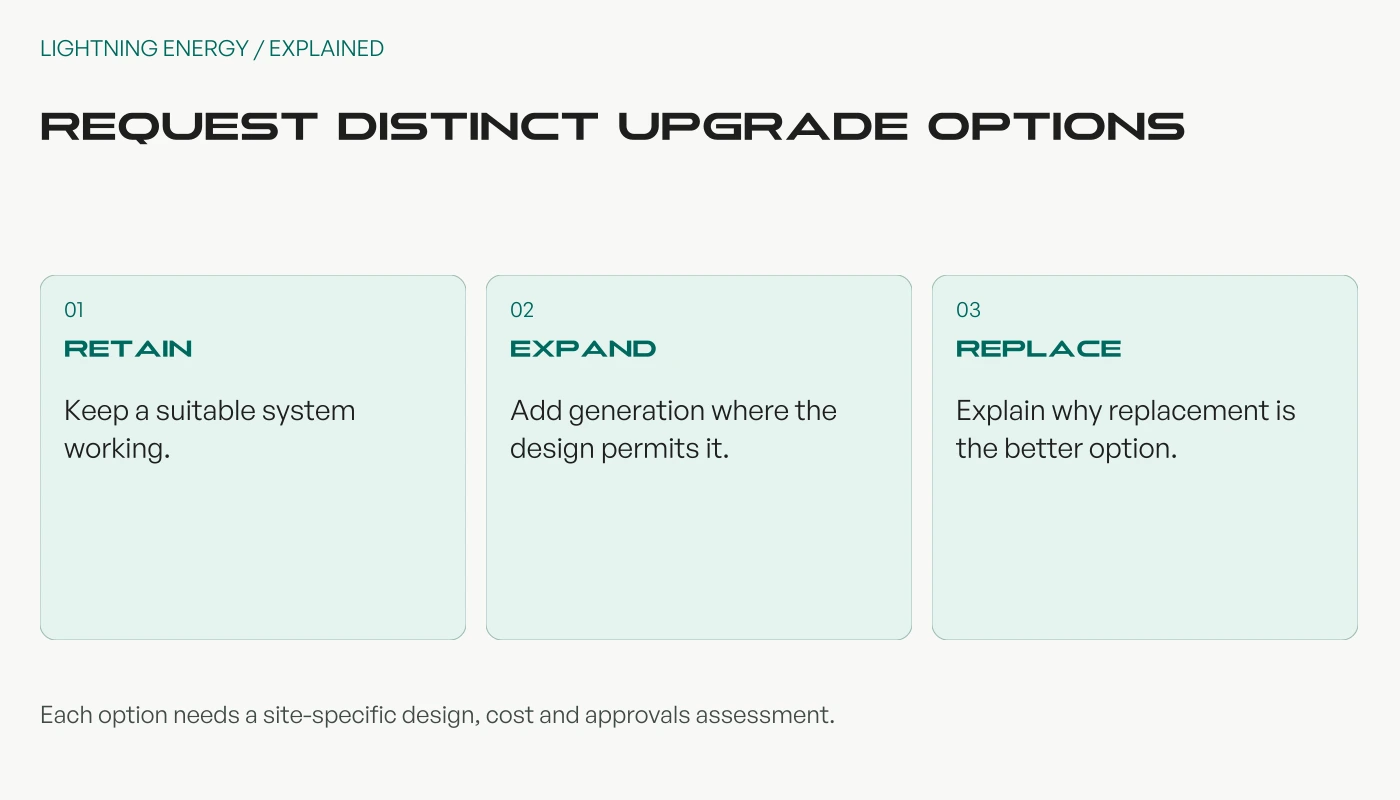
Ask for separate options where technically feasible. Retaining existing generation, adding capacity and replacing the whole array can have different costs, approvals and consequences.
An additional battery does not automatically require removing every existing panel. Compatibility, inverter arrangements and the proposed system design still need checking.
Our solar export-limits guide explains why more panel capacity does not automatically mean more permitted export.
If expansion is proposed, ask how new and existing equipment will work together. Do not assume panels of different models can simply be added to an existing string.
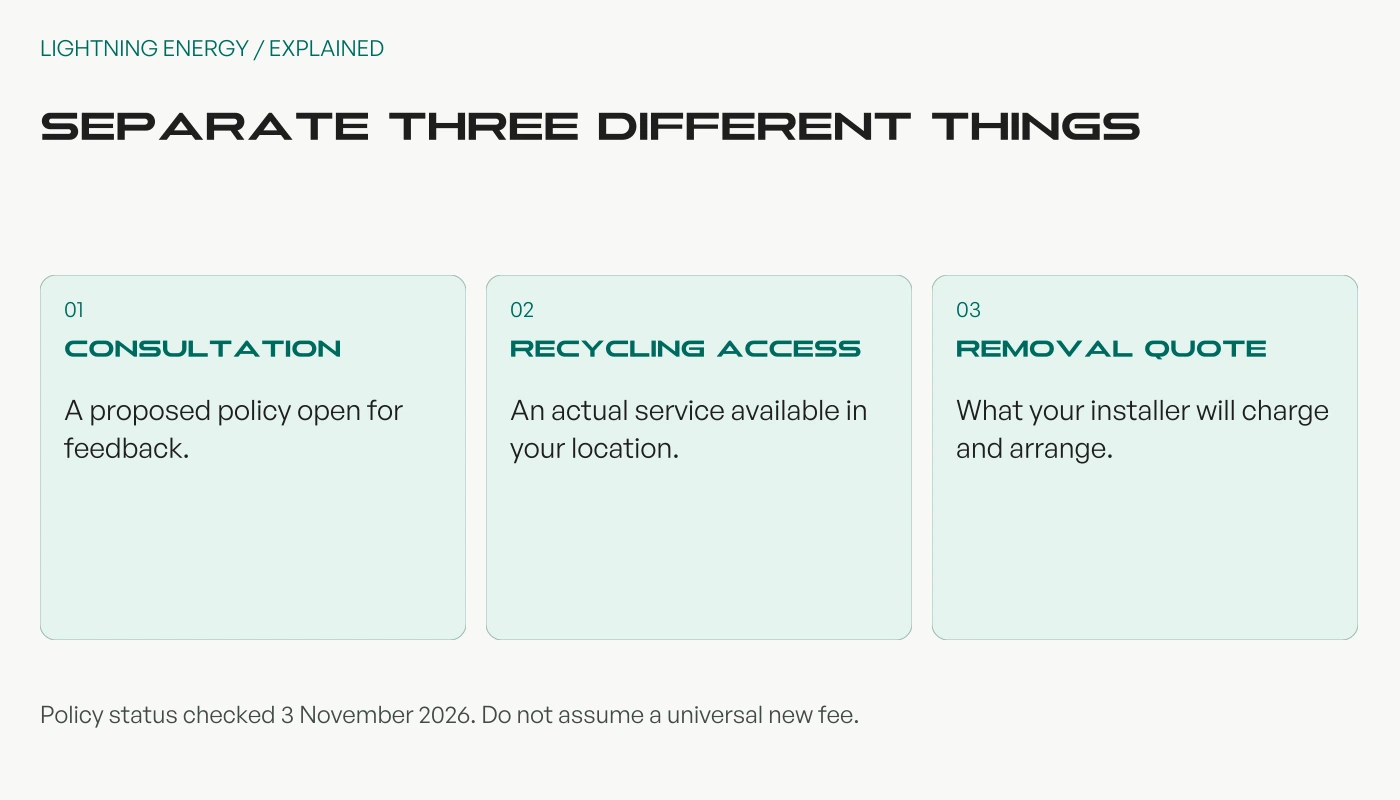
The NSW EPA is consulting on a draft Solar Panels Regulation. Its page describes proposed producer-responsibility arrangements and a closing time of 5 pm on 16 November 2026.
The proposal includes fees paid by suppliers through stewardship arrangements. A consultation is not proof that a specific new household retirement charge already applies.
Source: NSW EPA’s draft regulation consultation.
The Commonwealth’s solar-panel recycling page describes a $24.7 million pilot and a future stewardship proposal. Its published timetable alone does not confirm that collection is available at your address.
The department says the pilot does not cover decommissioning or buying replacement panels. Check an actual collection arrangement rather than assuming every removal is subsidised.
Source: DCCEEW’s solar-panel recycling information.
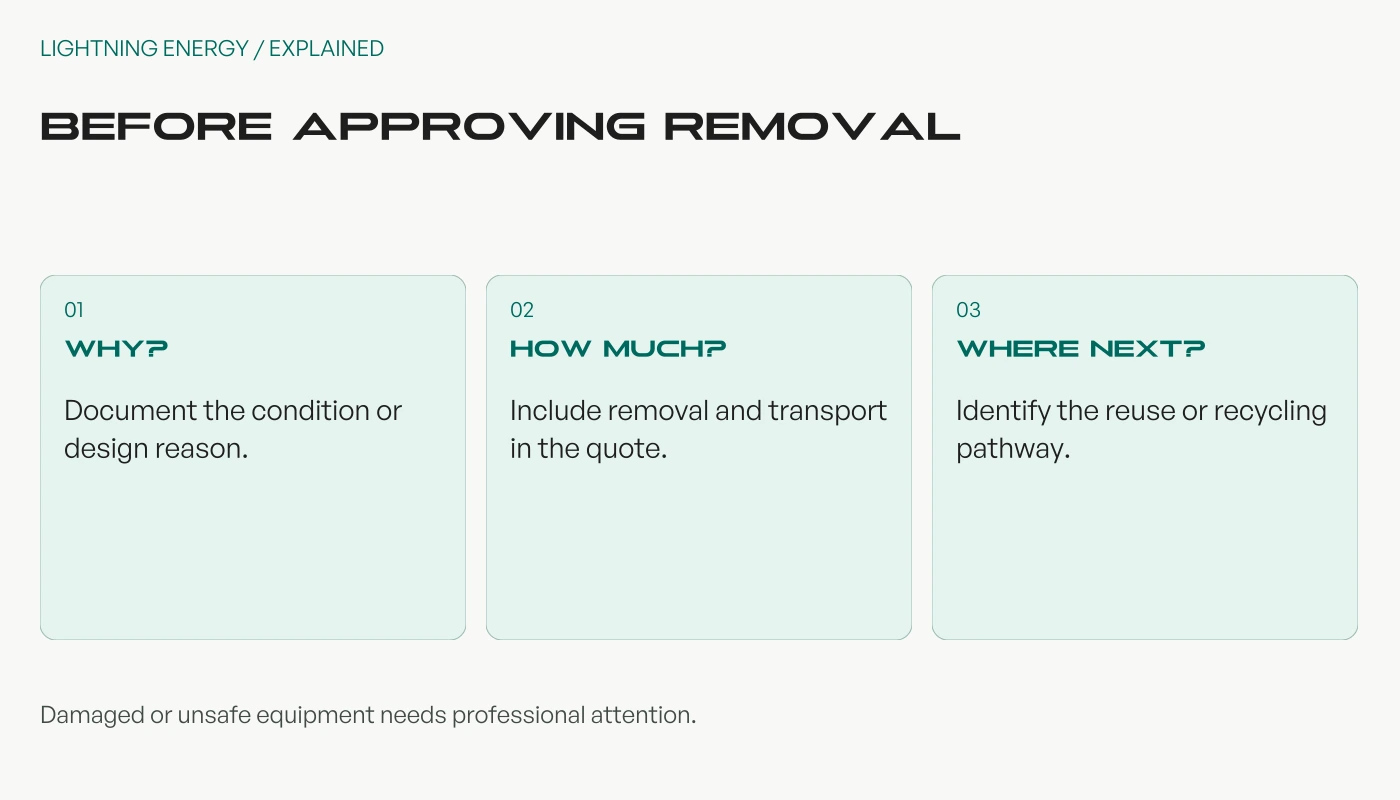
If panels will come off, ask who takes responsibility for them, where they will go and what documentation you receive. Include removal, transport and any recycling costs in the comparison.
Reuse also requires suitable assessment. Calling a panel second-hand does not establish its electrical condition, eligibility or suitability for another installation.
Our home battery quote checklist is useful when storage forms part of the upgrade. Make the retained equipment and exclusions explicit.
Keep original warranties and installation records with the new proposal. Ask which warranties apply to retained components and which apply to new work.
The useful comparison is total cost against the extra usable generation or other benefit. Name what changes: roof space, output, monitoring, compatibility or a fault being addressed.
Use household meter data when the goal is to support a battery. More nameplate capacity is not the same as more energy available at the right time.
Talk to Lightning Energy with your existing system details and proposed new loads. Ask for an explanation of what stays, what changes and why, before approving an early replacement.
Available times
Book a consultation and we'll map solar, storage, hot water, and the rebates around your bills and your goals.
Question 1 of 6
