
SolarEdge Leaving Australia: Warranty, Support and What Owners Should Do
SolarEdge is ending local sales in Australia. Check the November order deadline, warranty support, repair costs and what to do with an existing system.
SolarEdge is ending local sales in Australia. Check the November order deadline, warranty support, repair costs and what to do with an existing system.

SolarEdge is withdrawing direct local sales and operations from Australia and New Zealand. For existing owners, the immediate question is how to get support, rather than whether a working system needs replacing.
An installer notice reproduced by SolarQuotes sets out a final-order timetable and says eligible products remain covered by warranty. We checked that notice and the manufacturer’s support documents on 5 November 2026.
The notice gives 20 November 2026 as the last purchase-order date, with final delivery no later than 18 December 2026. It also says product certification renewals, active promotions and programs will cease.
Those are SolarEdge’s supply deadlines. They are not a promise that an individual retailer has stock or can complete an installation by a particular date. Ask your seller to confirm your order in writing.
Read the SolarEdge installer notice reproduced by SolarQuotes and the SolarQuotes report.
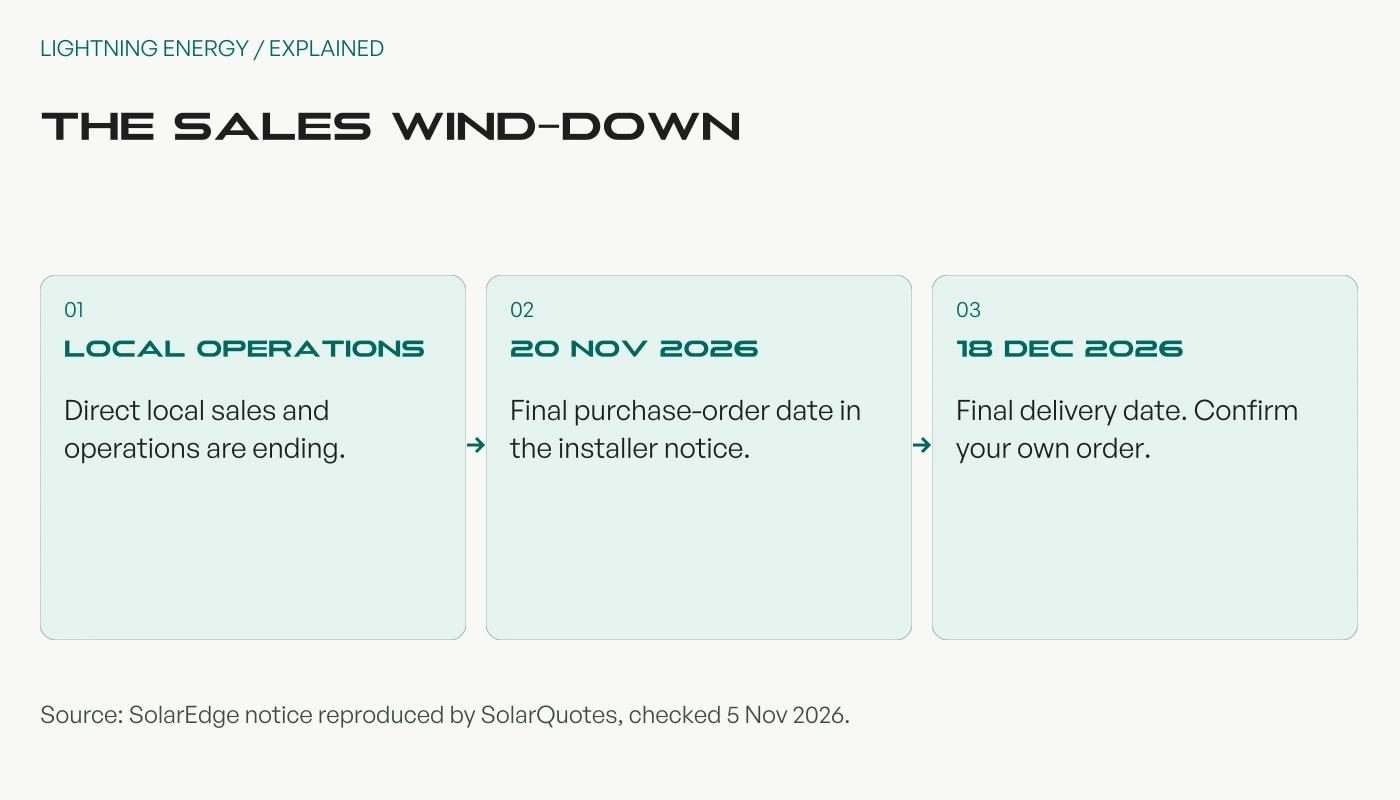
SolarEdge’s notice says eligible products it sold before the last-buy date in Australia and New Zealand retain warranty coverage.
This is a market withdrawal announcement; the notice does not announce liquidation or cancellation of every warranty.
Keep the warranty that applies to your equipment and purchase. Inverters, batteries, optimisers and accessories can have different terms. A headline warranty length is not a substitute for checking the model and serial number.
The December 2025 Australian limited product warranty requires a fault description, serial number and purchase receipt or warranty certificate when making a claim. Battery products have separate warranty documents.
That document excludes certain on-site labour, travel, removal and reinstallation costs unless agreed in writing in advance. Ask who will pay for diagnosis, access and labour before approving a visit. Your applicable terms may differ.
A repair approval and a booked technician are separate milestones. Get the case number, approved remedy, parts availability and next update date in writing. Do not assume a general dispatch target is a guaranteed repair time at your home.
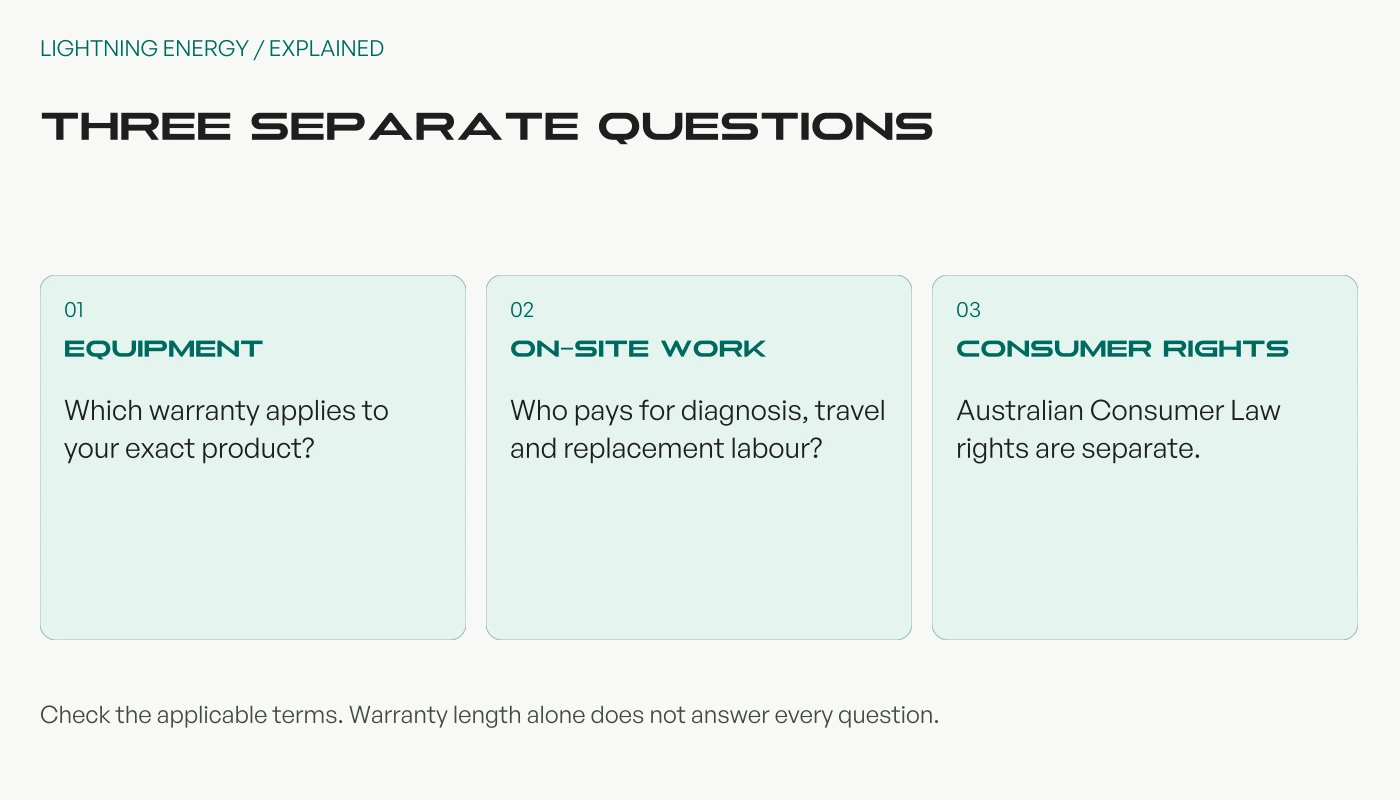
The ACCC’s solar and battery guidance confirms that consumer guarantees apply. Depending on the failure, a customer may be entitled to repair, replacement or refund.
Raise a problem with the business that sold you the system. A manufacturer’s change in local operations does not, by itself, remove the seller’s responsibilities under Australian Consumer Law.
The appropriate remedy depends on the circumstances. A commercial warranty exclusion does not settle every consumer-law claim. If the dispute remains unresolved, contact your state or territory consumer protection agency.
The ACCC accepts reports but does not resolve individual disputes. This article provides general information, not a decision about a particular warranty or legal claim.
The notice directs service enquiries to an International Tech Centre, with weekday support from 9 am to 5 pm local time. It lists 1800 465 567, WhatsApp 0488 850 311 and customercareaustralia@solaredge.com.
Start from the official SolarEdge support page for current contact channels and case-status tools. The system-owner resources are also available.
Our suggested approach is to send one clear evidence pack. Include the invoice, installation date, exact model, serial number, fault messages and existing case references. Keep copies of every reply.
Record symptoms from the app and safely accessible labels. Do not open equipment or climb onto the roof to collect evidence. Ask a qualified technician to assess electrical faults.
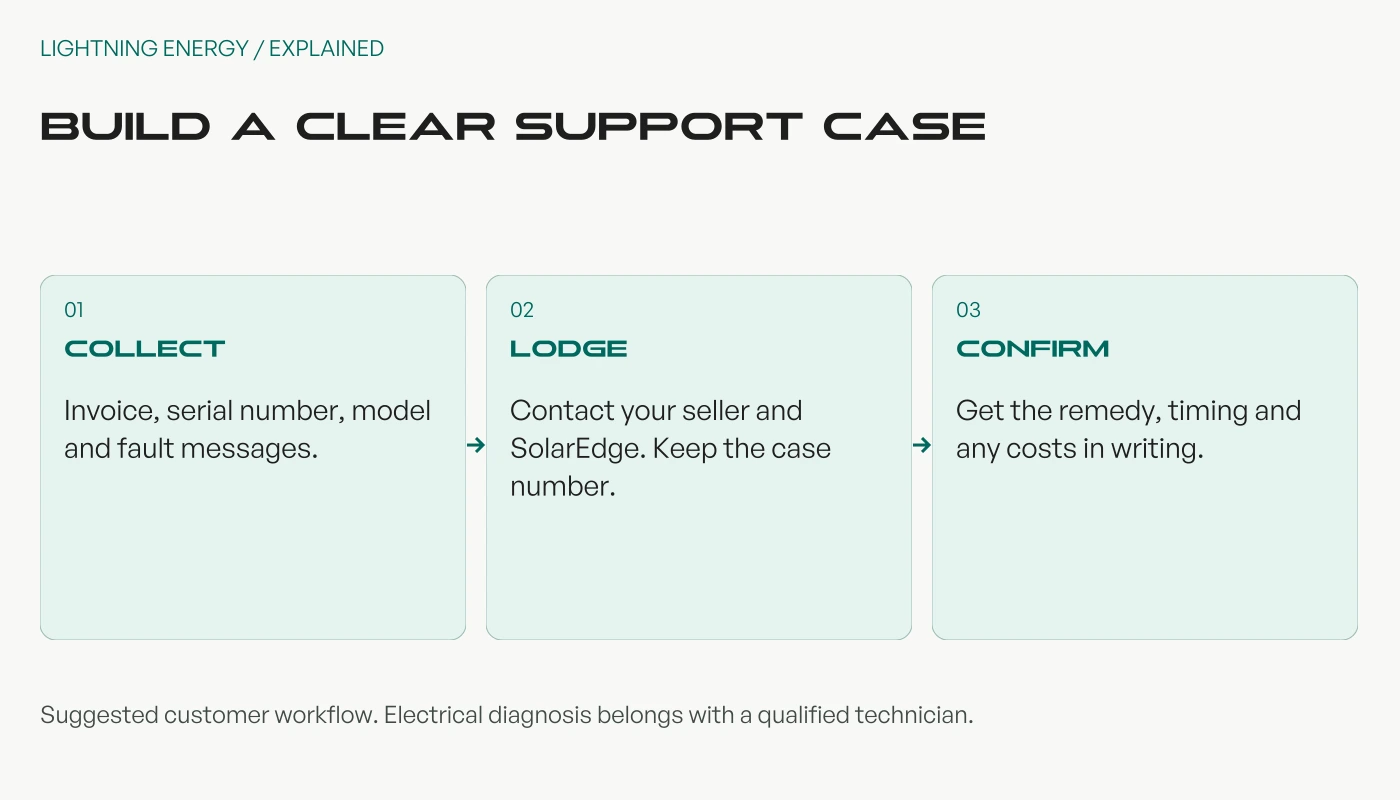
The withdrawal notice does not instruct owners to switch off or replace operating equipment. If your system is working normally, our practical recommendation is to check your records and support access before considering new hardware.
Make sure you can sign into your monitoring account. Save recent generation reports and your installation documents.
An app communication problem and a generation fault need different checks; ask your technician which one they have identified.
If your original installer is unavailable, our guide to recovering solar monitoring access explains the records worth gathering.
Do not assume a different inverter will be a simple swap, or that an extra optimiser will suit the existing string. Ask for a complete equipment list and a written compatibility assessment before ordering.
SolarEdge’s residential optimiser compatibility note specifies model combinations and firmware conditions for replacements and retrofits.
Have the installer check the current documentation for your exact system. Our guide to replacing an ageing solar inverter explains the broader design questions.
For a battery addition, compare keeping the existing solar equipment with a properly designed alternative. Our existing-inverter battery guide helps frame that discussion.
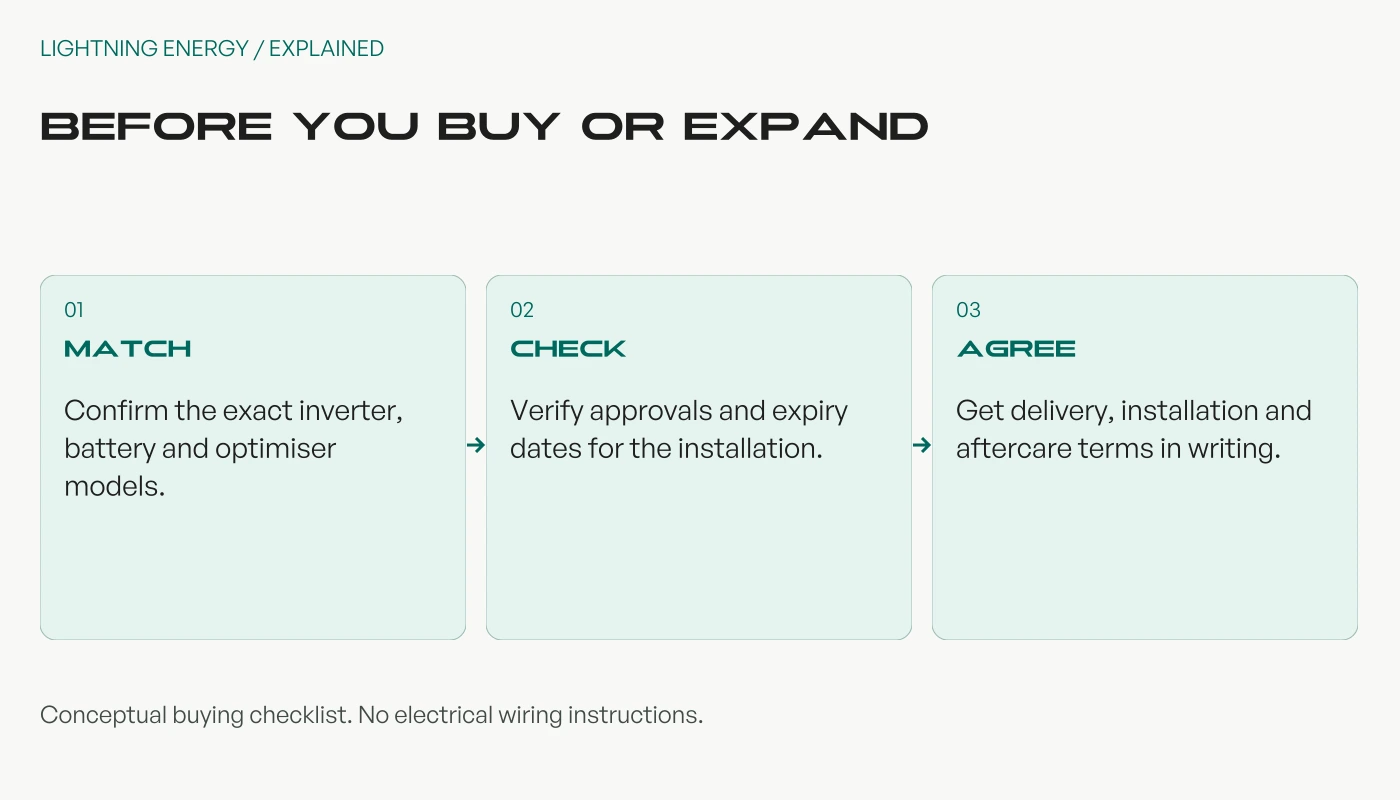
Ending certification renewals makes expiry dates a practical purchasing question. It does not establish that every SolarEdge model has already lost approval, or that an existing installation must be removed.
For solar systems claiming small-scale technology certificates, the Clean Energy Regulator requires approved modules and inverters.
The regulator says components must be fully installed and commissioned before their listed expiry date. Ask the installer to check the exact model, installation date and network requirements before accepting a clearance offer.
For an existing owner, the useful next step is a documented support plan: who diagnoses a fault, who handles the manufacturer claim and who completes any on-site work. Keep the answers with your system records.
For a new purchase, request a written explanation of delivery, compatibility, approvals and aftercare. A discount is only one part of the decision. Do not let a final-order date replace a proper assessment of the system.
We have not independently tested post-exit response times, local spare-parts stock or individual warranty outcomes. Those remain questions to put directly to SolarEdge and your supplier.
Contact Lightning Energy if you would like an assessment of repair or upgrade options. Send your equipment list and installation records so the discussion starts with the system you actually own.
Available times
Book a consultation and we'll map solar, storage, hot water, and the rebates around your bills and your goals.
Question 1 of 6
