
TOPCon, HJT and Back-Contact Solar Panels: What the Labels Tell You
Understand TOPCon, HJT and back-contact solar cells, then compare the complete Australian panel model using roof fit, documented specifications and warranty terms.
Understand TOPCon, HJT and back-contact solar cells, then compare the complete Australian panel model using roof fit, documented specifications and warranty terms.

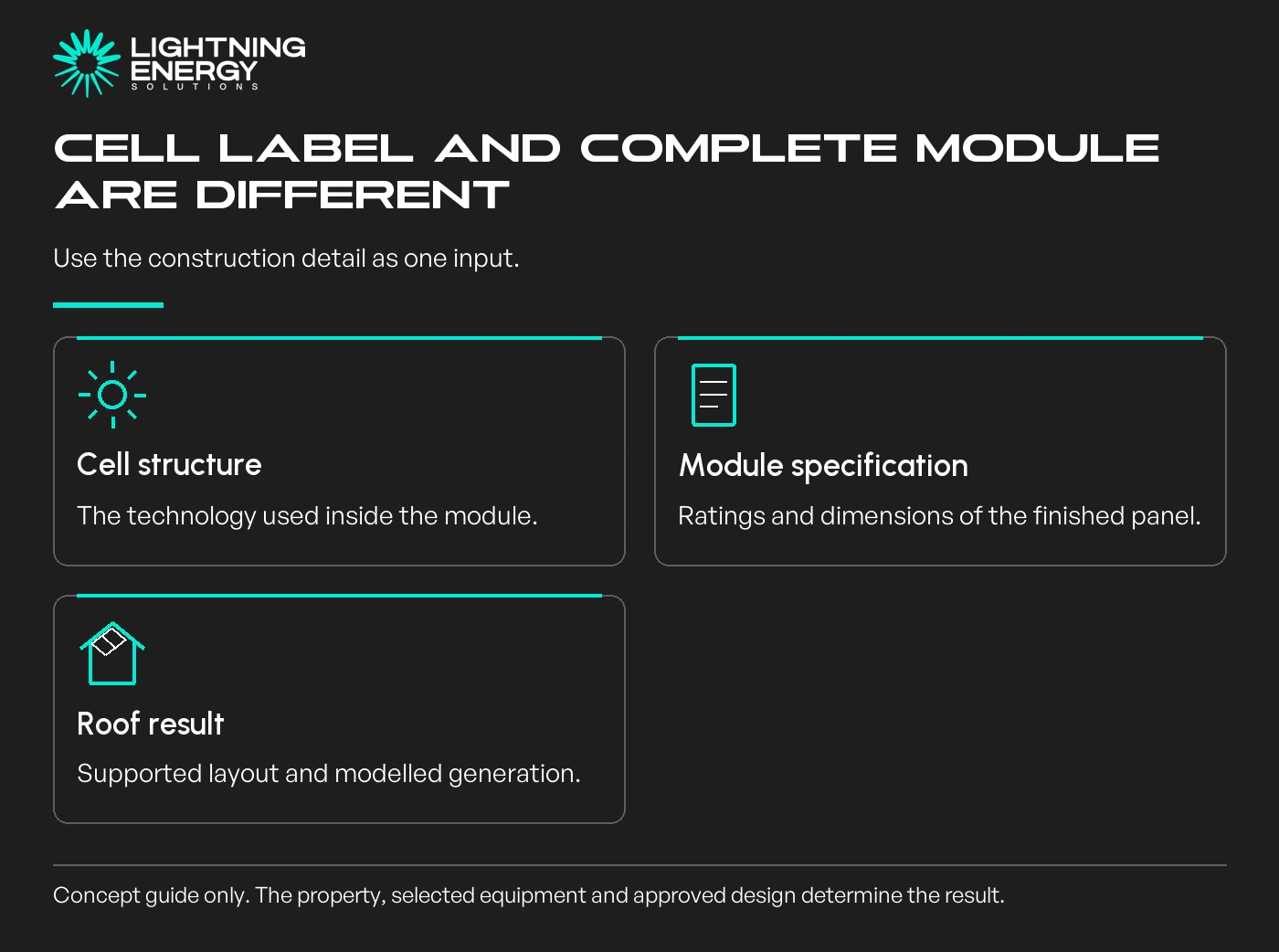
TOPCon, HJT and back-contact describe aspects of solar-cell design. They help explain how a product is built, but they do not replace the datasheet, roof layout or warranty when choosing panels.
Treat the technology name as the start of a question: what documented benefit does this exact module offer in the proposed installation?
A solar comparison should connect the cell label to the complete product and the household result, rather than ranking names in isolation.
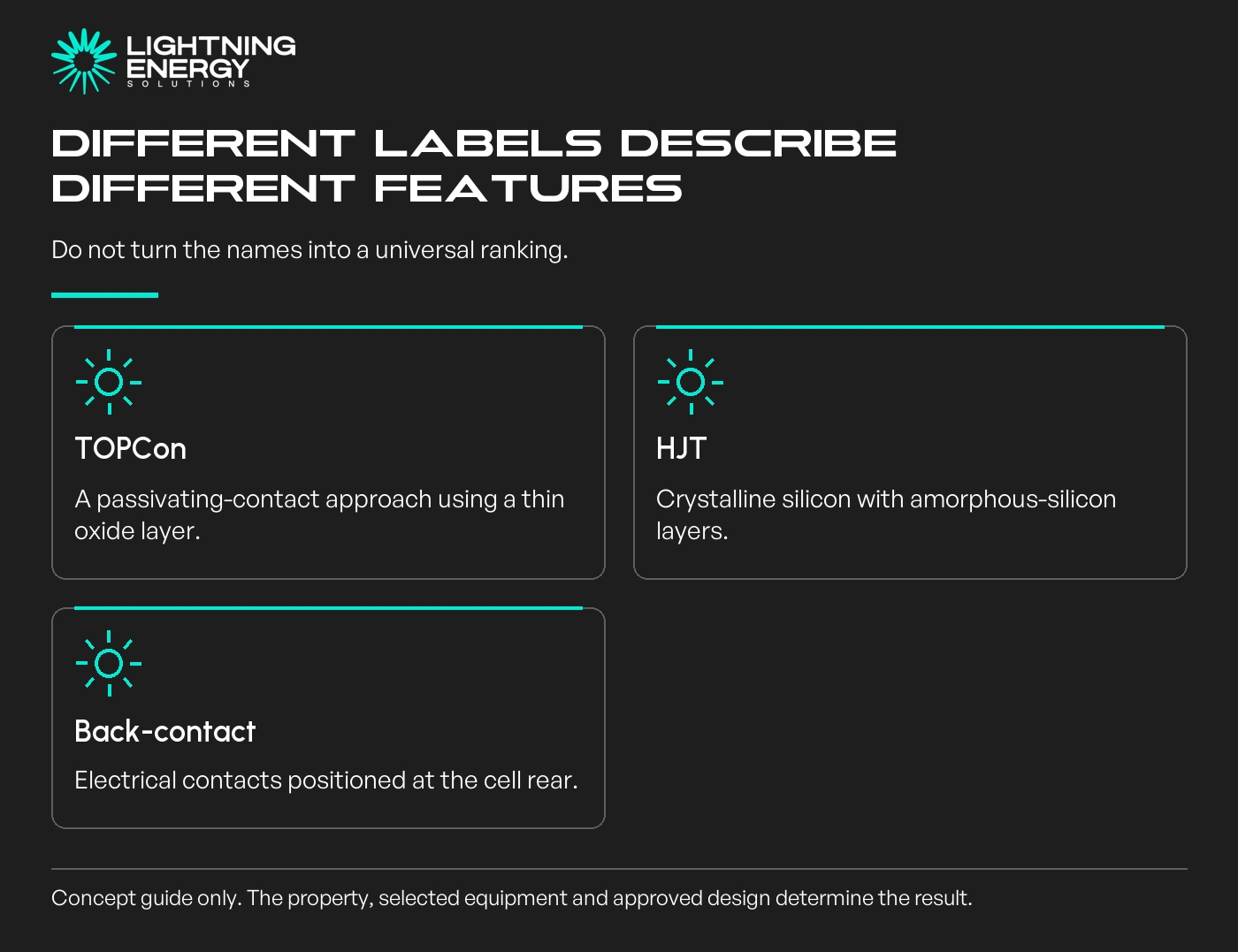
TOPCon refers to a tunnel oxide passivated contact. Fraunhofer ISE describes an ultra-thin oxide combined with a thin silicon layer as part of the contact structure.
Fraunhofer ISE’s TOPCon explanation.
The homeowner does not need to select those microscopic layers individually. The useful follow-up is how the finished panel’s documented ratings, dimensions and warranty compare with another suitable module.
Research-cell records are also different from the specification of a production panel. Do not transfer a laboratory efficiency figure into a quote for a different complete product.
HJT stands for heterojunction technology. REC’s technical explanation describes a cell combining crystalline silicon with thin amorphous-silicon layers.
REC explanation of HJT cell construction.
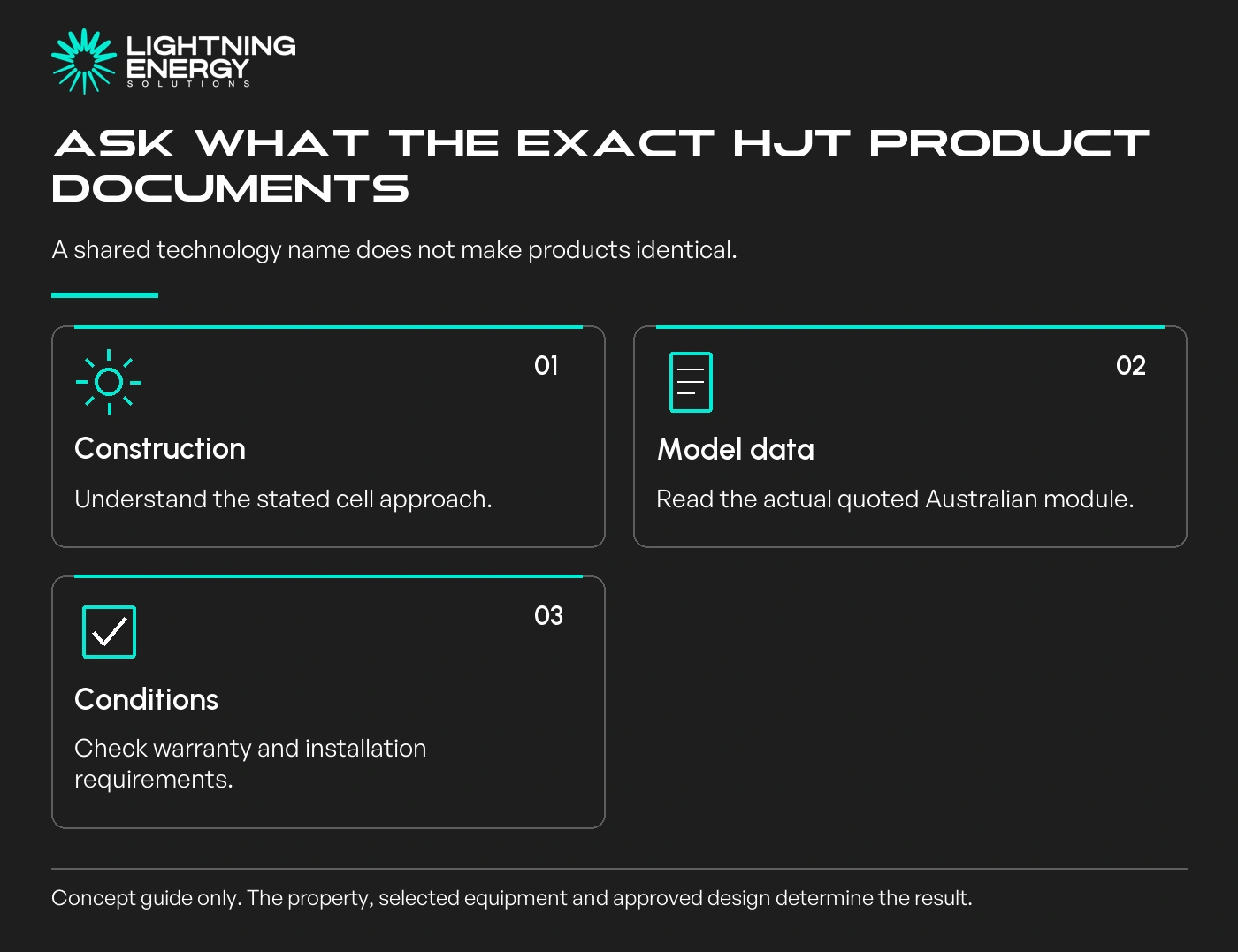
That source explains the construction principle; its historical product examples are not a current Australian specification comparison. Ask for the documentation of the model actually being offered.
Avoid assuming every HJT panel has identical temperature behaviour, dimensions or warranty cover. Those remain product-level questions, even when two brochures use the same cell label.
Back-contact designs place electrical contacts at the rear of the cell. ISFH’s research describes interdigitated rear contacts and the associated passivating-contact structures.
ISFH explanation of back-contact research.
These terms describe different design features, so they should not be treated as a simple ladder from basic to best. Ask the manufacturer to explain the particular architecture without assuming a label proves overall superiority.
An attractive uninterrupted front appearance may matter to a homeowner. Keep that preference separate from claims about annual energy, which need a supported comparison of the complete modules.
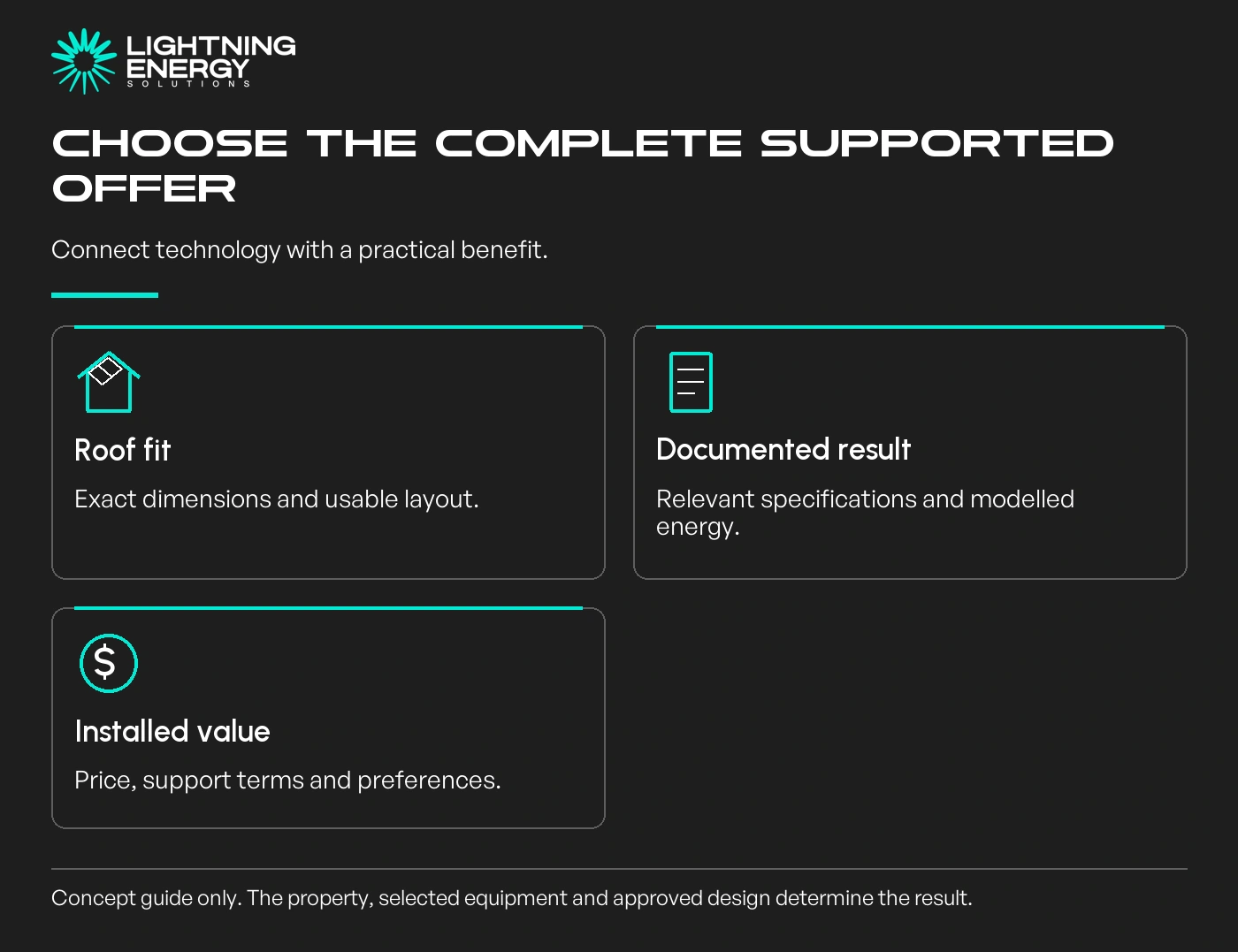
Imagine an illustrative small roof with two suitable panel options. One advertises a newer cell design, while the other fits the available dimensions more effectively. The roof drawing is needed before either can be preferred.
The system-size guide explains why array capacity, inverter rating and generation are different quantities.
Record exact model code, dimensions, rated output, relevant temperature data and warranty conditions. Compare the same roof and weather assumptions, with any price difference shown for the complete installation.
Our Jinko model guide provides an example of moving from a brand family to a specific module, rather than assuming every panel under the name is identical.
Do not reject a suitable panel simply because its acronym sounds less fashionable. Equally, do not dismiss a documented improvement when it addresses a real roof constraint or an important preference.
A useful proposal explains the particular product advantage, its limits and the additional cost. It should not need an unsupported technology ranking to make its case.
Contact Lightning Energy with the exact model numbers on your quotations. We can compare what fits, what the documents support and what changes for your home before treating the cell label as the deciding factor.
Available times
Book a consultation and we'll map solar, storage, hot water, and the rebates around your bills and your goals.
Question 1 of 6