
Will Your Solar Panels Recharge the Battery During a Blackout?
Solar can recharge a battery during some outages, but the supported inverter, backup controls and restart conditions determine what your system can do.
Solar can recharge a battery during some outages, but the supported inverter, backup controls and restart conditions determine what your system can do.

Solar panels can recharge a battery during a blackout when the installed system supports solar operation without the grid. Having panels and storage on the same property does not establish that capability.
Ask the installer to describe the exact outage energy path. It should identify which solar equipment remains operational, how excess generation is controlled and what happens if stored energy becomes depleted.
An ordinary grid-connected solar system is designed to stop supplying electricity when the grid fails. Adding a battery creates potential backup options, but those options require a supported design and appropriate equipment.
The Australian Government's battery guide explains that blackout operation is a specific system capability to confirm before purchase.
Australian Government: batteries.
Our solar inverter guide explains the conversion equipment involved. The next question is how that equipment behaves when the external grid is unavailable.
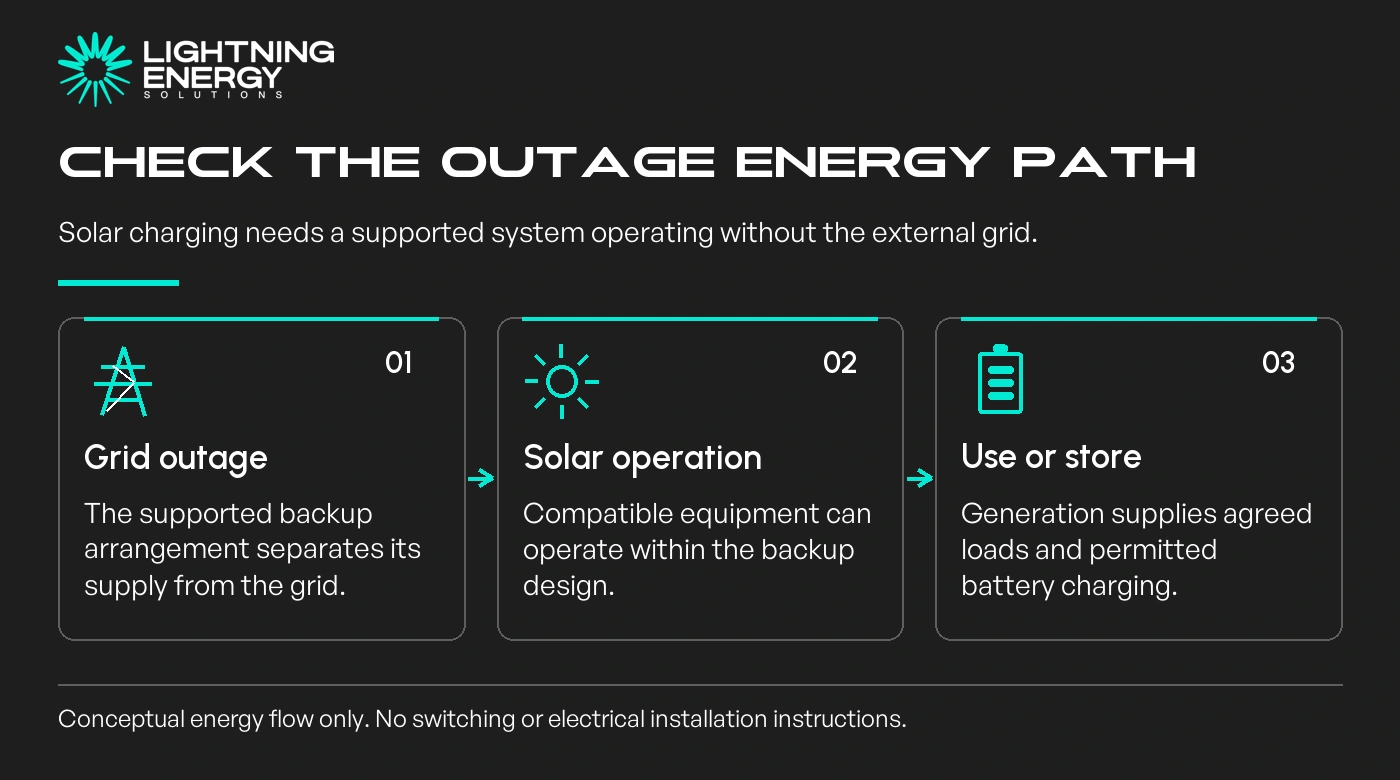
The system needs to separate its backed-up supply from the failed grid and provide the conditions required by the supported solar equipment. Compatibility during ordinary grid operation is a different question.
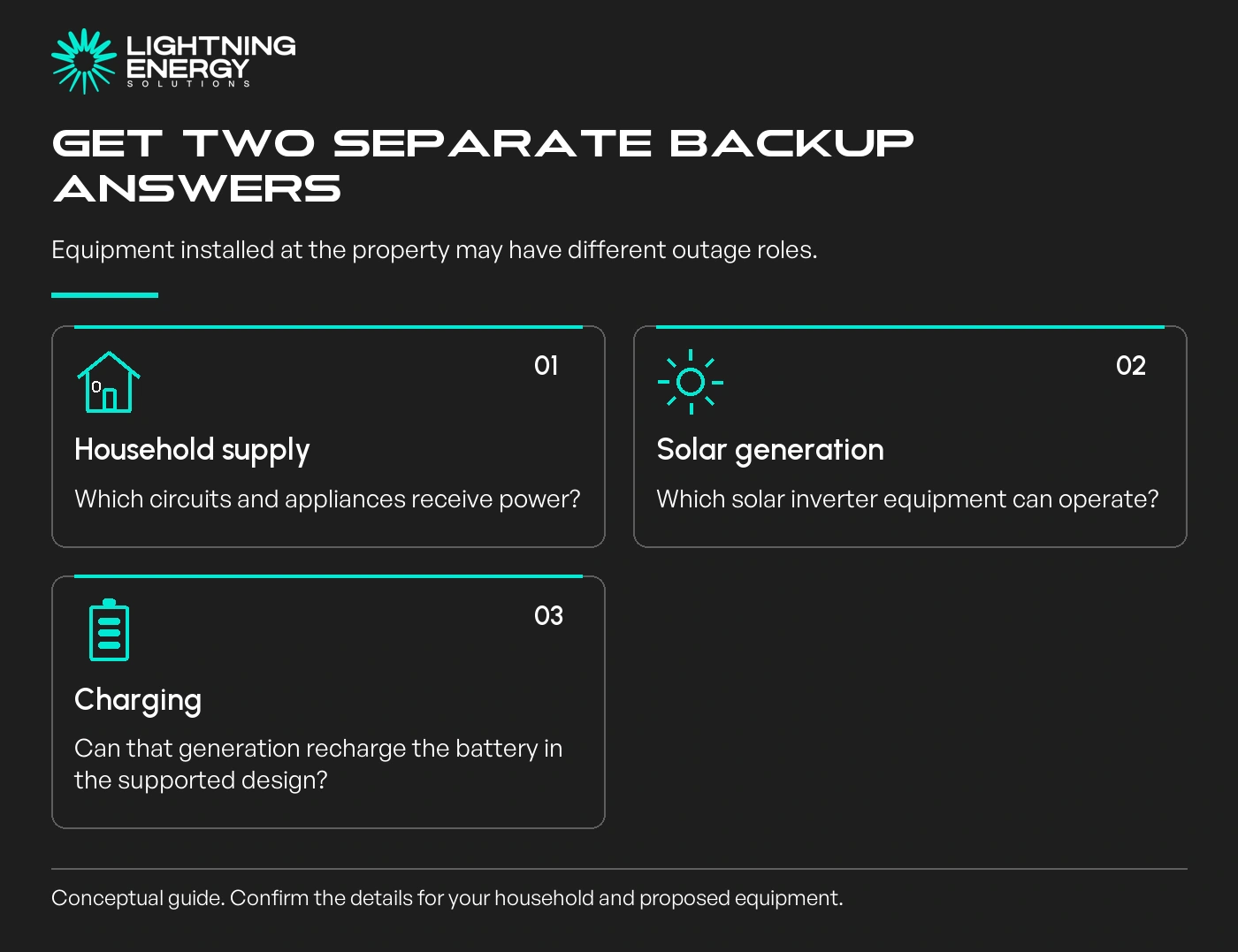
Ask whether existing solar is included in that arrangement or whether only the new battery supplies the selected loads. In some retrofit designs, the original solar equipment may remain unavailable during the outage.
A proposal saying backup included should therefore answer two questions: what receives power, and what can generate or recharge while the outage continues?
The battery quote checklist is a useful place to record those answers alongside the named controllers and inverters.
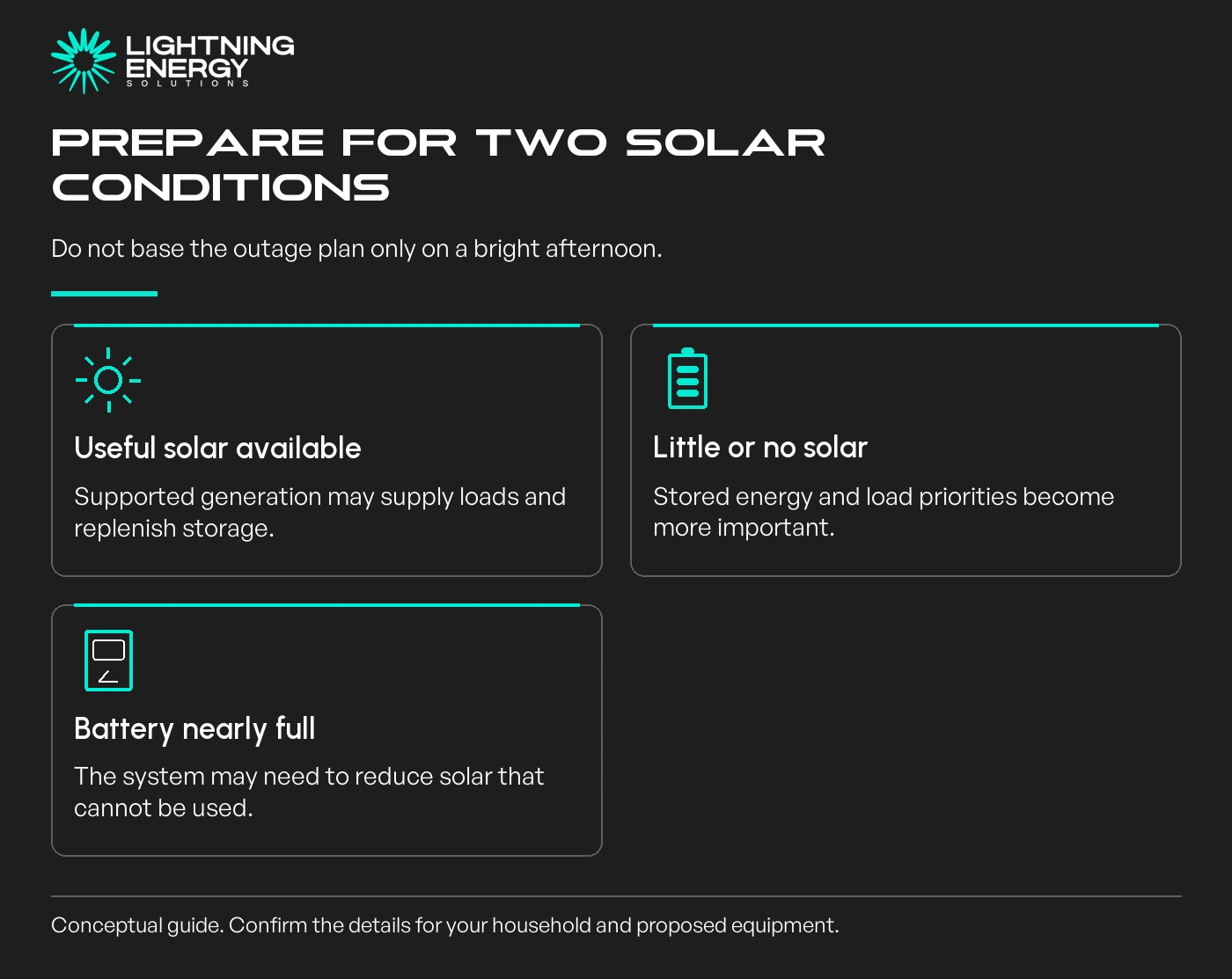
During an outage, electricity cannot simply be exported to the failed grid. The system must manage generation against the loads it supplies and the battery's available charging capacity.
Tesla's Australian owner guidance gives one example: in a supported Powerwall arrangement, solar can be reduced or stopped when generation exceeds what can be used or stored.
Tesla Australia: outage behaviour.
Imagine a hypothetical sunny afternoon when backed-up appliances need 1 kW and the nearly full battery can accept little more. A much larger solar array does not mean all its potential output will be used.
Temporary reduced solar production can therefore be part of normal outage control. The actual behaviour depends on the installed system, and unexpected faults still need professional investigation.
A battery running out during a long outage introduces another question: can the system restart solar operation, and under what conditions? Do not assume morning light always restores household power immediately.
Tesla describes standby and solar-recharge attempts in its owner instructions, with conditions attached. Other systems may use different thresholds or recovery processes.
Ask for the owner instructions that match your hardware and software. At handover, clarify what the system does automatically, which actions are owner-accessible and when support is required.
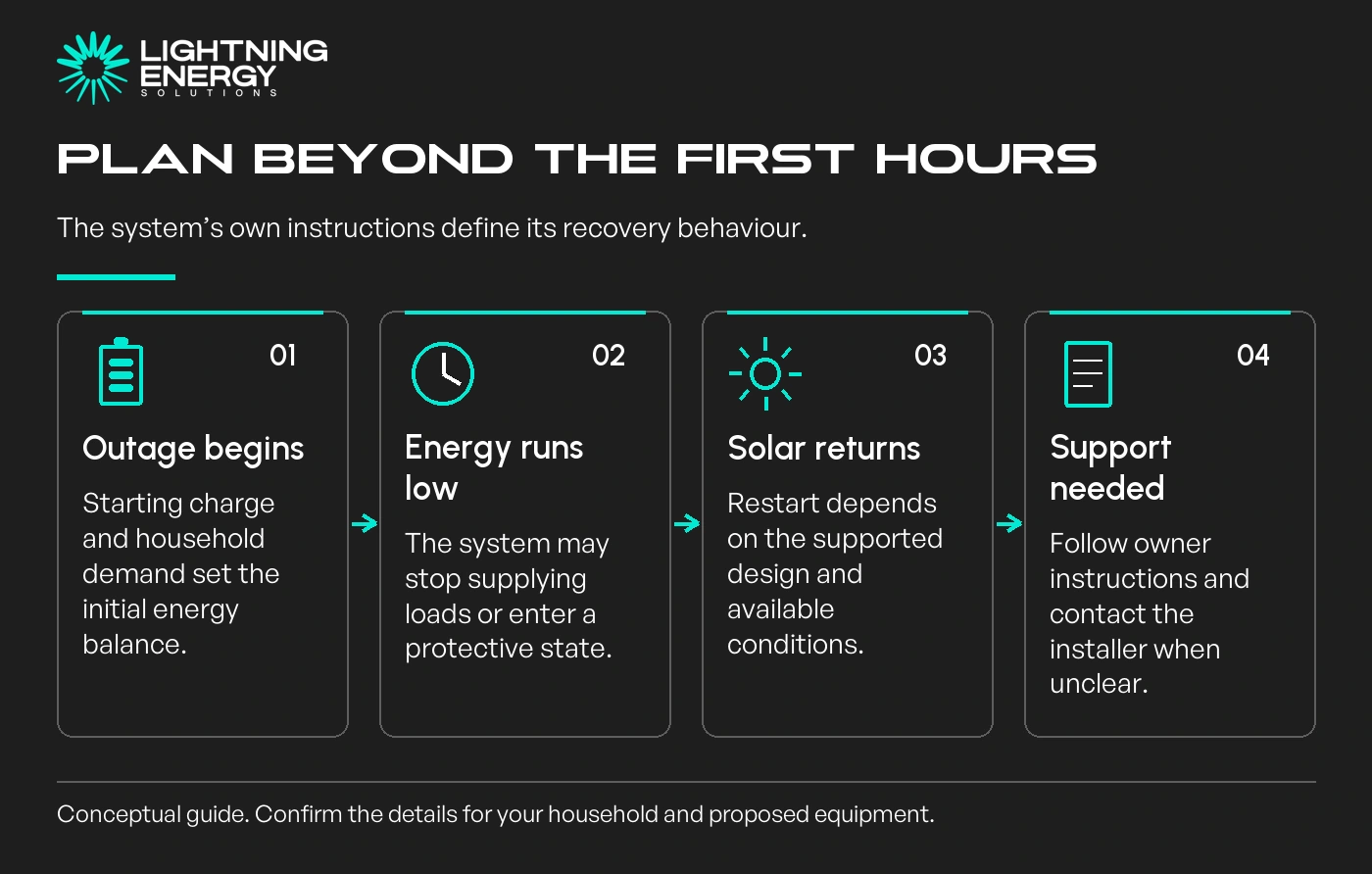
Avoid copying a restart procedure from another brand or opening electrical equipment. Follow the installed system's instructions and contact the installer when its status is unclear.
A battery plan should still make sense through a night or cloudy day. Start with the energy available when the outage begins and the loads you are willing to keep operating.
A large array may improve charging opportunity when conditions allow, but it cannot guarantee sunlight or remove the battery's charge-rate and power limits.
Our blackout guide helps prioritise household loads before relying on an optimistic recharge forecast.
If you only want evening solar use and do not value outage charging, an additional backup scope may not be worthwhile. If solar recharge is essential, require a documented supported design before purchasing.
Plan your battery upgradeAsk us to assess your existing solar equipment and outage priorities. We can explain whether solar recharge is supported and what limitations belong in the proposal.Available times
Book a consultation and we'll map solar, storage, hot water, and the rebates around your bills and your goals.
Question 1 of 6