
Australia’s Biggest Coal Generator Just Filed Plans for Two Giant Batteries
AGL files plans for a 350 MW Kangaroo Valley BESS and a 500 MW / 4,000 MWh eight-hour Bathurst battery — NSW firming pipeline, not your wall unit.
AGL files plans for a 350 MW Kangaroo Valley BESS and a 500 MW / 4,000 MWh eight-hour Bathurst battery — NSW firming pipeline, not your wall unit.
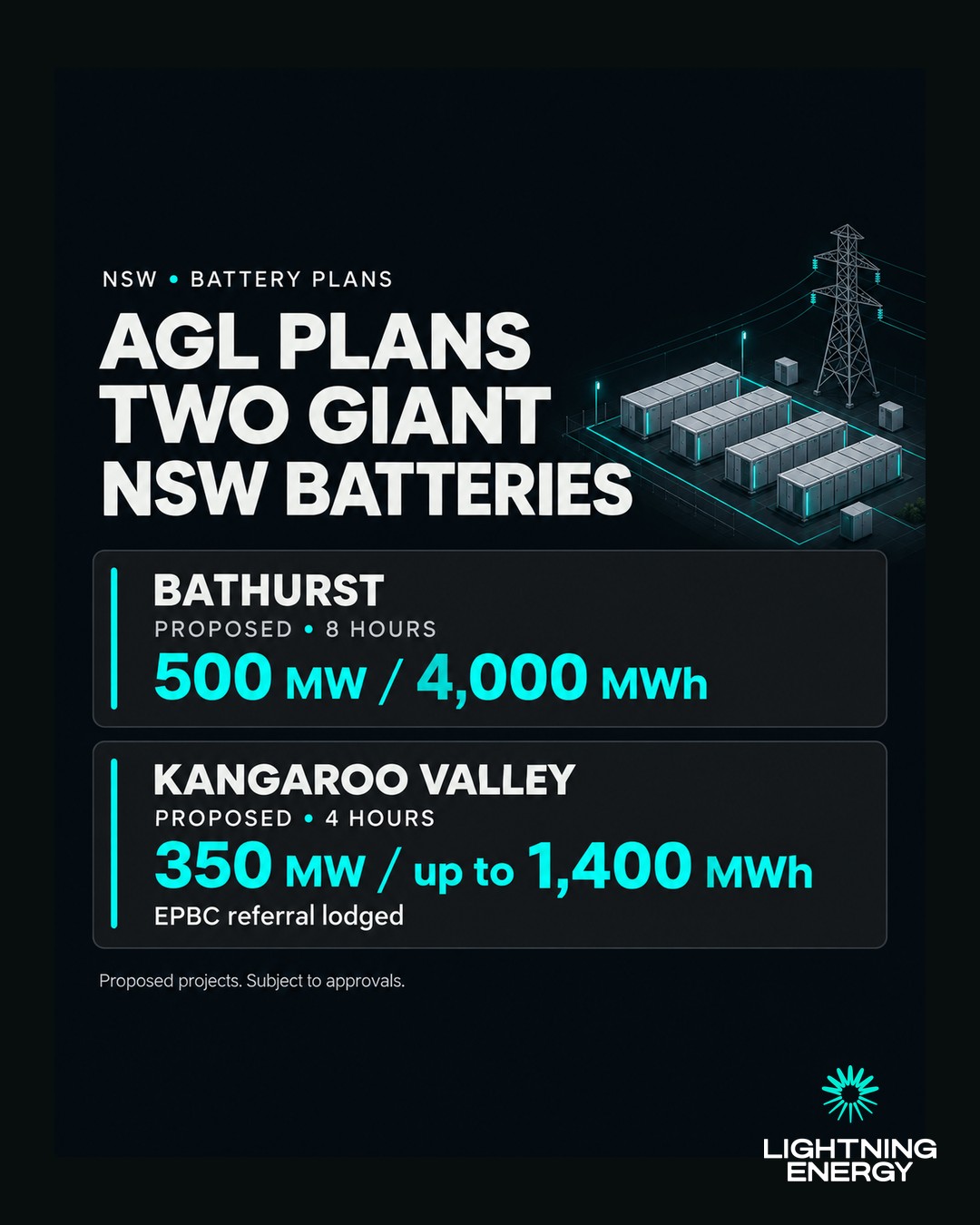
New South Wales — Here's what just landed on the transmission map. AGL, still Australia's biggest coal generator among the big privately owned utilities, has filed plans for **two** new grid batteries: a **350 MW / 1,400 MWh** project at **Kangaroo Valley** south of Sydney, and a **500 MW / 4,000 MWh** eight-hour machine at **Bathurst / Eglinton** west of Sydney — AGL's biggest storage bet to date.
This is not a wall-unit launch. It is utility kit on major **330 kV** corridors. The homeowner stake is simpler: big batteries firm the network so midday renewables stay useful after dark — and a home battery still owns the hours behind *your* meter.
Invest in your independence where the meter still answers to you. Stake your claim on evening power you control.
Source: RenewEconomy / Giles Parkinson & Joshua S Hill, 23 Sep 2026.
AGL has only just completed the **500 MW / 1,000 MWh** Liddell battery at its shuttered Hunter coal site — already covered on this site as NSW firming that hit full commercial ops. Separately, a **500 MW / 2,000 MWh** battery is under construction next to the Tomago aluminium smelter near Newcastle.
Today's news is the *next* filing: Kangaroo Valley into federal EPBC assessment, and Bathurst sized as an eight-hour operator with spare modules planned for a twenty-year life. Liddell is backdrop. These two proposals are the lead.
South of Sydney, AGL proposes **350 MW / 1,400 MWh** near a major **330 kV** switching station under an existing transmission corridor.
Per the EPBC application as reported:
A late-**2024** NSW scoping report also canvassed a larger **400 MW / 1,600 MWh** layout and other chemistries — sodium and flow among them. The live federal assessment figure for the news cycle is the **350 / 1,400** package. Treat the bigger option and alternate chemistries as scoping range, not a second approved project.
West of Sydney, the Bathurst battery sits about **6 km** from town at **Eglinton**, on an existing **330 kV** corridor — close to EnergyAustralia’s proposed Mt Piper battery at that coal site.
Published sizing:
| Measure | Figure | | --- | --- | | Operating capacity | **500 MW / 4,000 MWh** (nominal **eight-hour**) | | Planned installed energy | **>5,400 MWh** (redundancy over a **20-year** life) | | Construction target | Late **2028** | | Full operation | **2030** |
That installed-over-operating gap is intentional spare capacity for degradation and redundancy — not a second battery next door. It is AGL’s largest storage proposal to date.
NSW already has the Waratah Super Battery doing transmission-support work at a different scale and job. Bathurst’s pitch is duration: eight hours of firming on a western corridor, not a Central Coast shock-absorber brag.
AGL’s own storage path reads like a ladder:
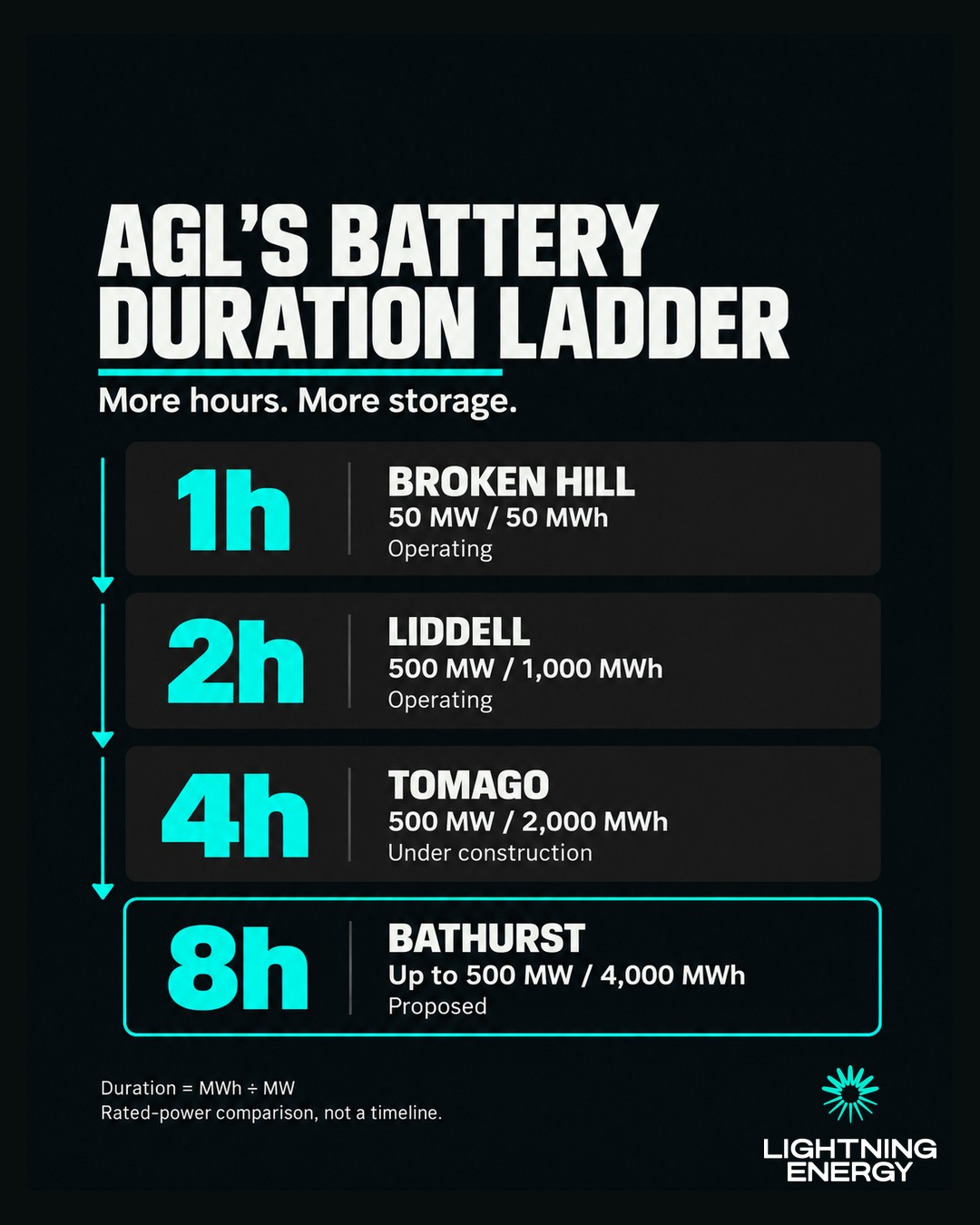
Falling module costs plus a longer firming need pull the industry toward multi-hour machines. Megawatts are the *rate*; megawatt-hours are the *tank* — useful when renewables stretch overnight, not only through the dinner spike.
AGL’s public line, paraphrased: batteries help replace coal-fired plant with flexible storage; they respond fast to shortfalls; they store excess renewables; they support a more reliable, resilient system.
That is grid language — not a promise your retail bill drops when a western NSW container farm switches on.
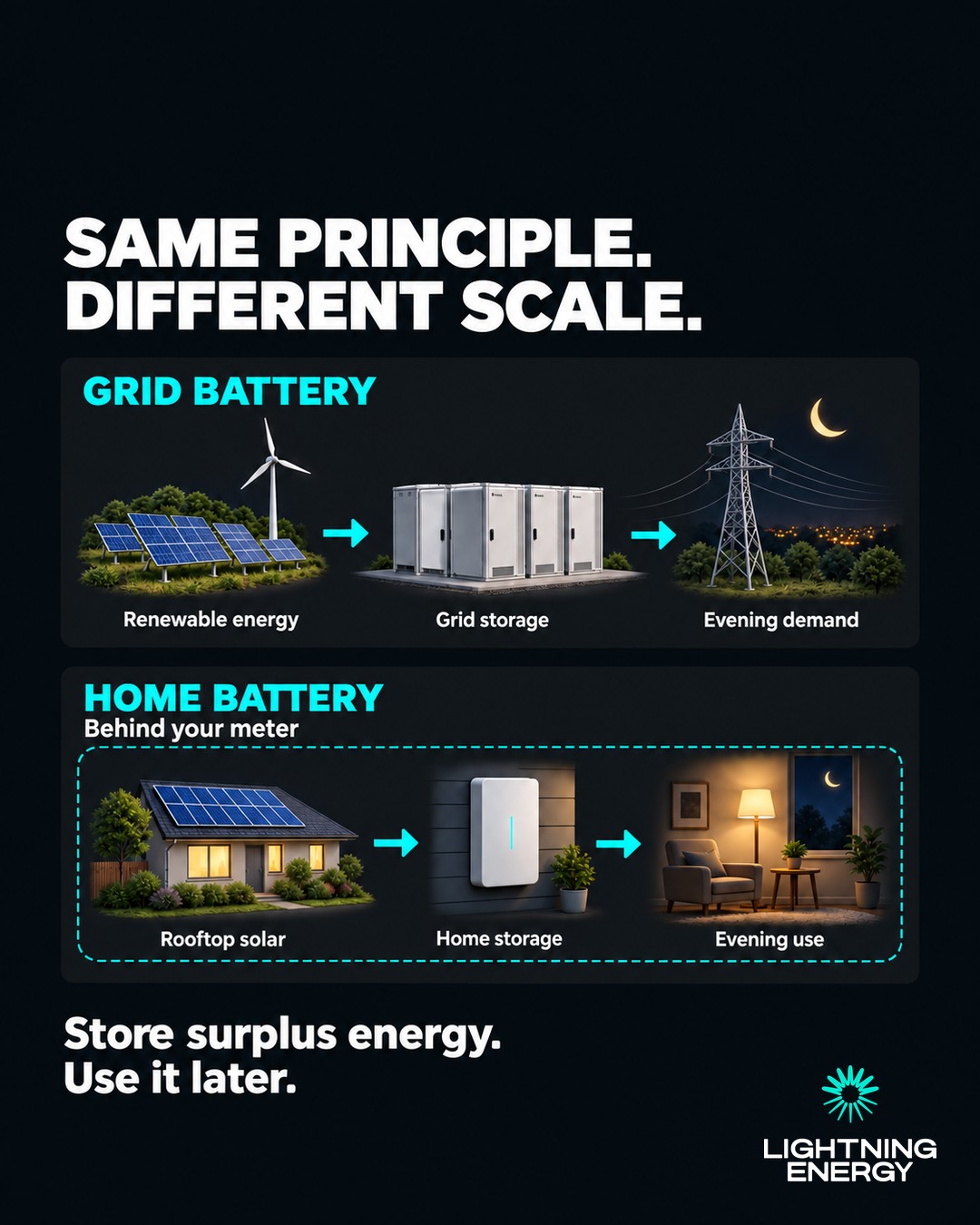
Grid BESS firms at scale — soaking surplus, covering shortfalls, buying the network time. A home battery does the same *behind the meter*: store midday solar, spend it when you draw, keep priority circuits on your terms when the design supports backup.
A Bathurst or Kangaroo Valley filing does **not** set your tariff, wipe the daily supply charge, keep the house lit through every local line fault, or invent a dollar saving on your next statement. What you can still own: roof solar matched to load, a compliant home battery sized to evening circuits, and tariff literacy so peaks hurt less.
Soft path only if you are shopping storage: federal **Cheaper Home Batteries** support is typically framed around / up to **~30%** off eligible home battery systems when you qualify. Eligibility depends on property and current rules — never invent a household dollar figure off a utility BESS headline. For who actually wins on the rebate math, read federal home battery rebate — who wins.
Two giant NSW filings from Australia’s biggest coal generator among the big private utilities is real network news. Kangaroo Valley is in EPBC assessment; Bathurst is pitched as an eight-hour operator with spare modules for a twenty-year life. Mega-BESS keeps the corridor honest. Your independence still starts on the roof and in the garage — with an eligible home battery stack when the site and rules fit.
If grid headlines have you staring at the bill, bring that bill to a design consult. Own your evening power. The containers will keep cycling either way.
Available times
Book a consultation and we'll map solar, storage, hot water, and the rebates around your bills and your goals.
Question 1 of 6