
All Energy Australia 2026 Wrap-Up: Batteries, Solar and Smarter Controls
Our All Energy Australia 2026 wrap-up covers new home batteries, rooftop solar, energy controls and commercial storage, with the practical questions buyers should ask.
Our All Energy Australia 2026 wrap-up covers new home batteries, rooftop solar, energy controls and commercial storage, with the practical questions buyers should ask.

All Energy Australia 2026 brought together products and debates spanning a household battery cabinet to utility-scale storage. The strongest thread was how hardware, controls and electricity use fit together.
The event ran on 28 and 29 October at Melbourne Convention and Exhibition Centre, as recorded by the venue. Pylontech also held a separate launch on 27 October in Melbourne.
This is a desk-researched wrap-up checked on 3 November 2026, using the published programme and manufacturer material. It is a selection of verified highlights, not a claim that we attended every stand or an exhaustive exhibitor catalogue.
The residential announcements point towards coordinated packages of inverter, modular storage and energy management. That can simplify a purchase, but configurations still need careful comparison.
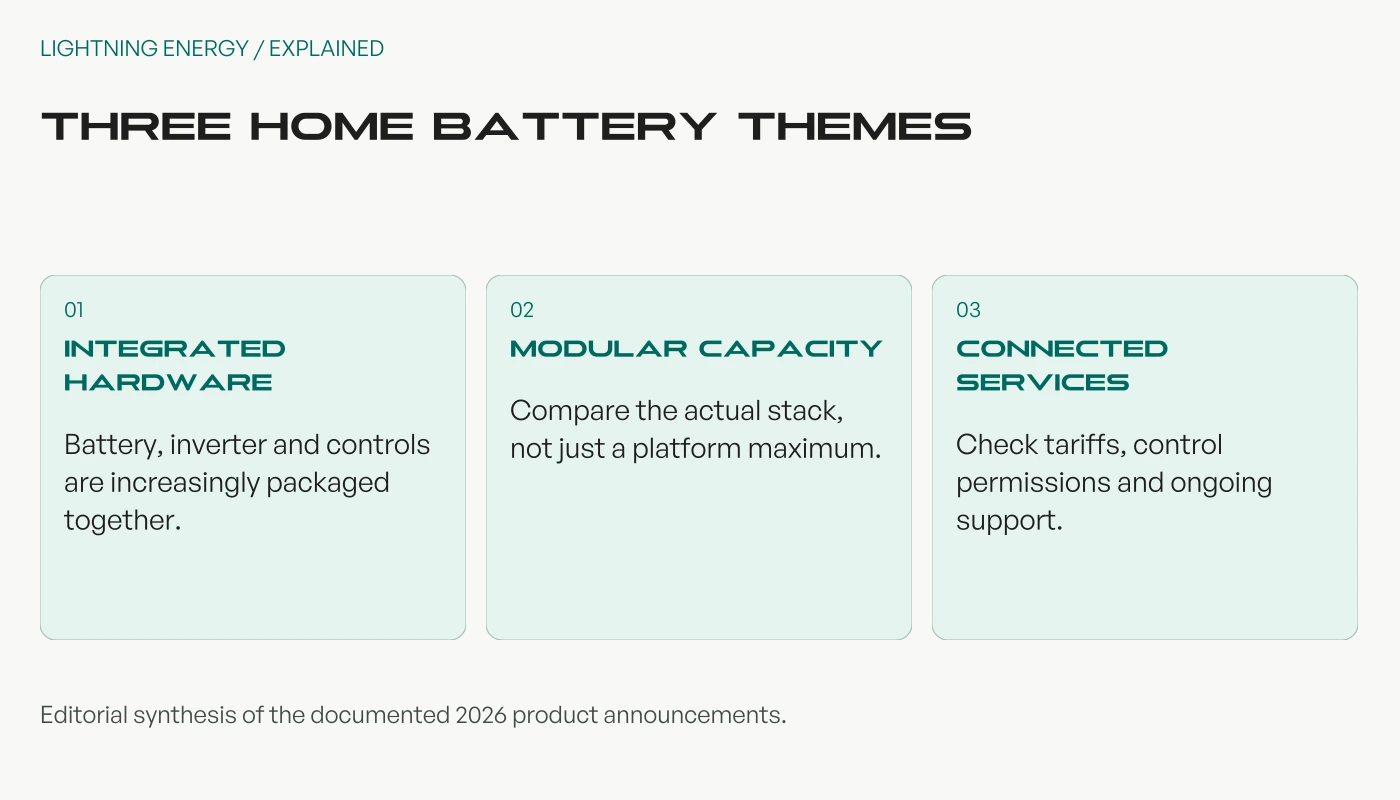
Sungrow's PowerHarbour launch introduces a modular all-in-one family. Its expansion headline refers to supported multi-cluster arrangements, while selected Pro configurations bring EV charging integration into the discussion.
Buyers should separate supplied functions from coming-soon variants and future V2X capability. A product roadmap does not establish compatibility with the EV already parked at home.
Pylontech's Force NEX launch release emphasises integrated hardware and energy management. Its app and control features deserve the same questions as the battery: what is supplied locally, and under which terms?
For context on a different approach to modular storage, see our existing Fox ESS Power Cube comparison. This is related reading, not a claim of a newly verified Fox launch at this event.
Anker's manufacturer release describes the XE battery platform, PowerDock Mini, portable power products and balcony solar equipment shown at the event.
Its XE discussion includes a 7 kWh module and a dual-cycle claim of 14 kWh of daily energy throughput. Moving energy through a battery twice does not make its physical storage capacity twice as large.
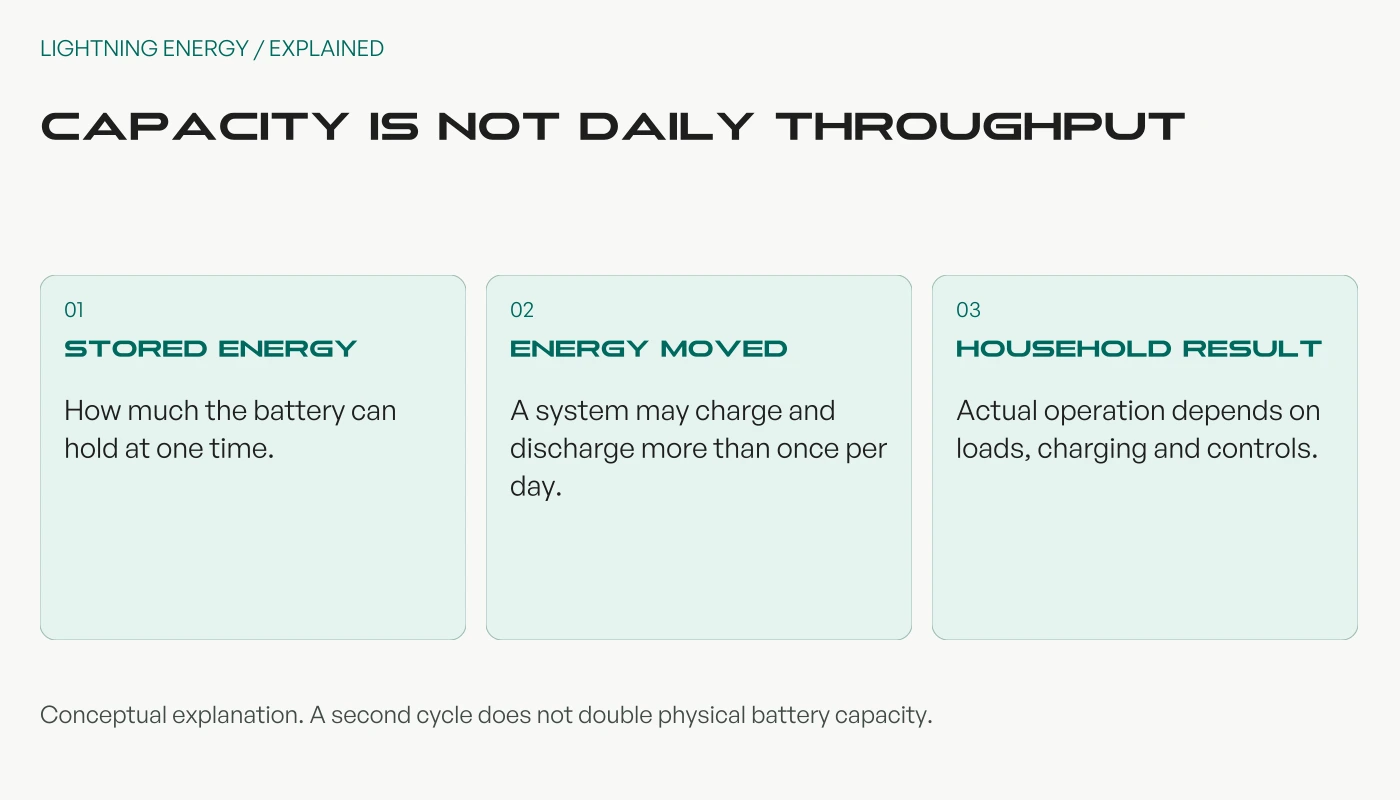
The distinction matters when estimating overnight backup or comparing two batteries. Actual cycling depends on access to charging energy, operating limits, household use and the chosen control strategy.
Our Anker SOLIX XE article examines that claim and the Australian context in more detail.
Balcony equipment on a stand does not settle whether a particular installation is permitted locally. Treat overseas plug-in marketing separately from Australian electrical and connection requirements.
Amber's GoodWe ESA announcement, published before the exhibition, confirmed SmartShift integration for eligible ESA systems and described its event presence with GoodWe.
The practical issue is eligibility for the exact equipment and service arrangement. Support for one range should not be read as approval for every product carrying the same manufacturer's logo.
Automated electricity trading also needs a household brief. Check tariff exposure, fees, reserve settings and the consequences of leaving the service. A demonstration of control does not guarantee a particular annual saving.
AIKO's event-related announcement describes its fourth-generation back-contact platform and INFINITE Ultra products. It identifies Z Series Australian availability as expected in 2027, which belongs in the future-product category.
Trinasolar's announcement highlights the full-black Vertex S+ G3 NEG10R.25Z for Australian rooftops, along with commercial and utility products. Its appearance-focused offering keeps aesthetics in the purchasing conversation.
Tongwei's event report describes TNC 2.0 FULLX and TNC 3.0 products. It also reports commercial agreements, which should not be confused with completed installations or independently measured generation.
For a roof owner, compare module dimensions, suitable roof coverage, electrical design and the installed offer. A panel's headline wattage is only one part of the roof's potential output.
Our all-black solar panel guide explains how appearance and performance can be assessed together.
Sungrow's event summary includes PowerKeeper, PowerStack 255CS and PowerTitan 3.0 alongside its residential products. These address different site sizes and operating requirements.
LONGi Energy Storage's event release covers the OneMatrix utility platform, Hi-MO One Pro commercial storage and OneNexus microgrid offerings. The shared theme is a broader range of applications.
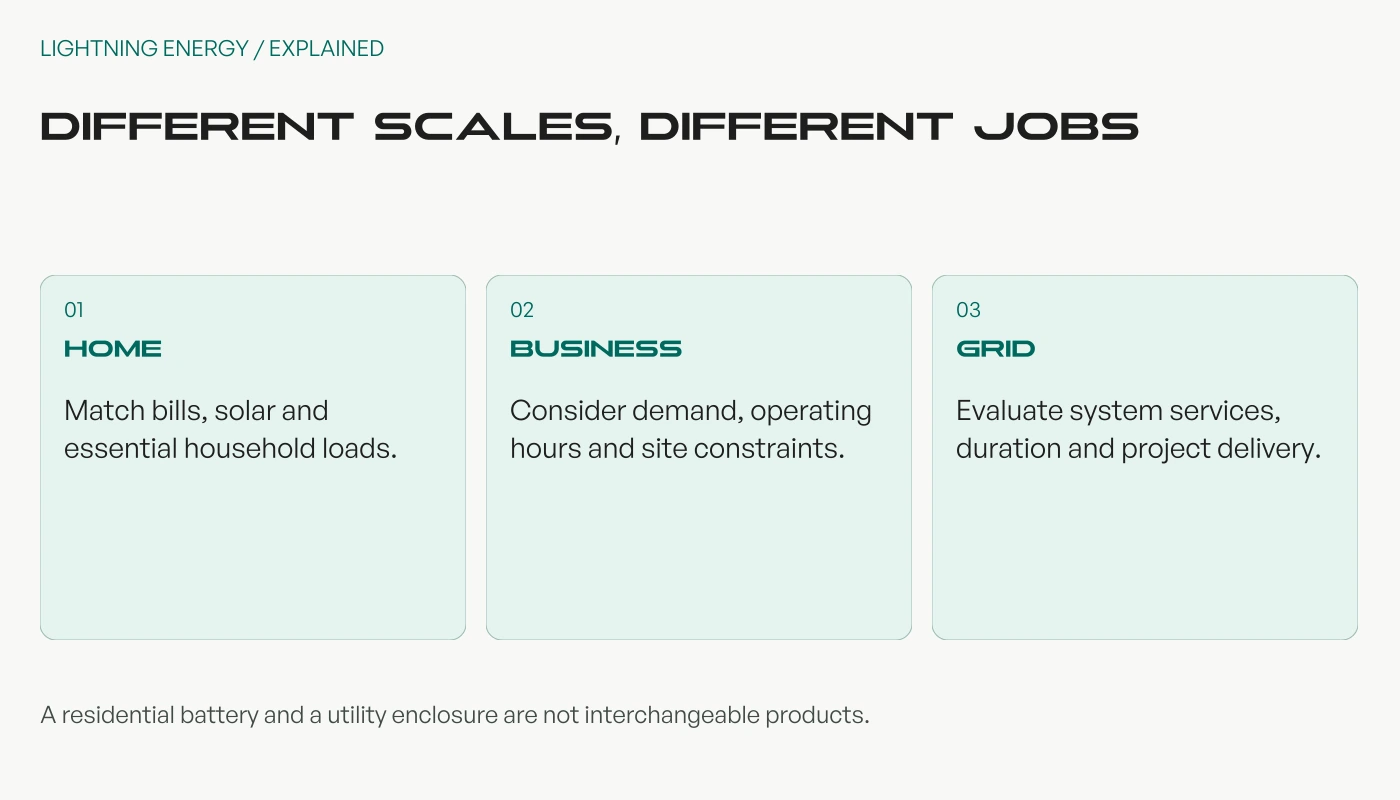
A business battery assessment should start with the site's electricity use, demand profile and operational priorities. A utility project's enclosure capacity is not a useful shortcut for choosing storage for a workshop or office.
Ask whether the proposed benefit is energy shifting, demand management, backup or another contracted service. Those objectives can lead to different system sizes and operating strategies.
The published conference agenda included electrification, energy efficiency, grid-forming storage, long-duration storage, data centres, EV charging and the demands of a changing electricity system.
It also covered consumer protection, apartment solar, workforce issues and regional outcomes, alongside installer-focused technical sessions. These are programme topics, not our account of what individual speakers ultimately concluded.
That breadth matters because the installation and operating environment determine how useful new equipment becomes. An impressive product cannot resolve a poor site design, unclear contract or missing support pathway on its own.
More product choices are useful when they produce clearer proposals. They are less useful when every quote leads with a maximum capacity or a feature that is not yet available in the supplied configuration.
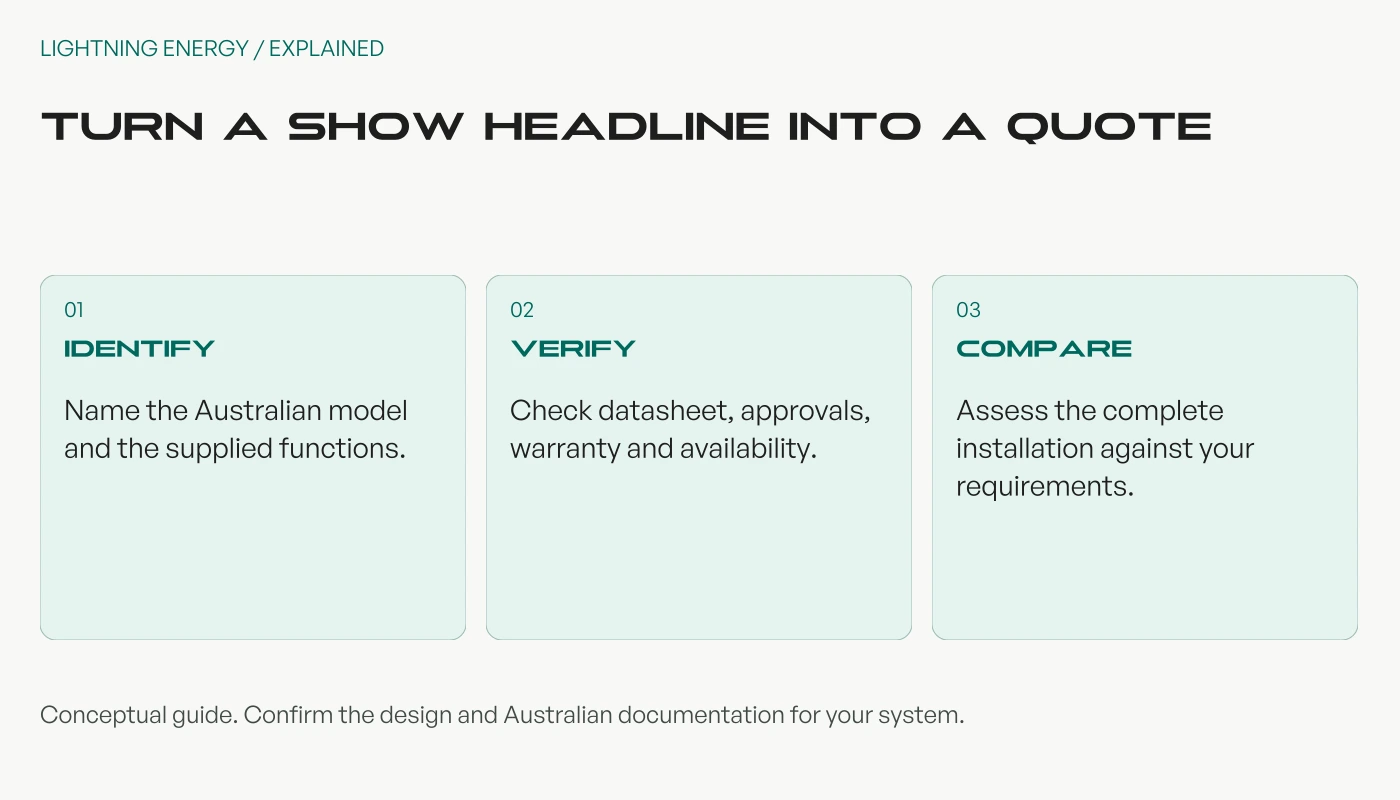
Ask for the exact Australian model, current documentation, usable energy, continuous output and backup scope. Then check the electricity service conditions separately from the hardware purchase.
For timing, distinguish an event announcement, local stock, a confirmed installation slot and a functioning feature. Those are separate milestones even when a marketing page places them close together.
The home battery quote checklist provides a practical way to compare the offers that follow the exhibition.
The documented announcements show continuing movement towards integrated home energy systems, more sophisticated controls and storage products for a wider range of commercial and grid applications.
For buyers, the strongest opportunity is to demand a better explanation of the whole system. Choose the configuration and support arrangement that meet your needs, and treat future capabilities as future capabilities.
Available times
Book a consultation and we'll map solar, storage, hot water, and the rebates around your bills and your goals.
Question 1 of 6
