
Fox ESS Power Cube Australia: Capacity, Backup and Buying Guide
A practical Fox ESS Power Cube PQ1 review for Australia: modular capacity, inverter choices, backup limits and the questions to put in an installed quote.
A practical Fox ESS Power Cube PQ1 review for Australia: modular capacity, inverter choices, backup limits and the questions to put in an installed quote.

Fox ESS Power Cube combines a hybrid inverter and stackable battery modules in an all-in-one arrangement. For Australian buyers, the useful question is which combination suits the home.
This review focuses on the Australian single-phase PQ1 range and EQ5500-S modules. It does not transfer specifications from the three-phase PQ3 family or an overseas product variant.
Checked on 3 November 2026, this is a desk-based buying guide using the Australian datasheet. We have not performed independent installation, efficiency or blackout tests.
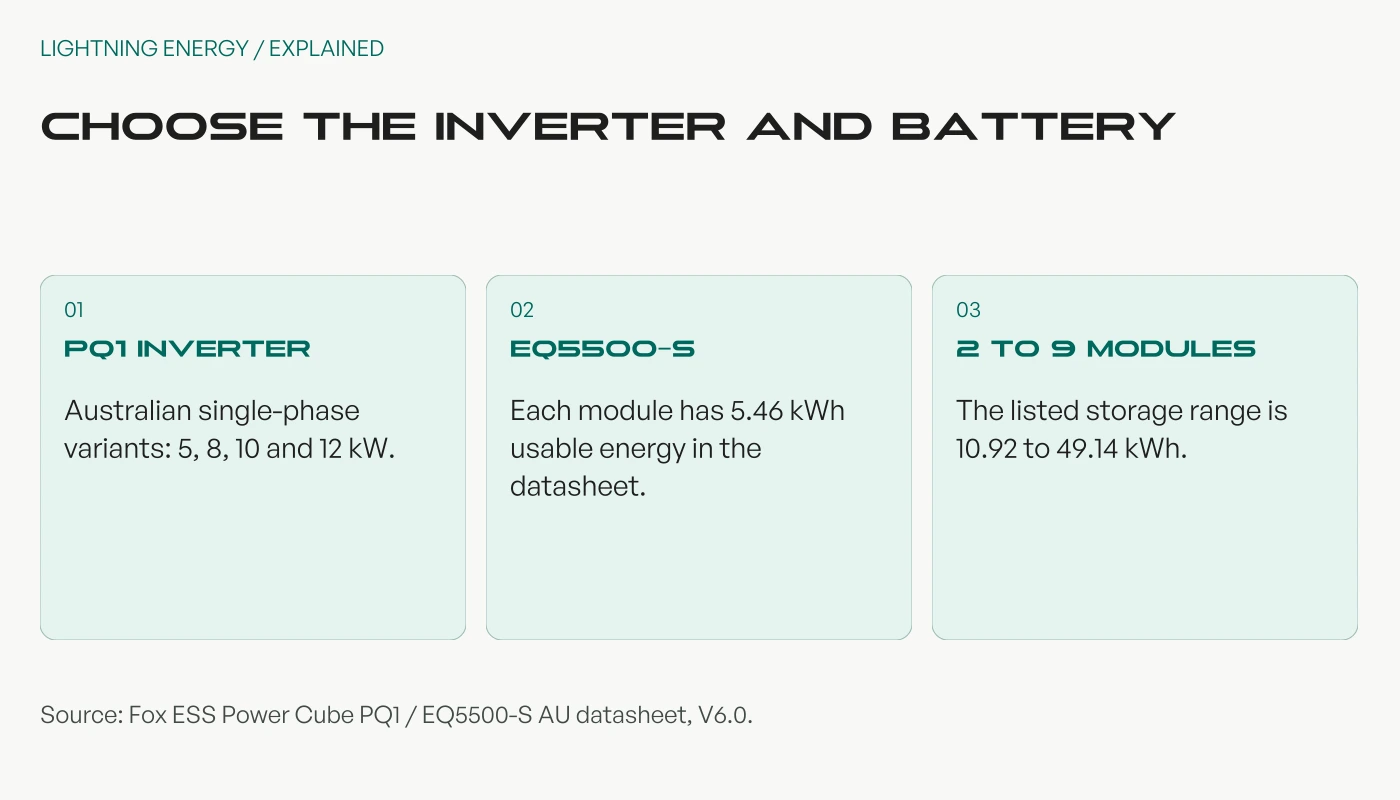
The Fox ESS Australian datasheet, version 6.0 dated 13 October 2026, lists PQ1 inverter variants rated at 5, 8, 10 and 12 kW. It lists two to nine EQ5500-S battery modules.
Each module is specified at 5.46 kWh usable energy. The corresponding stack range is 10.92 to 49.14 kWh. These are equipment specifications, not a forecast of energy delivered to your appliances each day.
A modular system allows the initial purchase to reflect your circumstances. It also means two quotes bearing the same product name can contain very different amounts of storage and inverter capacity.
Our Power Cube versus Powerwall 3 comparison looks at those different approaches to sizing.
Do not assume that every stack can provide the largest inverter's headline output under all conditions. Ask for the continuous charge and discharge limits for the exact inverter and module count being quoted.
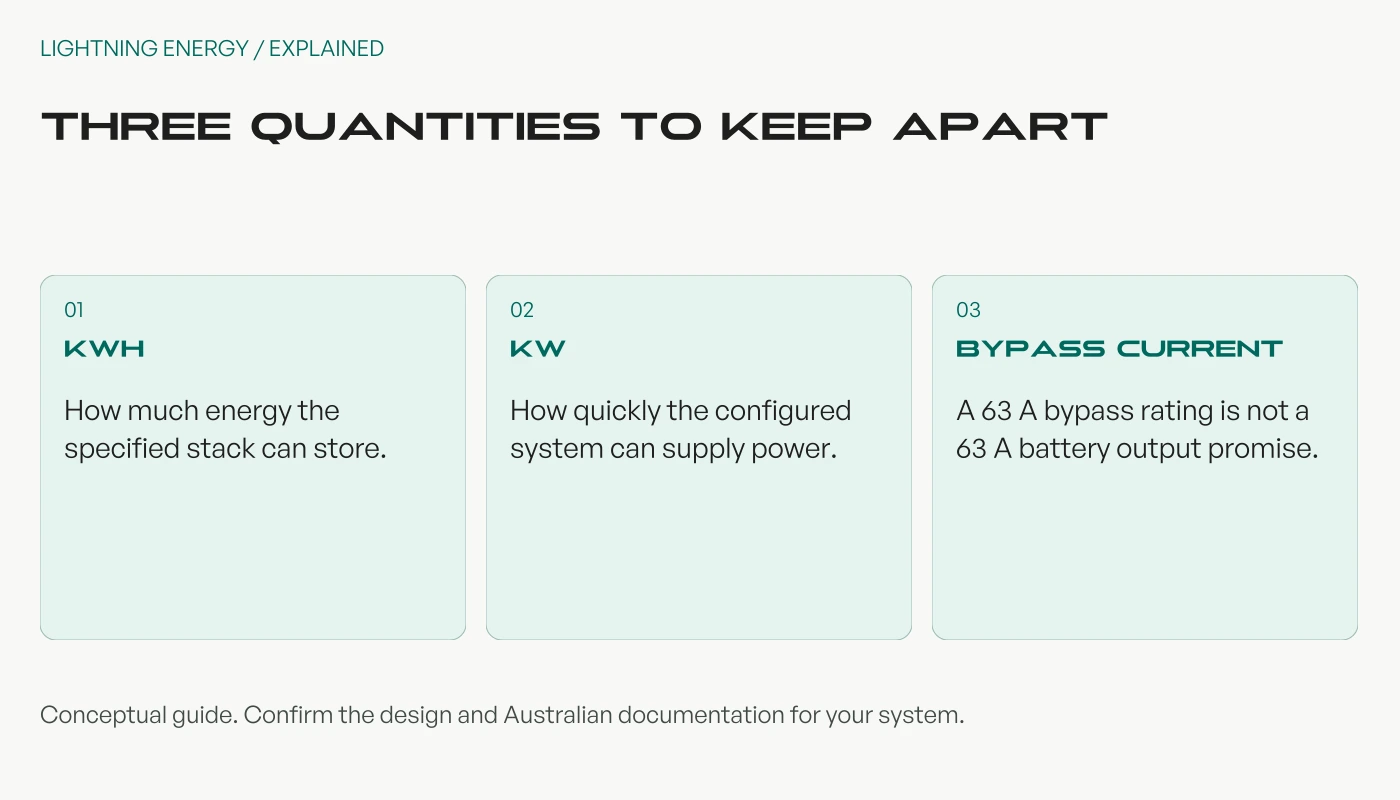
The datasheet also lists a 63 A bypass capability. Bypass current describes a different part of the system's operation; it should not be presented as the battery's own output capacity.
Think about both the duration of an evening load and the number of appliances running together. Our kW and kWh explainer separates those questions.
For example, adding storage may help a moderate load run for longer. It does not prove the system can start a large motor or support every major appliance simultaneously.
Fox ESS lists integrated gateway functionality and a 4 ms transfer figure. That is a manufacturer specification, not a guarantee of uninterrupted operation for every connected appliance.
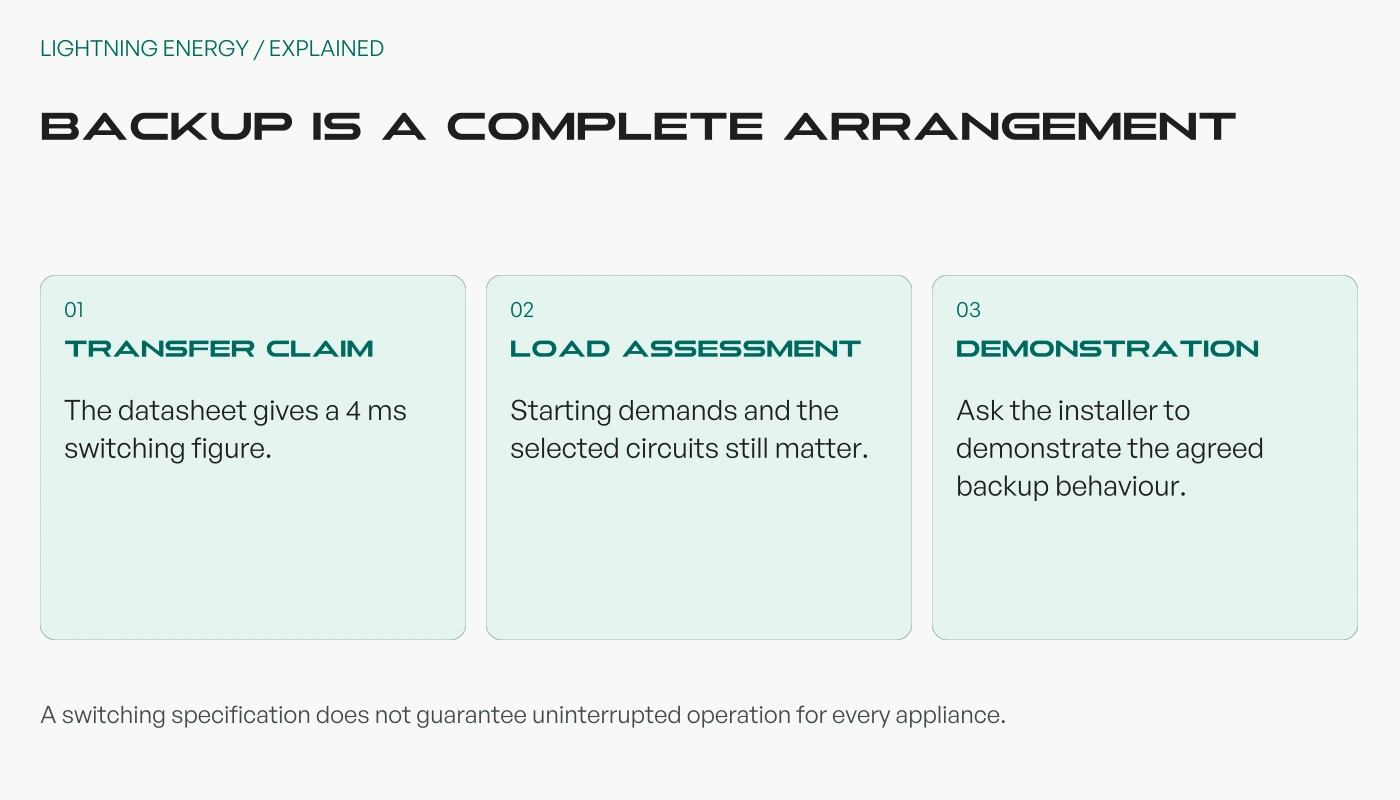
Sensitive equipment may have its own continuity requirements. Ask about those explicitly rather than treating a fast transfer claim as a replacement for an equipment-specific backup assessment.
Have the installer identify the supported circuits and any load management. Keep a record of the demonstration at commissioning so the household knows what to expect in a real outage.
The datasheet permits PV oversizing up to the stated model limits and specifies an IP66 enclosure. Neither specification removes the need for a site-specific design.
Roof orientations, strings, shading and existing equipment affect the solar design. Environmental ratings do not mean the unit can be installed anywhere without considering clearances and local requirements.
An all-in-one cabinet can make an installation look orderly. The quotation still needs to cover the switchboard, cable routes, protection, metering, communications and any required site work.
Use the battery quote checklist to compare what the installer has actually included.
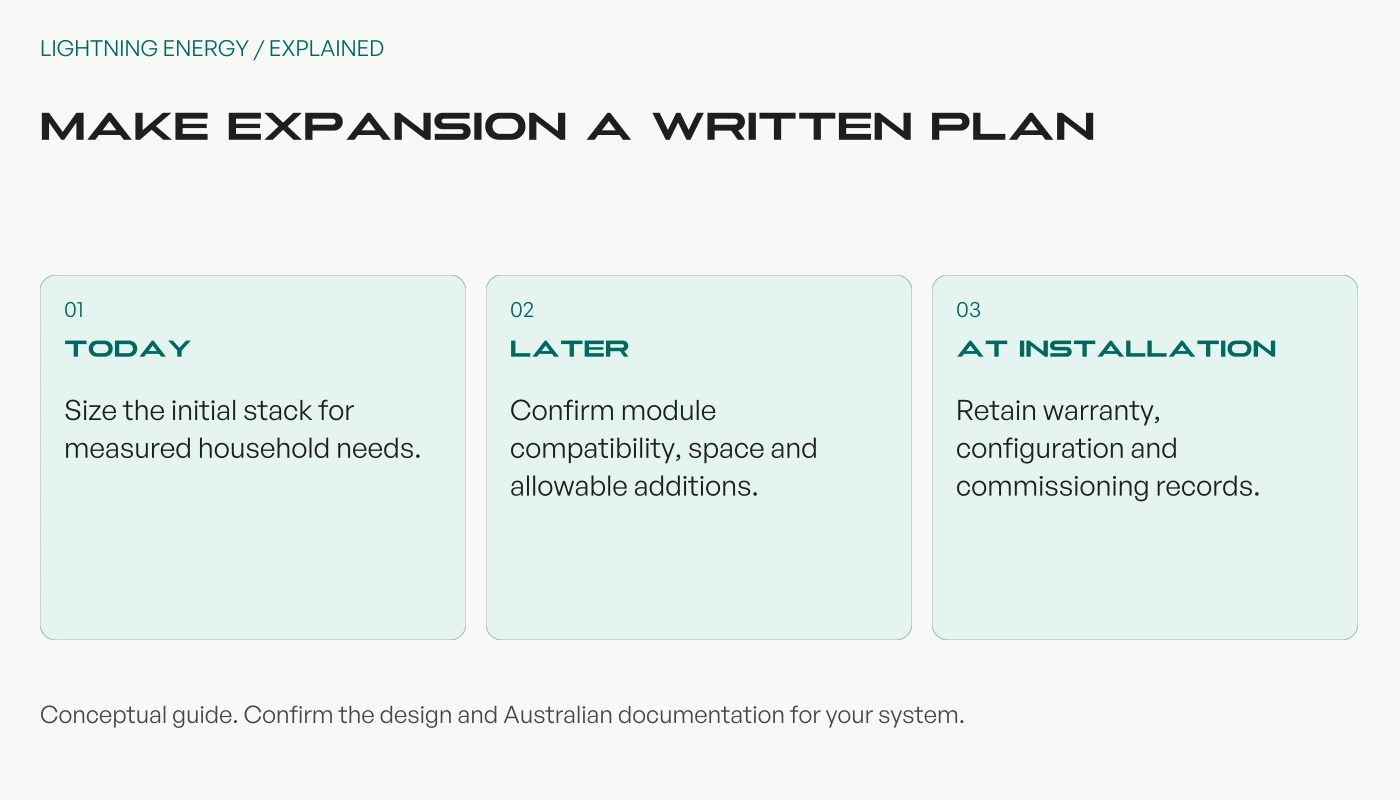
Modularity makes staged storage worth discussing, but a future addition needs compatibility confirmation. Get the proposed expansion pathway and its conditions in writing.
The starting point should be your usage data. Consider whether the existing solar can refill a larger stack and whether the anticipated extra demand is likely to occur while solar is available.
Check physical space, maximum supported capacity and the labour involved in returning to the site. The price of another module alone is not necessarily the full cost of a later expansion.
The datasheet's warranty headline is not a substitute for the complete Australian terms. Review capacity retention, operating conditions, service responsibilities and any exclusions in the supplied warranty.
Our battery warranty guide explains why years alone do not describe the whole protection.
Likewise, a VPP-ready description does not establish compatibility with every Australian energy plan. Confirm the exact product, firmware and provider arrangement before assuming rewards or automated trading.
We have not verified a single installed price that fairly represents all PQ1 configurations. Compare itemised quotes for the same inverter, battery modules, backup scope and installation work.
Power Cube offers a flexible way to specify an integrated single-phase storage system. The benefit is the ability to match a configuration to a household, rather than choosing purely by brand.
The limitations are the need to read configuration-specific ratings and confirm the complete installed offer. It belongs on a shortlist when the installer can explain both the normal operating limits and the backup arrangement clearly.
Available times
Book a consultation and we'll map solar, storage, hot water, and the rebates around your bills and your goals.
Question 1 of 6
