
Will Your Home Battery Work on a Cold Melbourne Morning?
Ask about cell temperature, available output and heating controls before comparing batteries for winter. An operating-temperature range alone does not tell the whole story.
Ask about cell temperature, available output and heating controls before comparing batteries for winter. An operating-temperature range alone does not tell the whole story.

A cold morning is a good reason to ask how a proposed home battery manages temperature. It is not, by itself, proof that a slow charge rate means the battery is faulty.
The useful comparison is the exact product’s documented behaviour at the proposed location. A headline temperature range or the presence of a heater cannot answer every performance question.
This guide was checked on 2 November 2026 using manufacturer and regulator information. It is desk research, not a cold-weather test or a ranking of battery brands.
The weather forecast describes the outside air. The cells inside a battery can be at a different temperature because of the enclosure, recent operation and thermal-management design.
Powerwall 3 Heat Mode white paper
Tesla’s Powerwall 3 Heat Mode white paper explains this distinction and describes dedicated cell-level heating in that product.
The paper also shows why charging and discharging need separate questions: their behaviour can differ at lower cell temperatures. Heating can draw energy from available sources, so it is not energy-free.
That document includes overseas examples. It is useful for understanding the mechanism, but it does not establish another model’s thresholds or predict a particular Melbourne home’s winter bill.
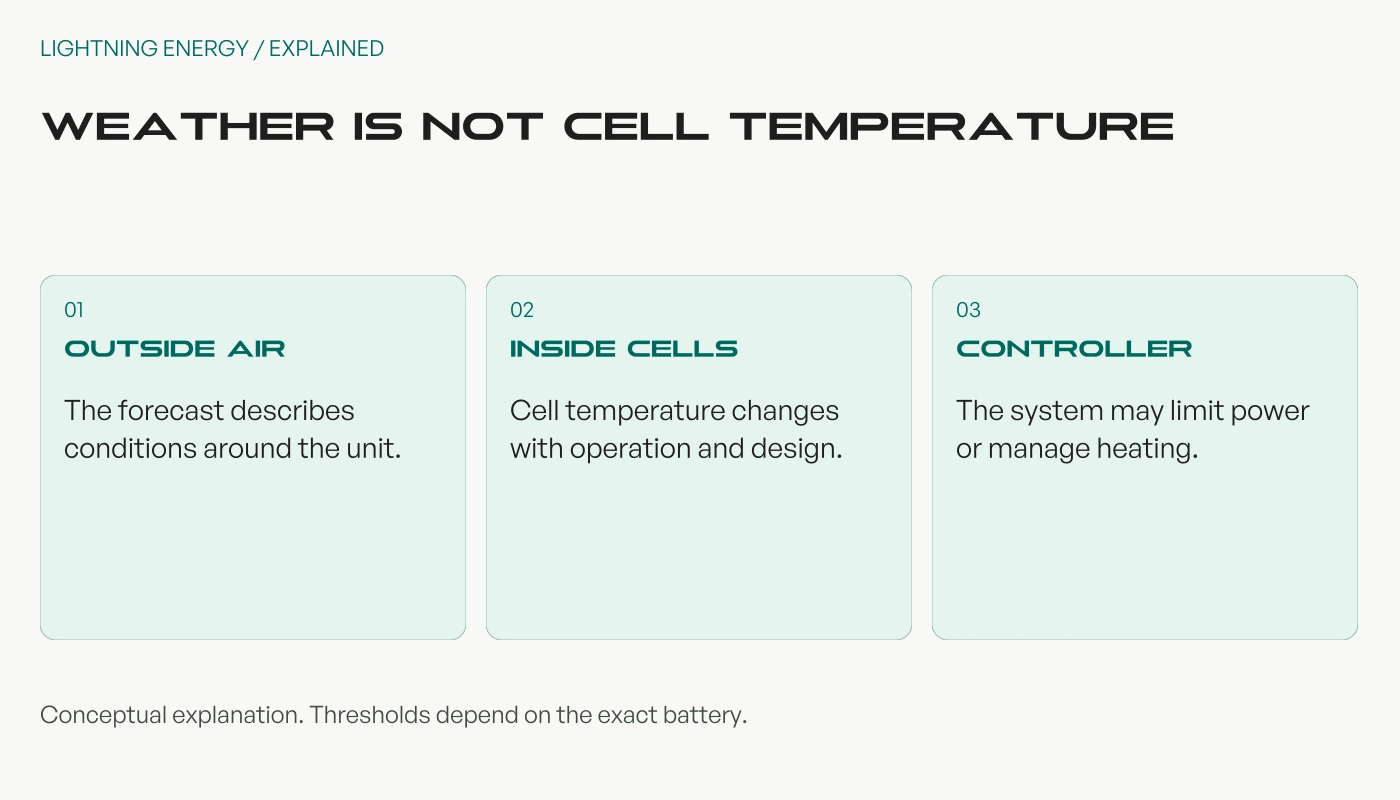
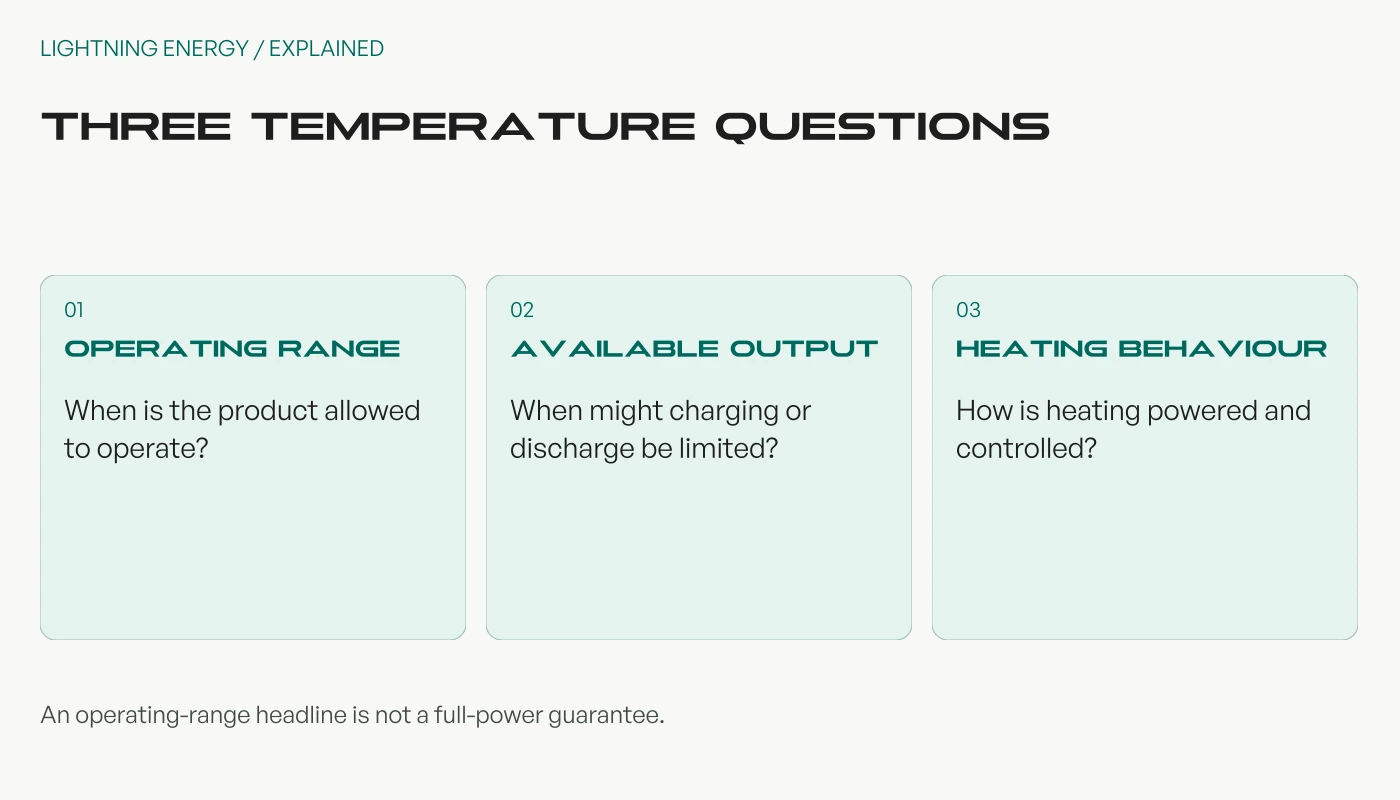
An operating range describes conditions in which a product is specified to operate. Ask separately whether the manufacturer limits charging or discharge power within parts of that range.
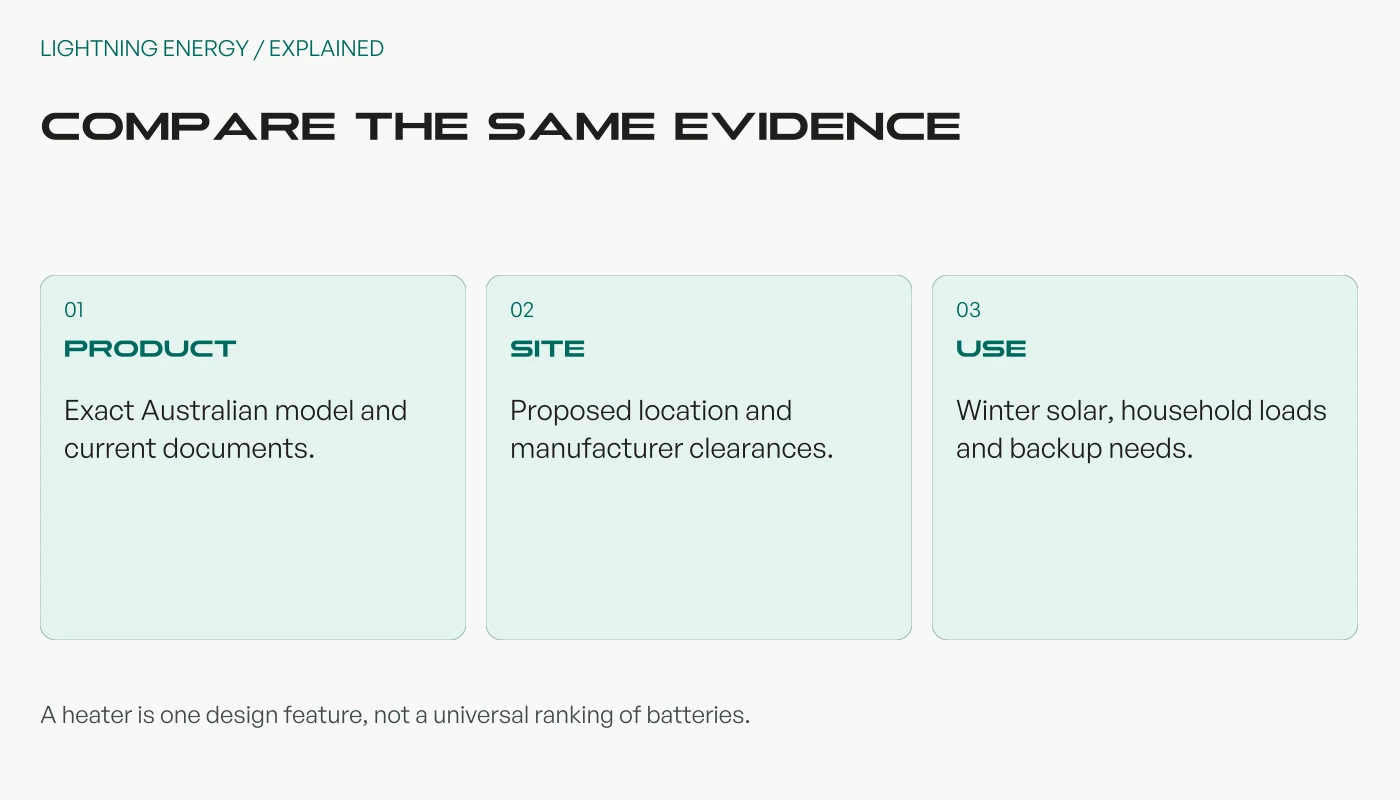
Request the exact Australian model number, current datasheet and installation manual. A similar product name from another country is not enough.
If heating is included, ask how it is controlled, what energy source it uses and what changes when the grid is unavailable. Ask the installer to point to the applicable document rather than making a universal promise.
Do not assume a heater means uninterrupted maximum output. Conversely, do not reject a system solely because it uses a different thermal-management design. Compare the documented performance against your actual requirements.
Our home battery quote checklist explains how to keep those details with the written proposal.
Ask why the installer has chosen the location and how it meets the manufacturer’s requirements. Discuss weather exposure, access, clearances and the other constraints of that particular site.
Energy Safe Victoria’s battery guidance
Energy Safe Victoria’s battery guidance sets out the professional responsibilities around safe installation and verification.
Moving a battery or changing its enclosure is not a homeowner adjustment.
Do not wrap the battery in blankets, add a homemade insulated box or block ventilation in an attempt to warm it. Seek product-specific advice from the installer or manufacturer.
Our battery location guide covers the broader site questions. A sheltered position still needs to be a permitted, suitable installation location.
A battery may receive less energy because the solar system has less surplus after household consumption. That is a different issue from the battery limiting its charge rate.
Separate solar generation, household demand, charge level and visible system alerts when discussing a low-charge day. A single screenshot can leave out the part of the day that explains the result.
Our guide to why a large battery may not fill in winter explains the energy-budget side. Adding battery capacity does not create additional solar production.
For outage planning, ask how the proposed system behaves with limited stored energy and cold conditions together. Keep that discussion separate from its normal grid-connected operation.
Tesla’s Australian Backup Reserve guidance
Tesla’s Australian Backup Reserve guidance explains the balance between holding energy for outages and using it day to day.
Other products have their own controls and rules.
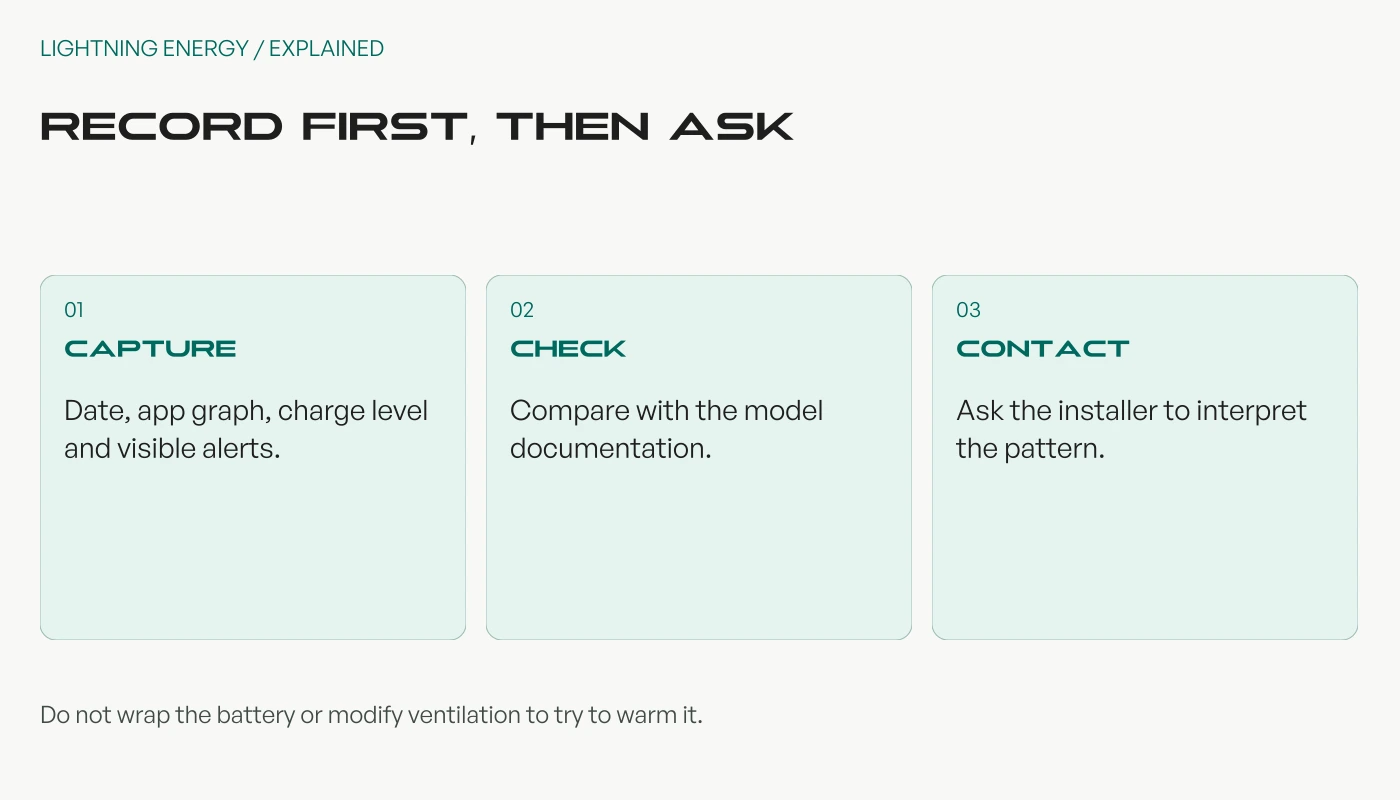
Record the date, time, weather conditions, charge level, operating mode and any visible alert. Save the relevant app graphs before they are difficult to retrieve.
Ask the installer whether the pattern matches the model’s documented behaviour or needs investigation. Do not dismiss a fault message as normal winter behaviour, and do not change protected settings yourself.
Include any recent software or equipment changes in that conversation. A colder day may coincide with a changed schedule or higher household demand; the temperature alone does not establish the cause.
For a new quote, request a written explanation of cold-weather operation and the limits relevant to your site. Our battery backup planning guide helps define the loads that matter.
Talk to Lightning Energy with the exact model and your monitoring records. A clear explanation of the evidence is more useful than a blanket claim that every battery either works perfectly or fails in winter.
Available times
Book a consultation and we'll map solar, storage, hot water, and the rebates around your bills and your goals.
Question 1 of 6
