
Melbourne Air-Con Rebates Without a Gas Heater: Can You Still Qualify?
No gas heater to replace? Check Melbourne VEU options for old electric heaters, existing air conditioners and new installations, plus retrospective claim limits.
No gas heater to replace? Check Melbourne VEU options for old electric heaters, existing air conditioners and new installations, plus retrospective claim limits.

You do not always need a gas heater to access a Victorian Energy Upgrades air-conditioning discount.
Melbourne households may have an eligible pathway when replacing electric equipment or installing an approved system without decommissioning an old appliance.
The discount can be very different from a gas-heater replacement offer. Identify the existing equipment before comparing advertisements, then have an accredited provider confirm the exact pathway.
Rules and sources checked on 22 November 2026. This guide explains the decision process; eligibility and the final installation scope need to be confirmed for your property.
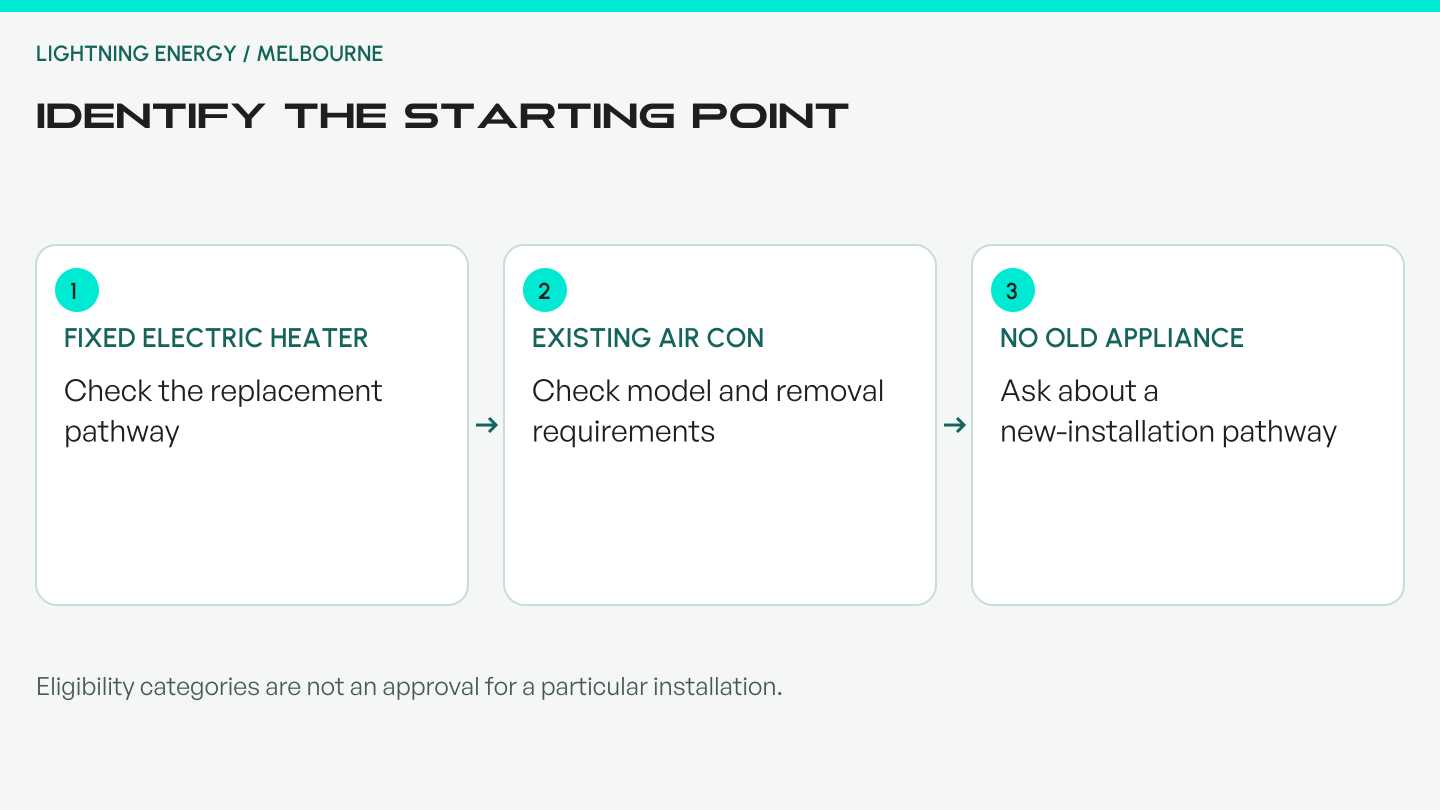
A portable fan heater, a fixed electric resistance heater and a reverse-cycle air conditioner are different starting points. Write down the model and whether the appliance is fixed in place.
The state heating and cooling table lists several pathways.
These include electric resistance heating, reverse-cycle replacement and installations with no decommissioned product.
This does not mean every product or installation qualifies. Ask the provider to match the existing system and proposed model to the current program requirements.
For a household adding cooling to a bedroom, the useful first question is whether the project is a new-installation pathway or part of a broader replacement. Do not assume a gas appliance elsewhere automatically changes that answer.
A large advertised discount may describe a particular ducted gas replacement and a particular replacement capacity. It is not a general cash payment available to every Melbourne household.
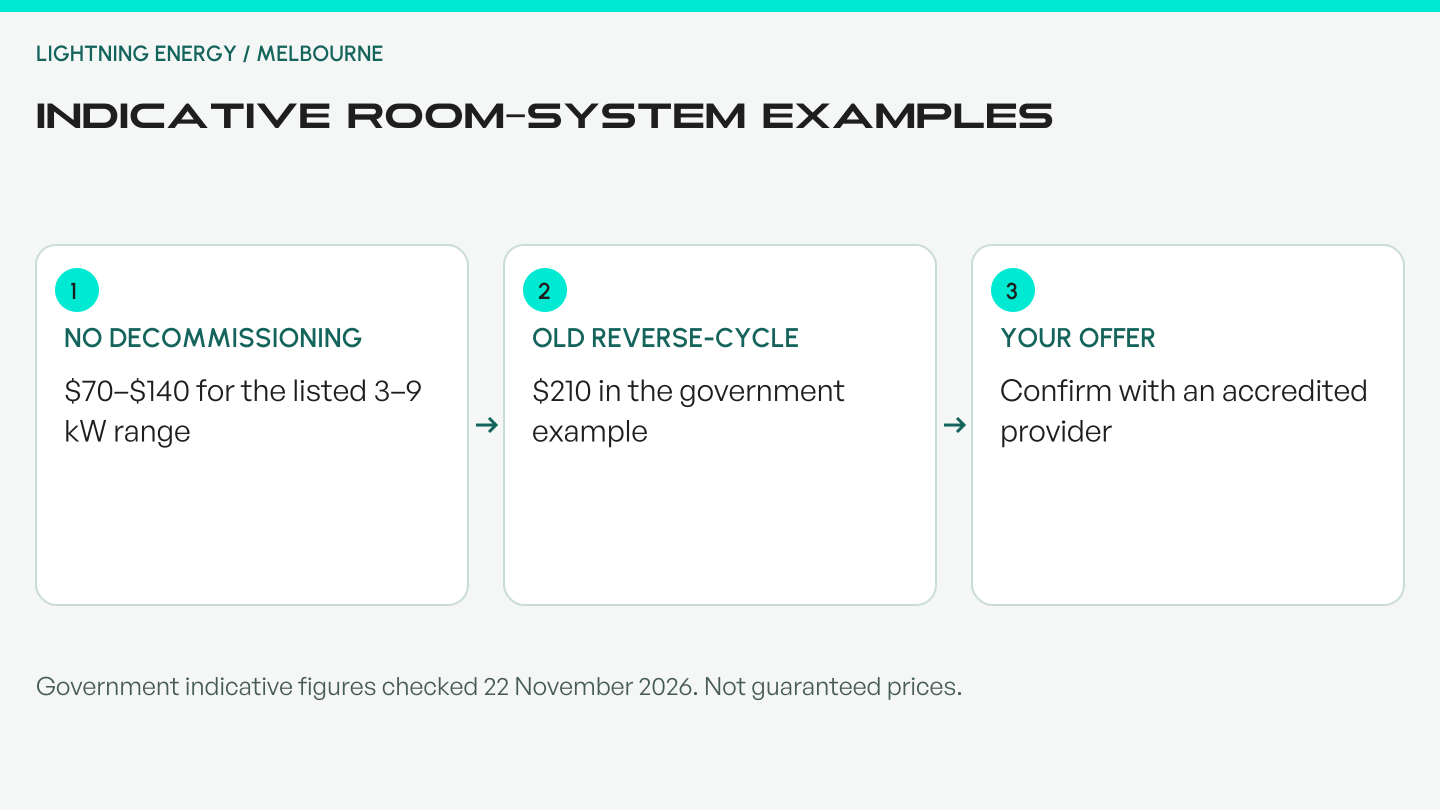
The November government table gives an indicative $70 to $140 for a 3–9 kW room system with no decommissioned product, compared with $210 for replacing a non-ducted reverse-cycle system. These are guides, not guaranteed offers.
The difference is a reason to obtain a correctly classified quote, not a reason to buy unnecessary equipment. Confirm the net price for a system suited to the room.
If two retailers show different incentives, ask both to identify the pathway, equipment and certificate-price assumptions. Their final retail offers can differ even when the equipment appears similar.
An approved product can still be the wrong size or configuration for the room. Ask for heating and cooling capacity, model numbers and a site-based explanation of the selection.
A room with large sun-exposed windows may need shading or envelope improvements as well as mechanical cooling. Describe the comfort problem rather than selecting a model from the discount alone.
For an existing air conditioner, ask whether a fault is repairable and whether warranty support applies. A replacement incentive is not evidence that an otherwise suitable system needs replacing.
Keep the cost of removal, electrical work and wall repairs visible. This makes a discounted replacement comparable with a repair or a different installation option.
Contact the accredited provider before committing. Agree on who records the existing appliance, confirms the replacement model and completes the evidence required for the incentive.
If equipment must be decommissioned, ask how that work and its evidence will be managed. Do not remove or discard the old appliance yourself in anticipation of a later claim.
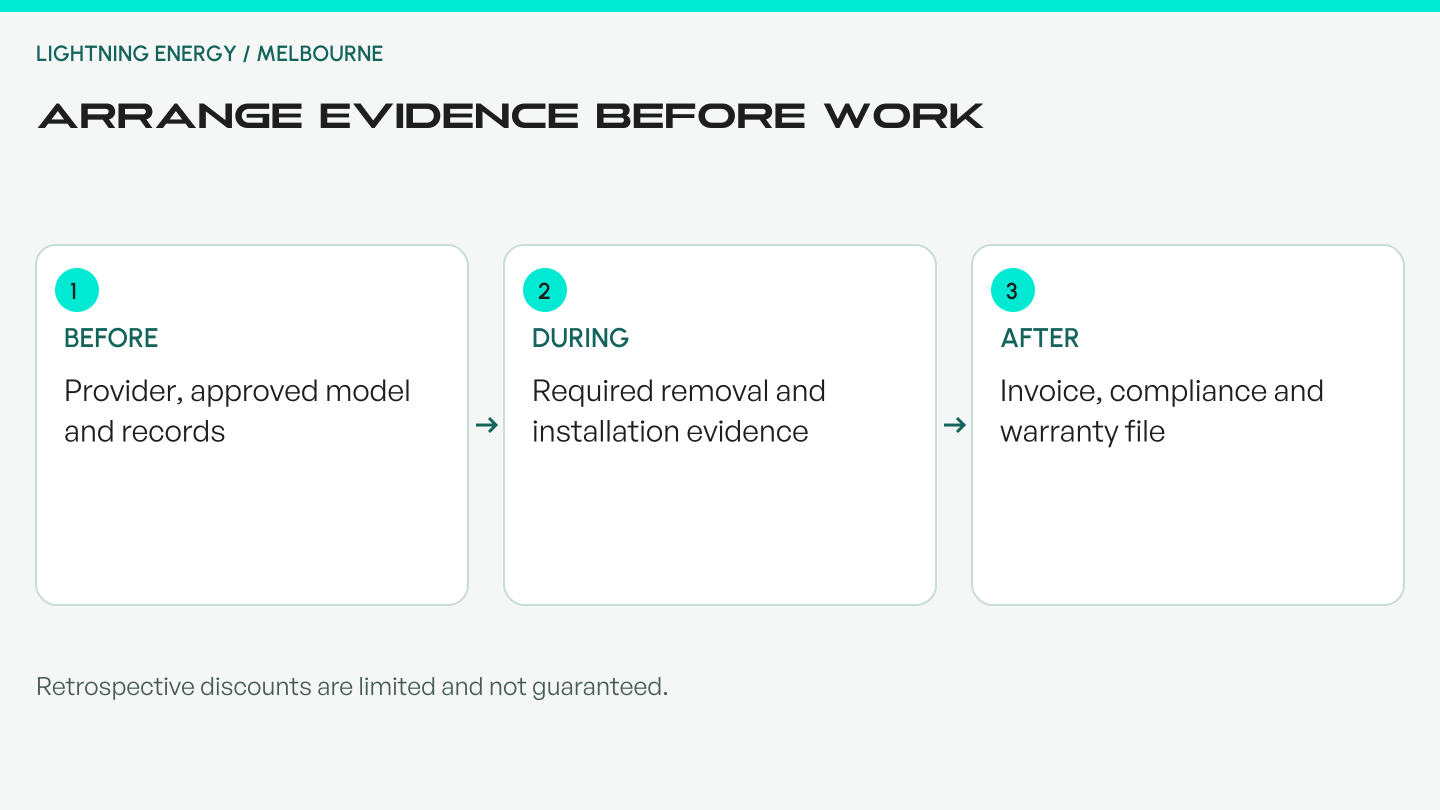
Victoria’s retrospective-discount guidance allows only limited possibilities after purchase or installation.
Approval, evidence, provider willingness and timing still matter; retrospective support is not guaranteed.
If the work is already complete, collect the invoice, model details and compliance records, then ask an accredited provider to assess what is possible. Do not treat a promised future rebate as money already received.
Ask each installer to itemise equipment, labour, electrical work, removal and optional extras. Then show the confirmed VEU reduction and the amount due.
For a hypothetical replacement, compare a repair quote, a standard replacement quote and a higher-efficiency replacement quote. Use the same required room coverage and installation location for each.
Check whether the price assumes a straightforward installation. Long pipe runs, difficult access or switchboard work should be identified before you choose a retailer.
Ask when the price and incentive assumptions expire and what happens if installation moves. Keep the accepted quote and any variations together.
Photograph the existing equipment and its model label. Describe the room, existing heating and cooling, electrical supply and access constraints.
Ask which VEU activity applies and whether the exact replacement is approved. Get the complete installed price after the confirmed discount.
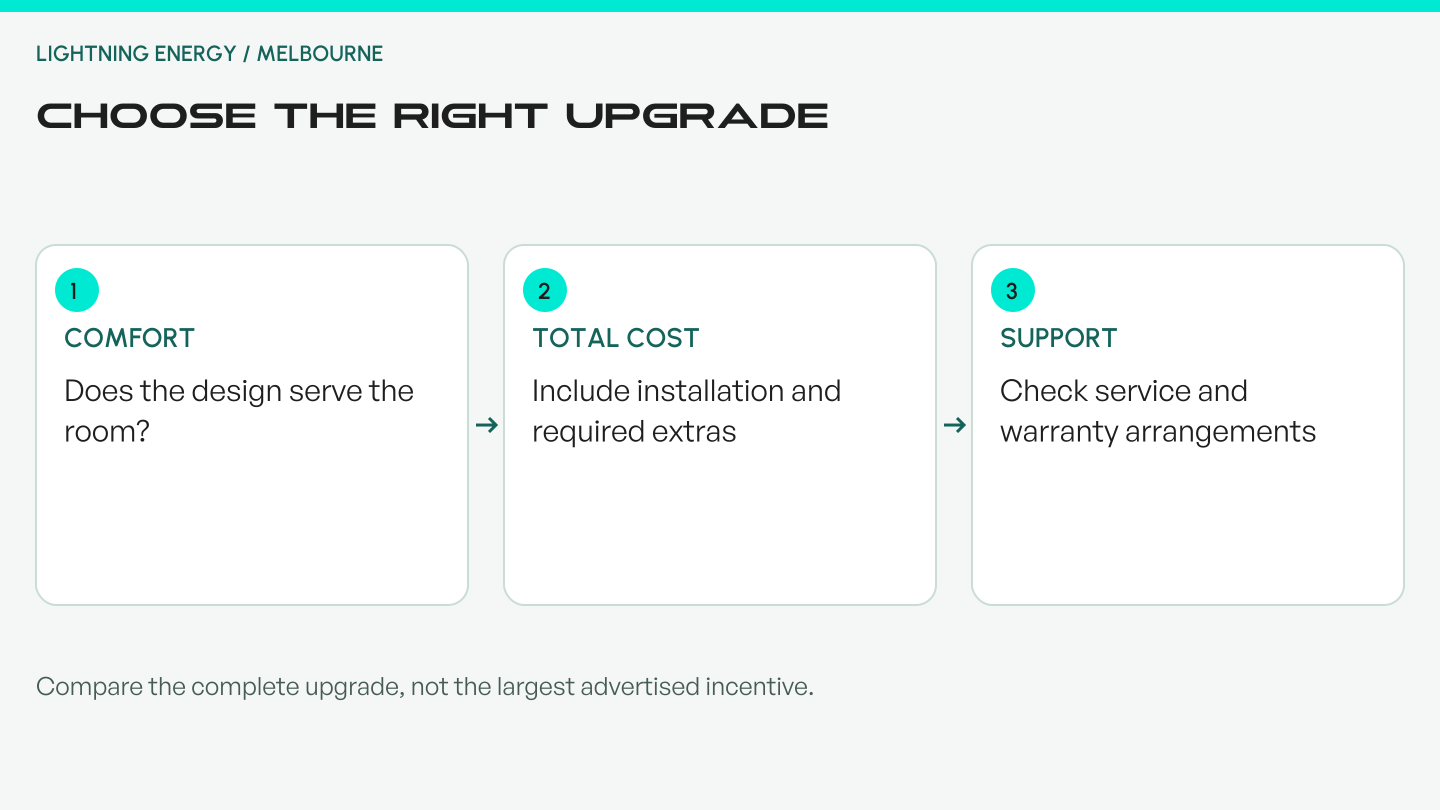
Choose on comfort, efficiency, installation quality and support. A small incentive on the right system can be more useful than a larger headline attached to a project you do not need.
There is a VEU pathway for approved installations with no decommissioned product. The provider must confirm the product and installation requirements; the discount is usually different from replacement offers.
A retrospective VEU discount may be possible in limited cases, but it is not guaranteed. Speak to an accredited provider before work wherever possible.
VEU air-conditioning eligibility and quotes.
Like-for-like replacement or ducted redesign.
Air-conditioner warranties and workmanship.
Current VEU heating and cooling pathways.
Retrospective VEU discounts, updated November 2026.
Choosing a suitable reverse-cycle system.
Cover: existing Lightning Energy website photography, used as installation or home-energy context. The pictured property is not claimed to be in the suburb discussed or to have received a particular incentive.
Diagrams are conceptual guides.
Available times
Book a consultation and we'll map solar, storage, hot water, and the rebates around your bills and your goals.
Question 1 of 6