
Sodium-Ion Home Batteries in Australia: Should You Wait?
Sodium-ion storage is progressing, but a grid-scale launch is not an Australian home battery offer. Compare real availability, support and your reasons for waiting.
Sodium-ion storage is progressing, but a grid-scale launch is not an Australian home battery offer. Compare real availability, support and your reasons for waiting.

Sodium-ion battery announcements deserve attention. They do not, on their own, tell an Australian homeowner what can be installed, warranted and supported at their address.
The practical question is whether a specific available system meets your needs. Chemistry is one part of that decision alongside price, controls, usable energy and local support.
This is a desk-researched assessment checked on 3 November 2026. We have not tested a sodium-ion home battery or verified an Australian household installation offer in this review.
CATL announced its TENER Sodium energy storage system in June 2026. The manufacturer describes a large stationary-storage platform, with international deliveries scheduled for June 2027.
Its announcement discusses a platform exceeding 30 MWh, not a wall-mounted household product. The delivery date is a manufacturer’s schedule, not proof of stock arriving for Australian home installations.
Source: CATL’s TENER Sodium announcement.
CATL and CHANGAN also unveiled a sodium-ion passenger vehicle in February 2026. That is evidence of progress in vehicles; it does not establish residential inverter compatibility or an Australian home warranty.
Source: CATL and CHANGAN’s vehicle announcement.
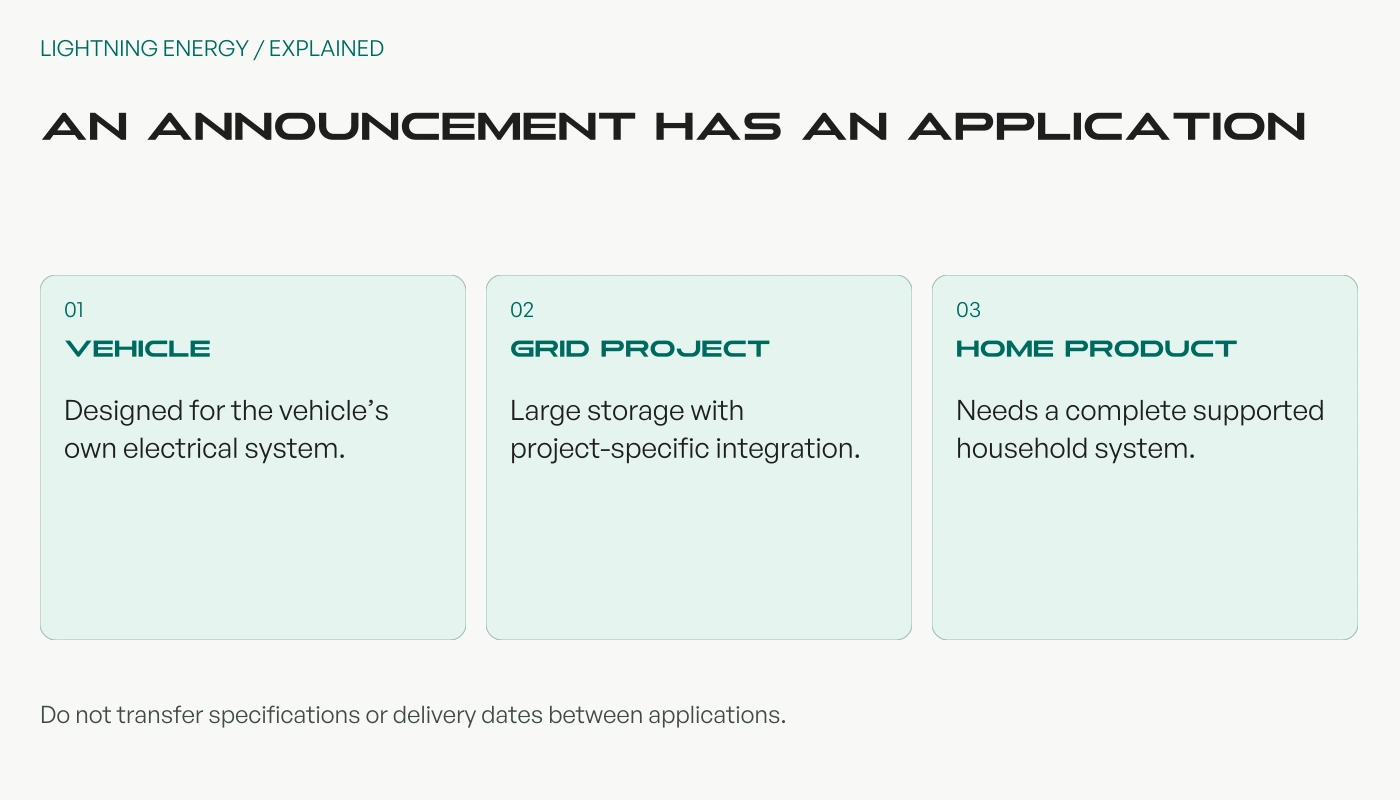
Sodium-ion refers to a family of battery technologies. A promising cell result does not describe every enclosure, inverter, control system or warranty built around it.
Treat lower-cost and safety claims as product-specific claims requiring evidence. Neither sodium-ion nor lithium-based storage should be described as risk-free.
For background, our LFP and NMC comparison separates chemistry from installation and warranty questions.
Ask for the exact model, usable capacity, continuous output, installation requirements and Australian support contact. A distributor’s expression of interest is different from a firm installed quote.
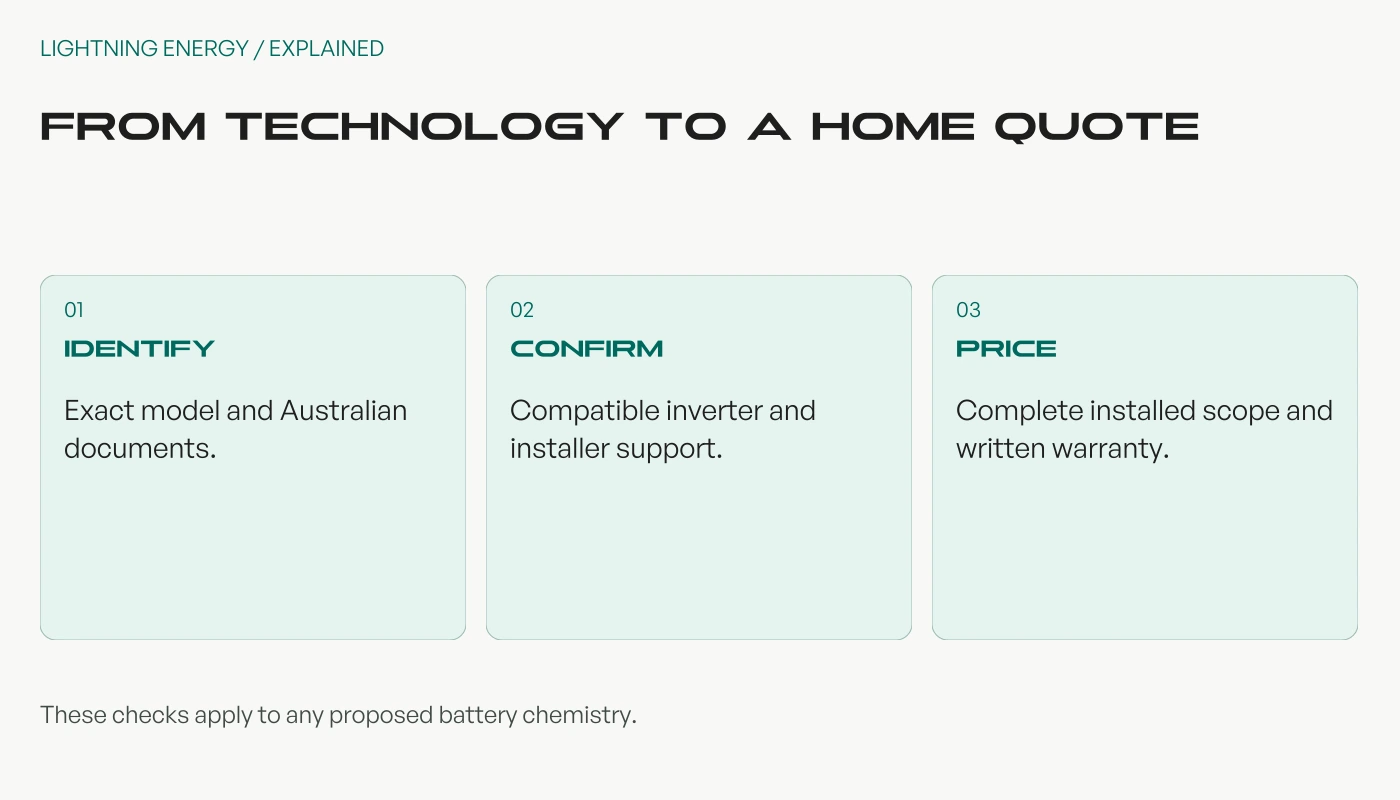
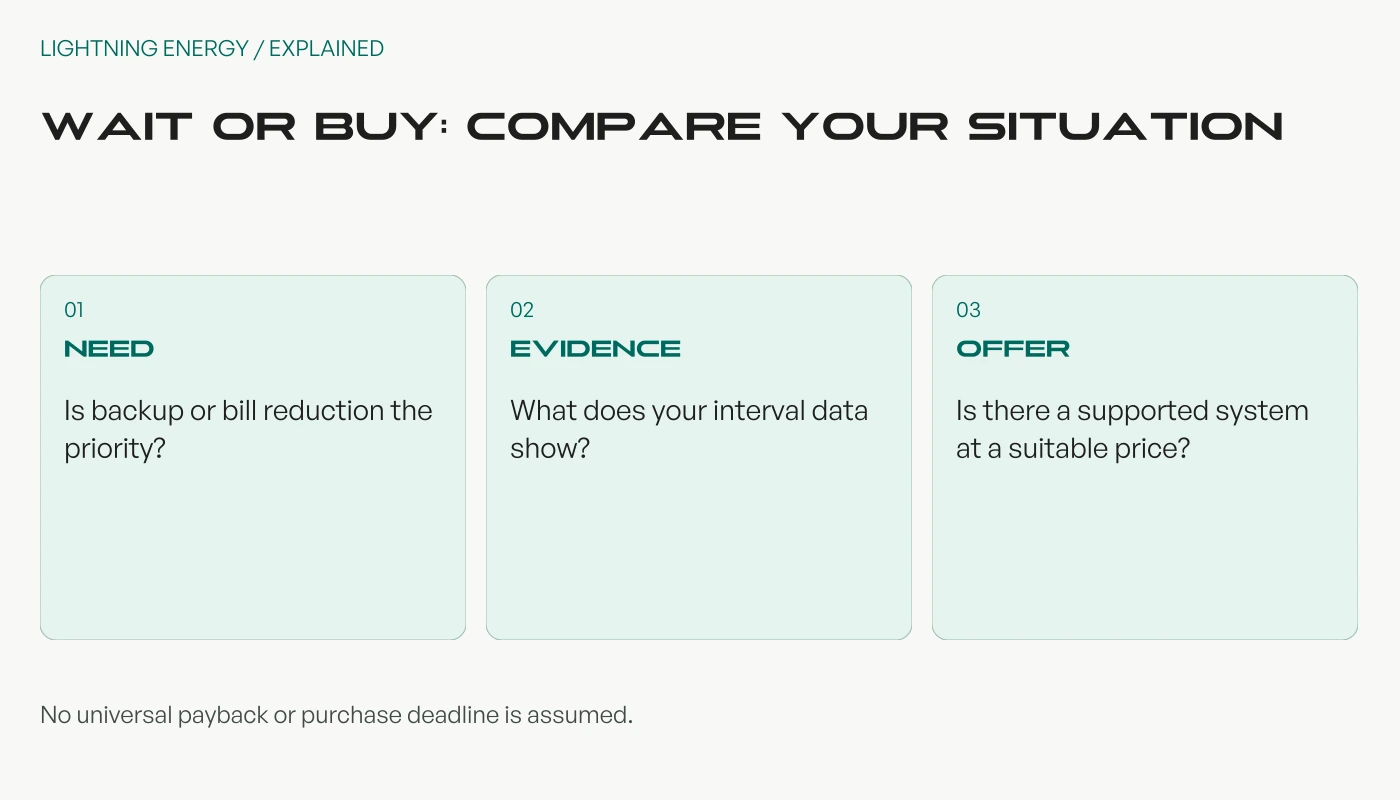
Waiting may suit a household with little evening consumption, limited solar surplus or an imminent move. You do not need to buy a battery simply because a new technology is in the news.
Buying now may suit a household with a clear backup requirement or a strong case from measured consumption. Either conclusion needs your own numbers, not an assumed national average saving.
Compare the cost of continuing with your present setup against the total proposed purchase. Include financing costs where relevant, conversion losses and the value of solar exports you would give up.
Start with evening and overnight meter data. A bigger battery cannot create surplus solar that the roof does not produce.
Do not assume a future product qualifies for a current discount. Ask the installer to show the applicable eligibility requirements and product listing for the exact equipment being quoted.
Our battery discount timing guide explains why an installation date and system size matter. Recheck the rules when an offer is ready.
A predicted price fall or a future certificate value should not be presented as money already saved. Request separate equipment, installation and incentive amounts.
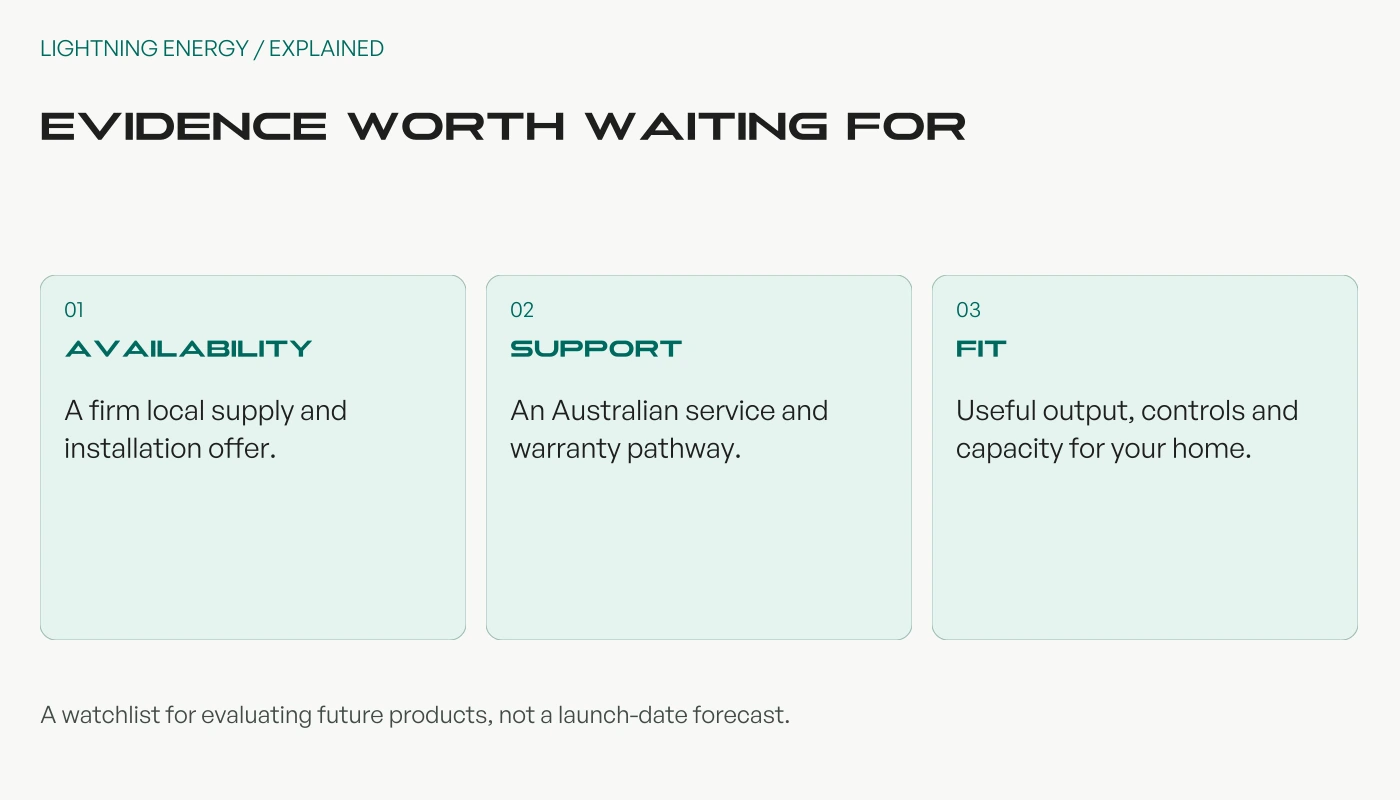
Write down what would make a future sodium-ion system preferable: a lower installed cost, a particular operating capability or stronger support. Then compare actual offers against those requirements.
A grid-scale launch is worth following. It is not a reason to dismiss current products, and it is not a promise that a better household option will arrive on a fixed date.
Contact Lightning Energy with your usage records and requirements for a comparison of available systems. We can keep the conversation centred on a supported solution and the work it needs to do.
Available times
Book a consultation and we'll map solar, storage, hot water, and the rebates around your bills and your goals.
Question 1 of 6
