
Solar Hub NZ Collapse: The Claim Deadline Customers Need to Know
Solar Hub NZ entered liquidation on 13 October 2026. The official creditor deadline, deposit and warranty steps, and separate lessons for Australian solar buyers.
Solar Hub NZ entered liquidation on 13 October 2026. The official creditor deadline, deposit and warranty steps, and separate lessons for Australian solar buyers.

Solar Hub NZ Limited has entered liquidation, leaving customers trying to recover money paid for solar systems. The immediate priority for affected households is to document their claim and contact the appointed liquidators.
This is a New Zealand company and a New Zealand insolvency process. The notice does not establish anything about the financial position of Australian businesses with similar names.
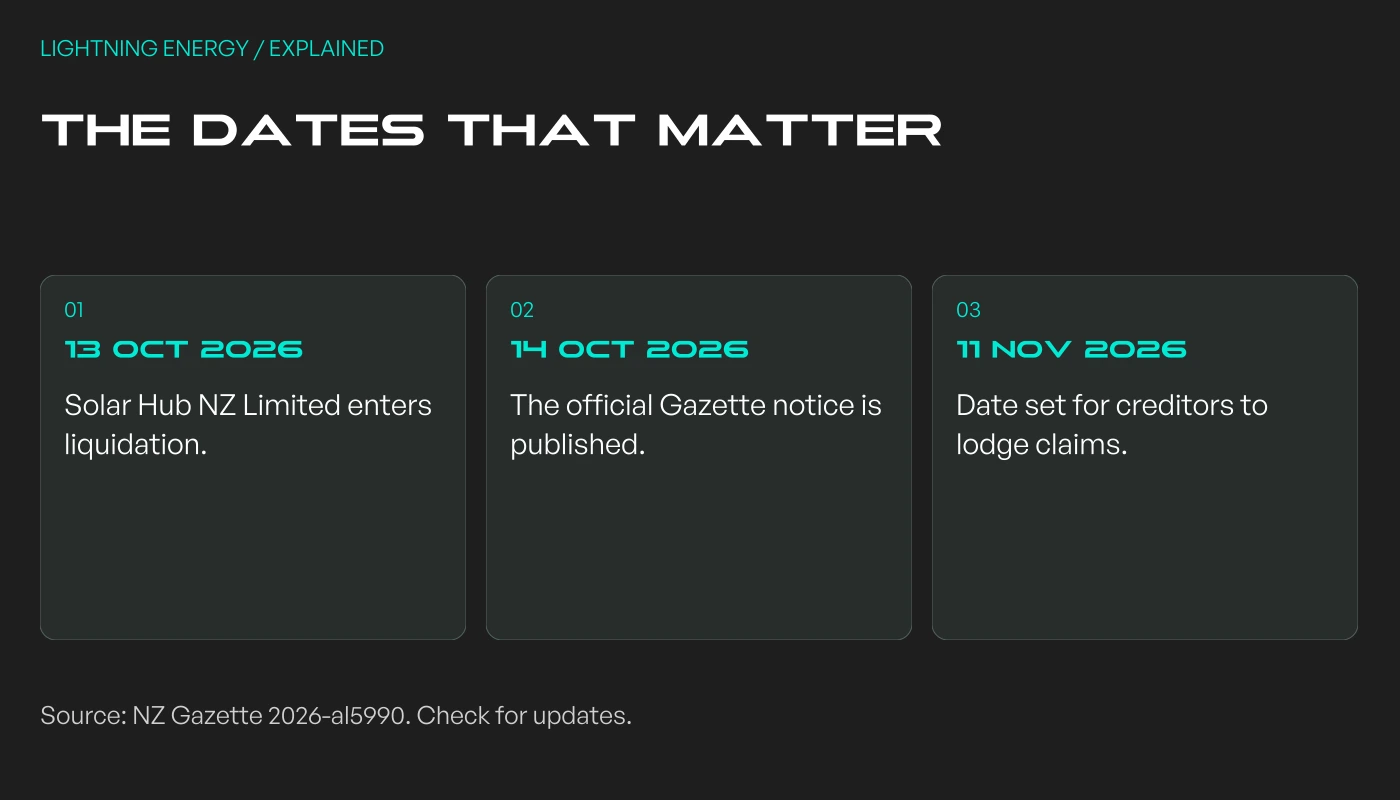
The New Zealand Gazette records a shareholder resolution placing Solar Hub NZ Limited into liquidation at 3.30pm on 13 October 2026. The notice was published on 14 October.
It names Chiragkumar Bhailalbhai Patel and Gareth Russel Hoole as joint and several liquidators. Creditor enquiries are directed to Ecovis KGA Limited in Auckland.
The notice sets 11 November 2026 as the date for creditors to make their claims and establish any priority. Missing that date can affect participation in distributions made before a claim is lodged.
Check the official Gazette notice for the precise wording and current contact details. It lists businessrecovery@ecoviskga.co.nz and New Zealand telephone (09) 921 4635.
In its 15 October report, Stuff described a customer who said she paid a NZ$13,140 deposit in June and was still waiting for installation four months later. That is one reported customer account, not a total loss figure.
Stuff also reported that SEANZ had dealt with complaints and subsequently revoked the company’s membership. These details are attributed to Stuff’s reporting; we have not independently interviewed the customers or the association.
Read Hamish McNeilly’s original Stuff report.
We have not established the final amount owed to customers or the likely recovery rate.
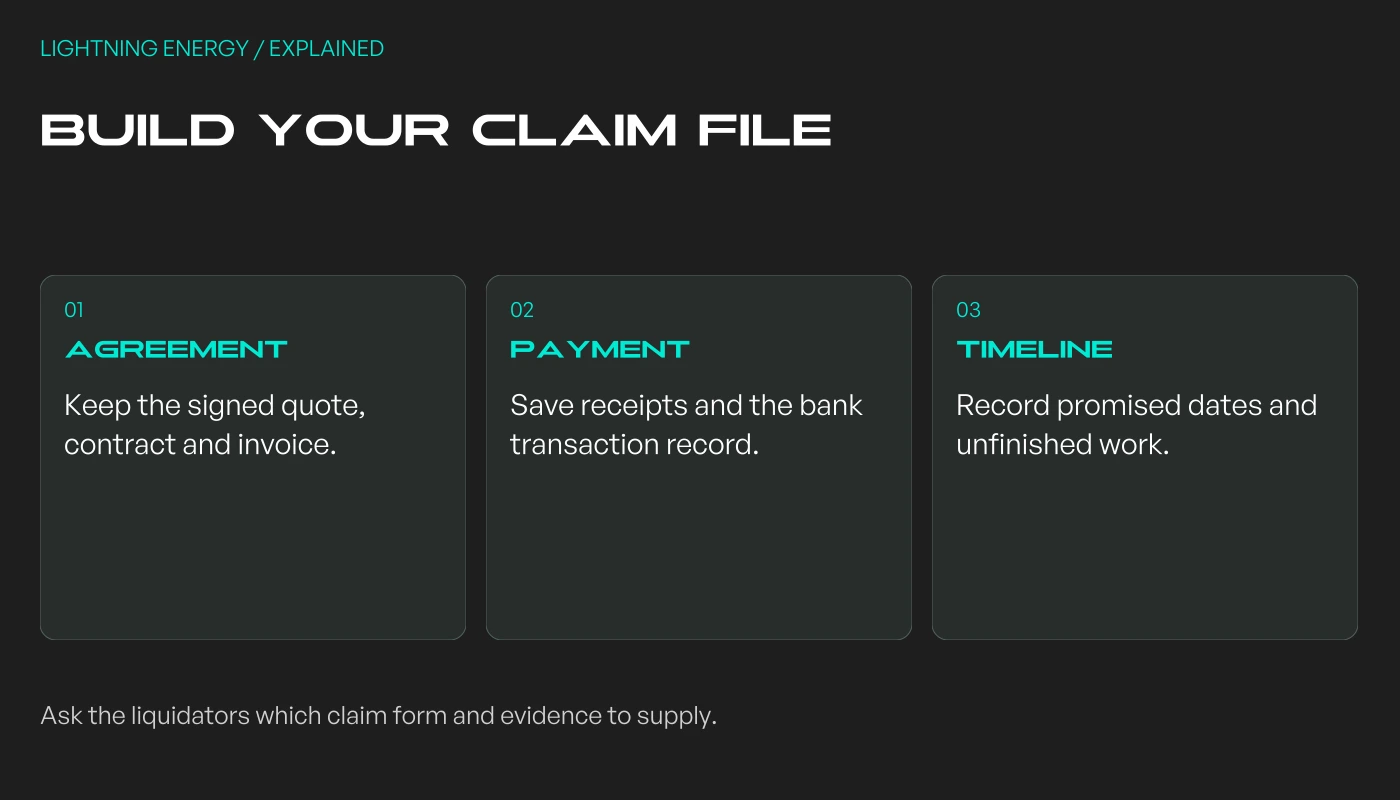
Gather the signed agreement, invoice, payment record and correspondence. Record what was promised, what arrived and what remains unfinished. Ask the liquidators how to submit the claim and obtain acknowledgement.
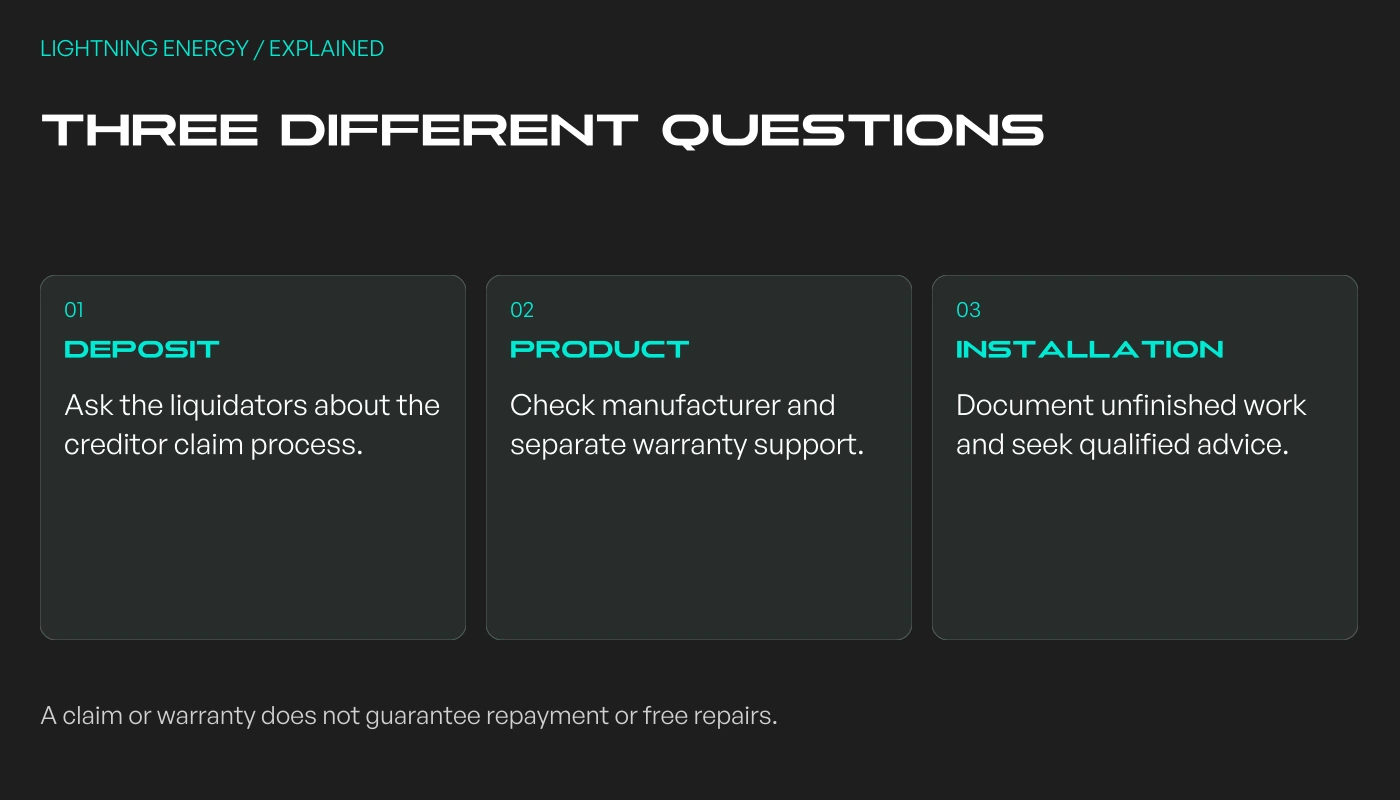
New Zealand Consumer Protection advises customers with undelivered purchases or deposits to contact the liquidator. A valid claim does not guarantee repayment: there may be insufficient money available.
If you paid by credit card, contact your bank promptly about a possible chargeback. Time limits apply. If you used finance, speak to the lender about incomplete or undelivered work rather than assuming the debt disappears.
Source: New Zealand Consumer Protection’s closed-business guidance. Advice and remedies depend on the contract and circumstances.
An installer closing does not, by itself, show that every installed system is faulty. Separate any equipment problem from installation workmanship, incomplete commissioning and the company’s financial position.
Keep model names, serial numbers, warranty documents and commissioning records together. Preserve access to your monitoring account and download useful reports while they remain available.
New Zealand Consumer Protection identifies the manufacturer or separate warranty provider as possible contacts for faults. The available remedy depends on the circumstances and warranty terms; it is not automatic replacement cover.
Our guide to recovering solar monitoring access explains the records worth retaining. Its Australian context does not replace advice on a New Zealand claim.
The local process is different. For an Australian company, the ACCC directs consumers to ASIC’s published insolvency notices to check the appointment and identify the administrator or liquidator.
Customers owed money are usually unsecured creditors and may recover only part of their payment or nothing. The ACCC recommends contacting the external administrator and promptly asking the payment provider about possible reversal options.
A manufacturer separate from the failed retailer may still be able to assist with a product fault. That does not mean it will reimburse a missing installation deposit or pay every labour cost.
Source: ACCC guidance when a business goes bust. Australian guidance should not be used to interpret Solar Hub NZ’s creditor deadline.
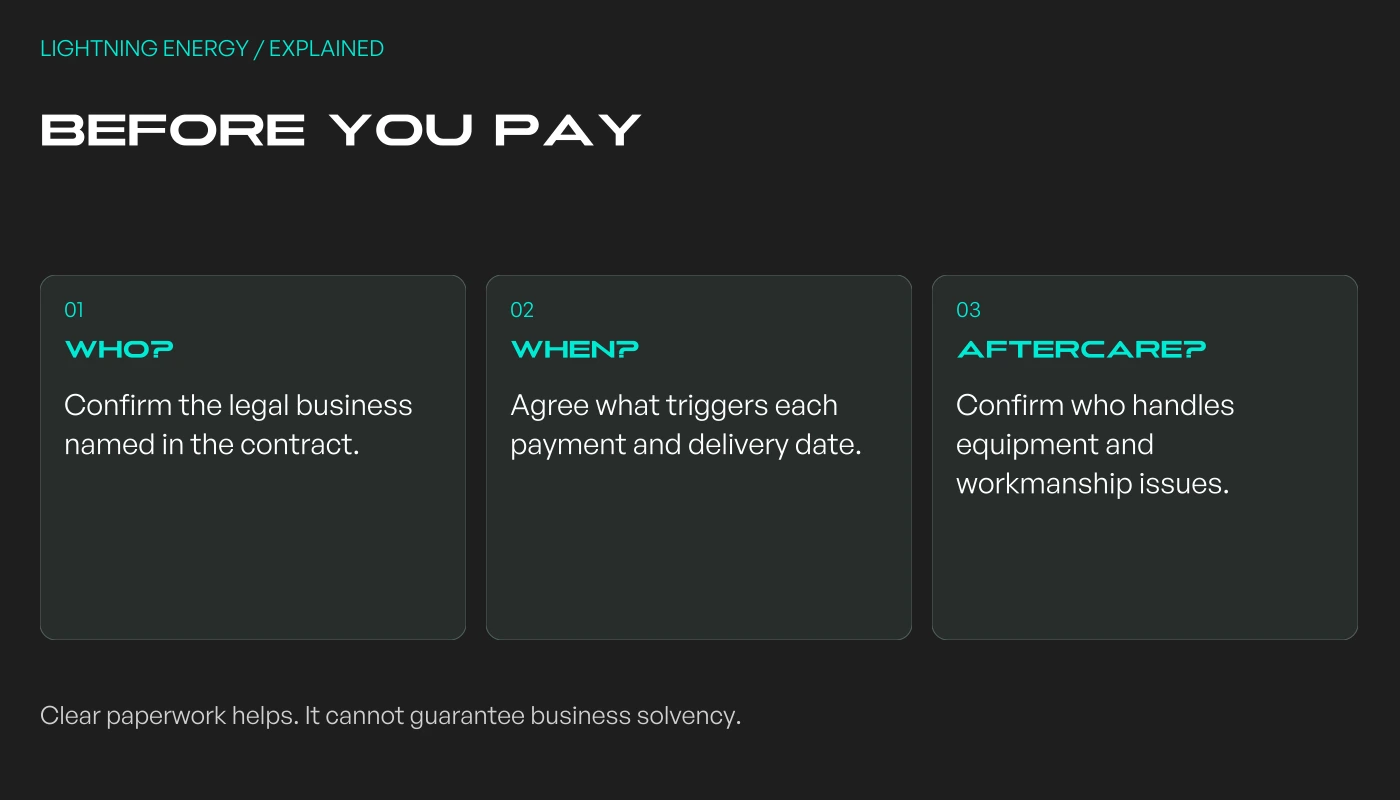
Before paying, make the agreement specific: who is the contracting entity, what equipment is included, when is each payment due, and what happens if the timetable changes? Ask which party is responsible for aftercare.
Compare the full scope in your solar quotes, including installation and handover. A familiar panel brand is not a substitute for a clear contract with the business taking your money.
This liquidation is a reason to examine contracts and support arrangements carefully. It is not evidence that every solar business is in difficulty or that a particular technology has failed.
Our solar warranty guide separates product, performance and installation cover. Those are different promises and should be documented separately.
For Australian households planning an upgrade, solar and battery quotes should explain the proposed system and the work around it. Ask questions before paying, not only after a delay appears.
Checked 15 October 2026. This article combines an official notice, attributed reporting and general consumer information. The cover uses illustrative Lightning Energy solar photography, not a Solar Hub NZ installation.
Available times
Book a consultation and we'll map solar, storage, hot water, and the rebates around your bills and your goals.
Question 1 of 6
