
Sydney Solar and Battery Rebates Above $150,000 Household Income
Above the NSW Home Energy Saver loan income limit? Separate the loan test from federal solar and battery discounts, VPP incentives and other finance options.
Above the NSW Home Energy Saver loan income limit? Separate the loan test from federal solar and battery discounts, VPP incentives and other finance options.

Earning more than the new Home Energy Saver loan limit does not automatically remove every solar or battery incentive available to a Sydney household. Different programs test different things.
For a new application, check the NSW loan income rule separately from federal system eligibility and optional VPP participation. Avoid treating the rejection of one form of support as a decision about all the others.
Rules and sources checked on 22 November 2026. This guide explains the decision process; eligibility and the final installation scope need to be confirmed for your property.
The current NSW loan page says new applications after 9 am on 10 November 2026 use a $150,000 combined taxable household income threshold.
Earlier applications are assessed under the previous $210,000 threshold.
This is a household test under the program’s definition, not a separate allowance for each applicant. The lender assesses supporting documents and credit eligibility.
Some older summaries still mention $210,000. For a new application, rely on the dated change notice and November guidelines, then confirm the position with the finance provider.
If your income is close to the threshold, ask the provider which completed tax-year documents it requires. Do not substitute an informal estimate or assume gross salary and taxable income are identical.
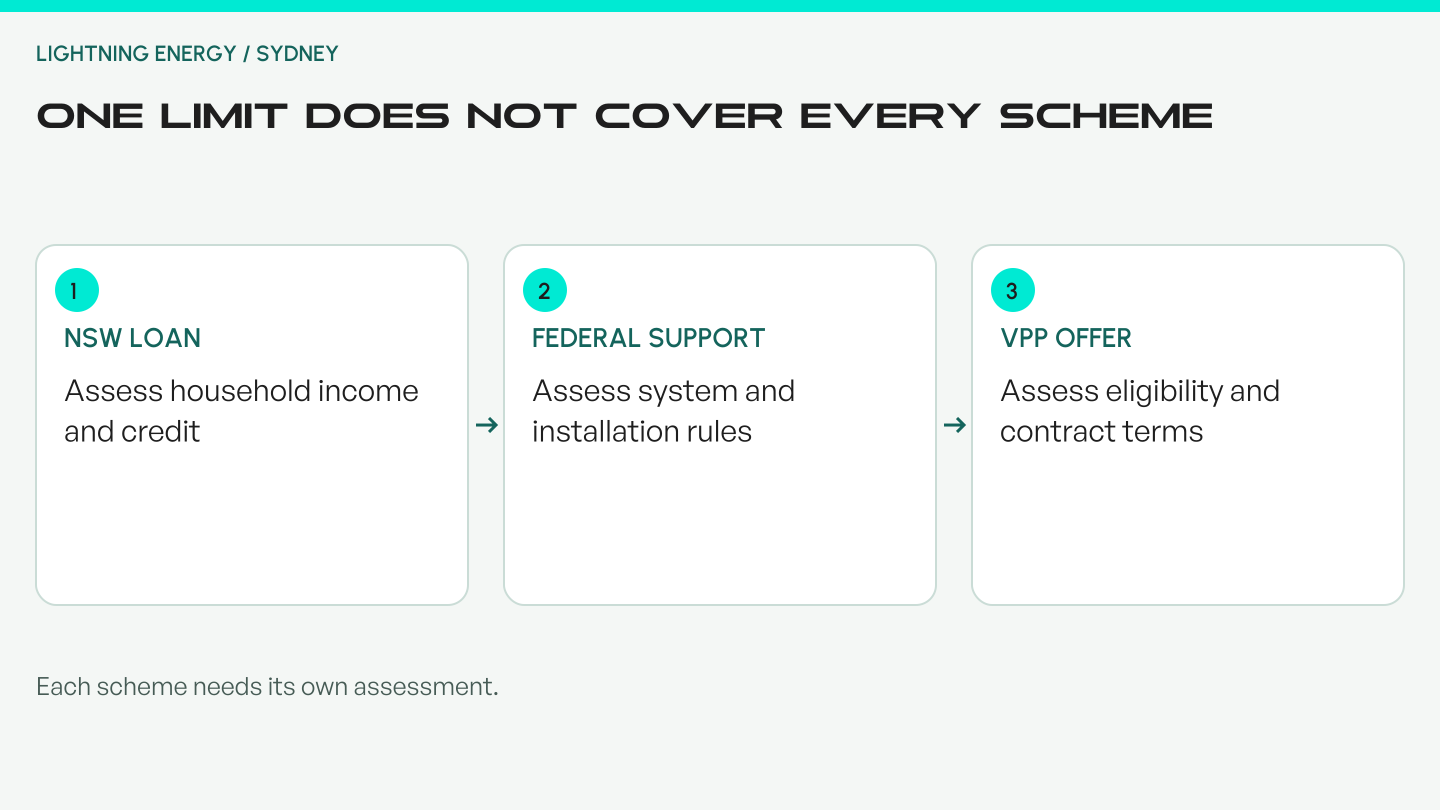
The federal Small-scale Renewable Energy Scheme supports eligible systems through small-scale technology certificates, commonly called STCs. A retailer can reflect assigned certificate rights in an upfront discount.
Energy.gov.au’s rebate guide explains that rebates, certificate-based support and loans are different forms of assistance.
A loan income limit should not be copied across to unrelated schemes.
The current CER battery eligibility page sets equipment, installation and premises requirements.
It does not list the NSW $150,000 household-income test as a federal battery condition.
That does not mean every battery qualifies. Ask the installer to check the exact models, approvals, installation date and any previous battery STC claim at the premises.
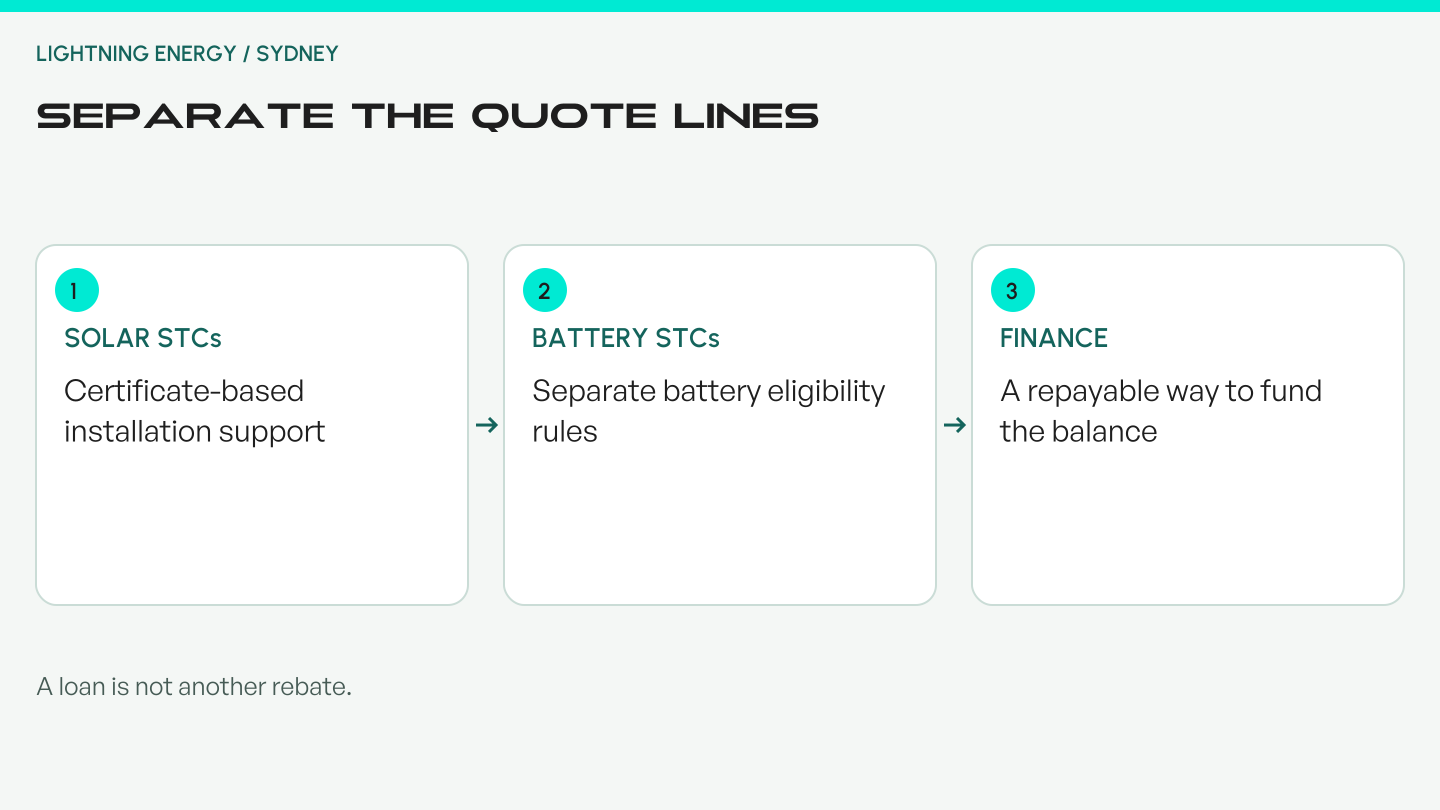
A virtual power plant can control participating batteries under an agreed contract. The NSW joining incentive has its own requirements and provider offer; it is not the same as the federal installation discount.
Ask for the proposed incentive separately from ongoing export payments or bill credits. Then compare import rates, daily charges, fees, battery access and exit terms.
The useful question is whether the complete arrangement suits the household, not whether it restores a lost loan benefit. A joining payment can be outweighed by other plan costs.
For a battery intended to provide outage protection, check the reserve setting and how VPP control interacts with it. Do not assume every provider offers the same level of control.
The Household Energy Upgrades Fund supports discounted finance through participating lenders.
It is a different program from NSW Home Energy Saver and has lender-specific eligibility and product requirements.
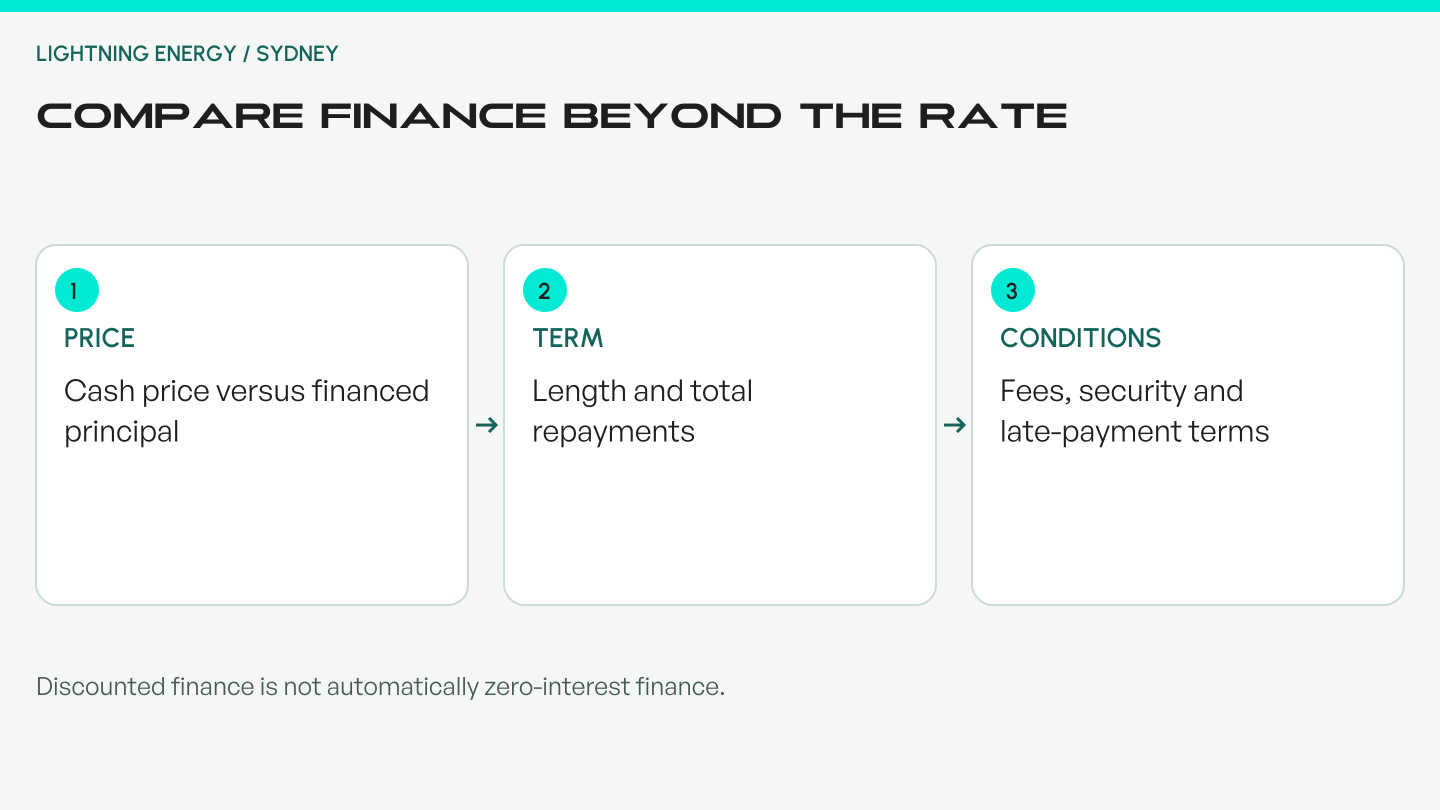
Ask for the interest rate, comparison rate, fees, security, term and total repayments. A discounted rate can still produce substantial interest over a long term.
Compare any finance quote with the cash price for the same installation. Check whether a promotional payment hides a larger financed principal or a cost added elsewhere.
If considering mortgage finance, assess the repayment term as well as the rate. Spreading an equipment purchase across many years can change the total cost even when the headline rate is lower.
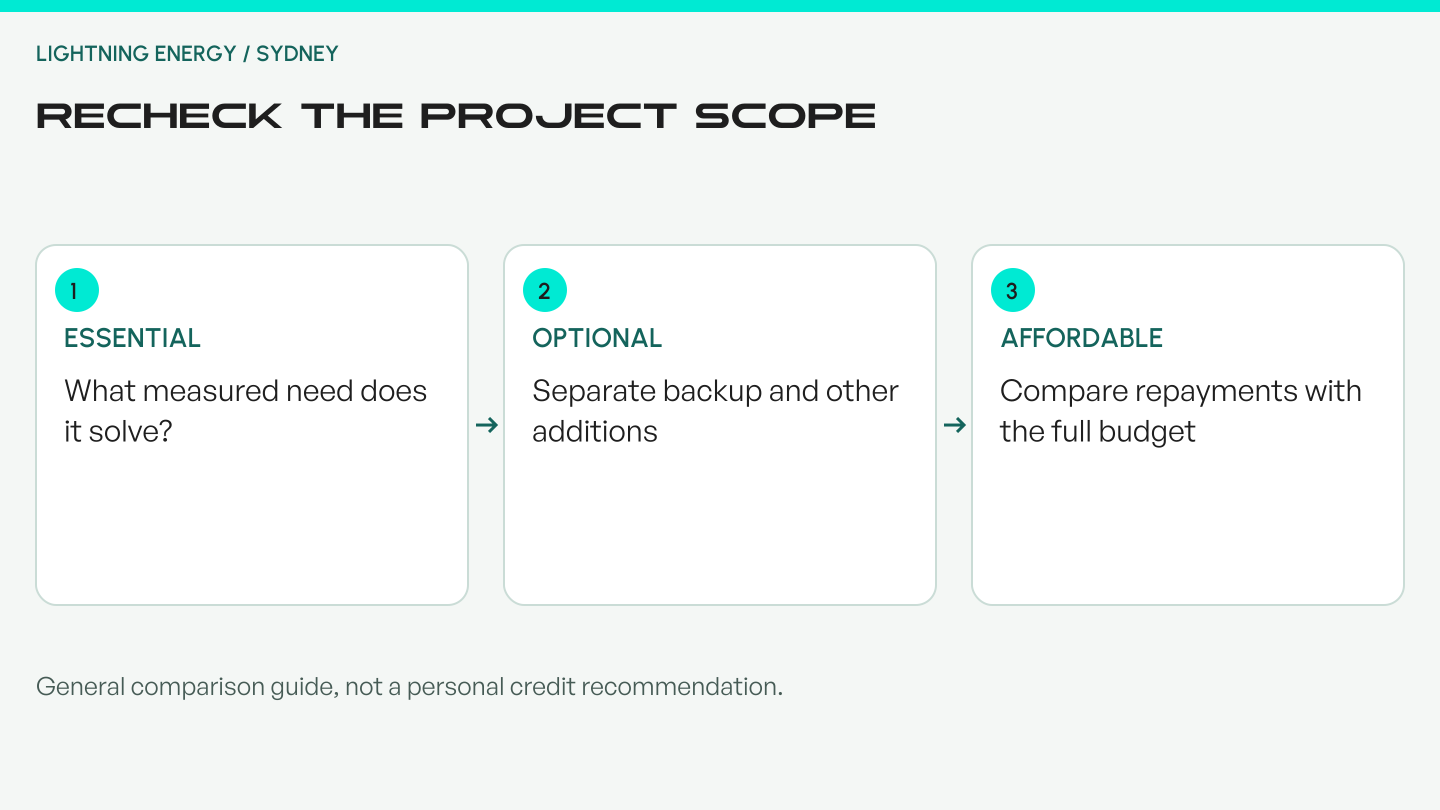
If a project was affordable only with the NSW loan, revisit its scope before taking another credit product. A smaller system, staged work or waiting for a stronger cash position may be worth comparing.
Ask for separate solar, battery and backup prices. This shows which part of the project creates the financing need and which part addresses a measured energy requirement.
Keep any savings estimate conservative and transparent. Include actual consumption, tariff assumptions and the effect of seasonal generation rather than relying on a simple annual average.
This article explains program distinctions and comparison questions. It cannot establish whether a particular credit product is suitable for your household.
Request separate lines for solar STCs, battery STCs, any VPP offer and the remaining purchase price. Finance should then appear as a way to pay that balance, not as another saving.
For each incentive, ask who checks eligibility and what happens if the assumption fails. Record whether the contract price can change and when any payment is received.
An itemised quote makes it easier to see which support remains relevant after an income-rule change and to compare different installers on the same basis.
The NSW Home Energy Saver loan uses that income threshold for new applications. The current federal battery eligibility page does not list the same household-income test.
No. Finance approval and installation-incentive eligibility are separate assessments. The system must still meet the relevant scheme requirements.
Federal battery size and installation-date rules.
VPP rewards, tariffs and exit terms.
Government rebate and loan distinctions.
Household Energy Upgrades Fund.
Cover: existing Lightning Energy website photography, used as installation or home-energy context. The pictured property is not claimed to be in the suburb discussed or to have received a particular incentive.
Diagrams are conceptual guides.
Available times
Book a consultation and we'll map solar, storage, hot water, and the rebates around your bills and your goals.
Question 1 of 6