
Flat, Time-of-Use or Demand Tariffs: Compare Your Whole Electricity Bill
Understand usage rates, time windows and demand charges. Compare retail plans with your interval data before assuming solar or a battery makes one tariff cheaper.
Understand usage rates, time windows and demand charges. Compare retail plans with your interval data before assuming solar or a battery makes one tariff cheaper.

The cheapest rate on a plan is not necessarily the rate you use most. A solar household can export at lunchtime and still buy substantial electricity during the evening.
Choosing between flat, time-of-use and demand pricing starts with the plan’s written rules and your own usage. This guide was checked on 3 November 2026 and does not quote a current retailer offer.
A single-rate plan does not change its usage price simply because it is evening rather than midday. Daily supply charges and any other fees still matter.
This can make comparisons simpler, but it does not guarantee a smaller bill. A household able to shift substantial use may find another structure works better.
A time-of-use plan changes usage rates across defined periods. Read its peak, shoulder and off-peak times; names and windows are not universal across retailers or regions.
The AER’s tariff explainer describes these structures and notes that meter requirements can restrict the plans available to you.
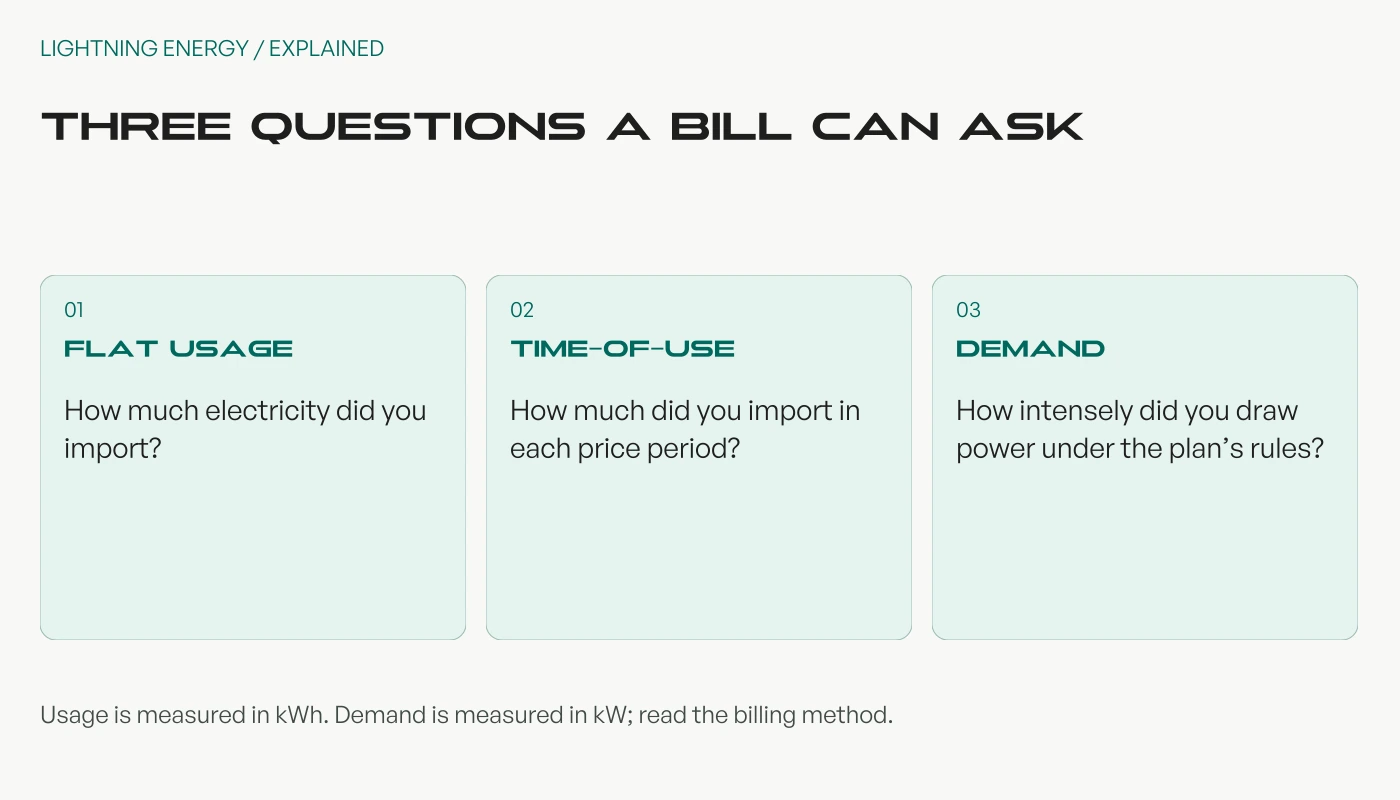
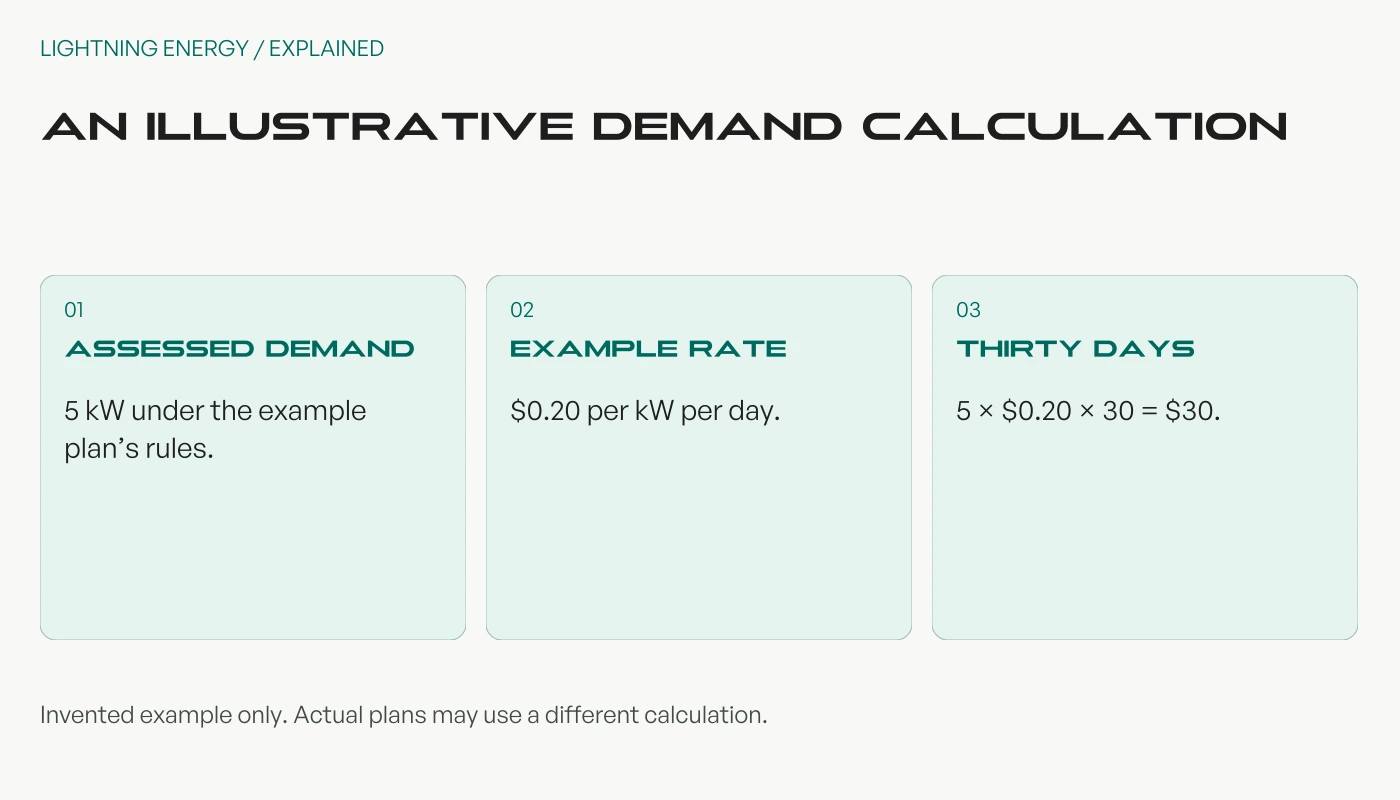
Demand pricing can add a charge to normal supply and usage charges. Retailers may use a maximum, an average of peaks or seasonal calculations, so do not assume one universal formula.
Residential demand tariffs do exist. They should not be dismissed as something relevant only to businesses. Energex lists residential demand structures.
A network tariff and the price your retailer charges are different layers. Ask which demand calculation actually appears in the retail plan you are considering.
For illustration, a plan charging $0.20 per kW per day against a 5 kW assessed demand would add $30 over 30 days. That invented example explains the units; it is not an available offer.
A battery can reduce grid imports while it has available energy and sufficient output. It may not cover every load or every expensive interval.
Check battery size against evening meter data. A capacity figure in kWh does not tell you the maximum power it can supply at once.
For demand pricing, ask what happens during the relevant assessment window if the battery is empty, its output is limited or a new appliance starts. A single successful evening is weak evidence for a full billing period.
For time-of-use, compare the cost of charging, conversion losses and foregone solar exports with the imports avoided. Daily supply charges generally remain part of the bill.
Our battery and peak-demand guide explains why the operating strategy matters alongside the hardware.
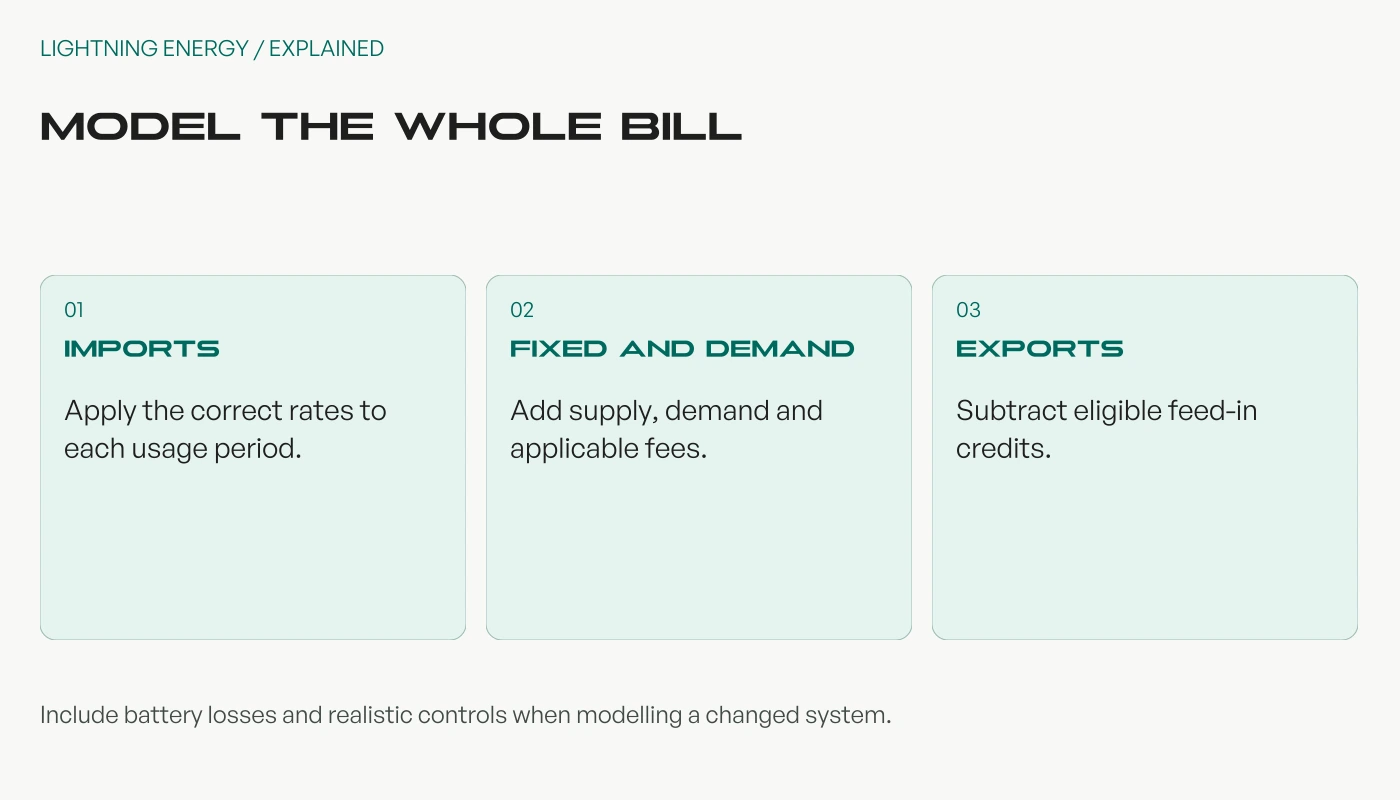
Use a year of interval data where possible. Include winter heating, summer cooling, holidays and EV charging. If you only have a short sample, label the result as an estimate with that limitation.
Compare a present-day scenario and a realistic shifted-load scenario. Moving every appliance to the cheapest period on a spreadsheet does not mean the household can live that way.
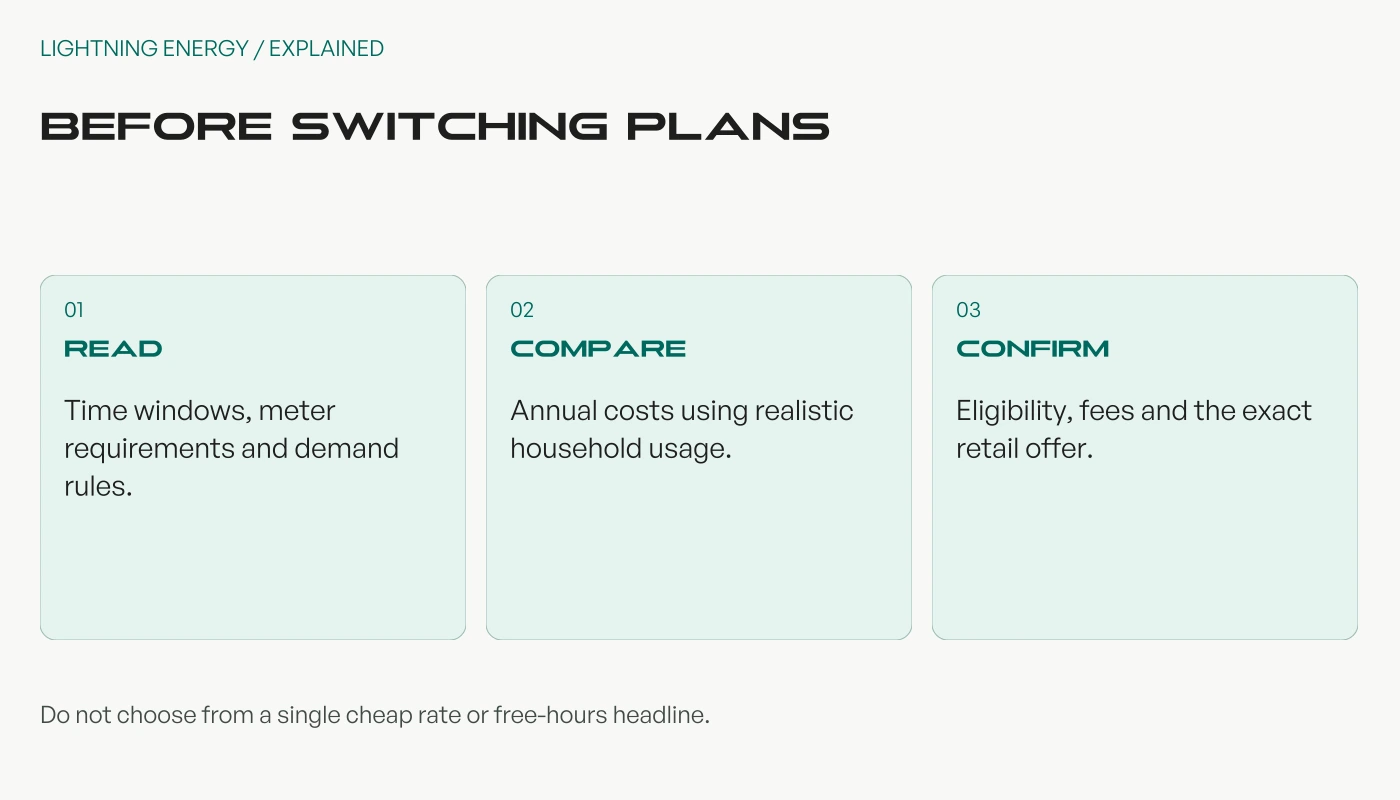
Energy Made Easy explains its estimates. Confirm demand charges, eligibility and solar export assumptions with the retailer.
Victorian households can use Victorian Energy Compare to compare available offers. A reference or default offer is not a promise of the cheapest plan for your home.
Ask whether your existing controls support the proposed strategy. If several devices have schedules, check that EV charging and water heating will not unintentionally create a new expensive peak.
Our solar electricity plan checklist covers the details beyond the feed-in rate.
Contact Lightning Energy with interval data and the written offers if you are considering storage or changed controls. Keep equipment costs separate from the estimated benefit of switching retailer.
Available times
Book a consultation and we'll map solar, storage, hot water, and the rebates around your bills and your goals.
Question 1 of 6
