
Fox ESS Power Cube vs Sigenergy SigenStor: Compare Backup and Expansion
Compare Fox ESS Power Cube and Sigenergy SigenStor in Australia: exact battery configurations, backup hardware, usable capacity, expansion and quote checks.
Compare Fox ESS Power Cube and Sigenergy SigenStor in Australia: exact battery configurations, backup hardware, usable capacity, expansion and quote checks.

Fox ESS Power Cube and Sigenergy SigenStor both combine solar conversion and modular battery storage. The important differences emerge when you ask what stays on during a blackout and what an expansion will actually involve.
This Australian comparison was checked on 8 November 2026. It is desk research using manufacturer documents and the Clean Energy Council register, not a hands-on test or an installed-price ranking.
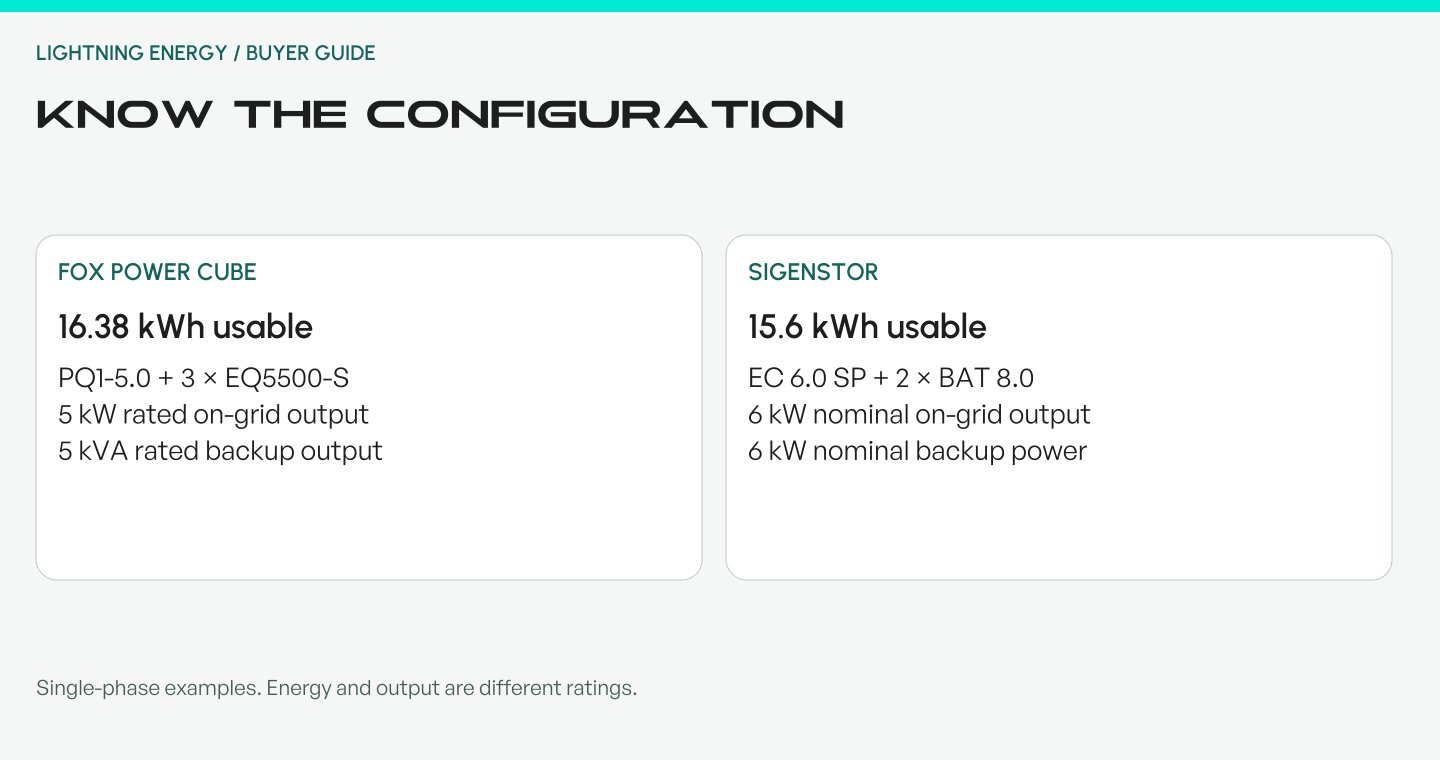
Our Fox example is PQ1-5.0_EQ5500-S_3S: a PQ1-5.0 single-phase inverter with three EQ5500-S modules. The Australian datasheet specifies 16.38 kWh usable energy, 5 kW rated AC output and 5 kVA rated backup output.
Our Sigenergy example is SigenStor-6S-16: EC 6.0 SP with two BAT 8.0 modules, without an EV DC module. It has 15.6 kWh usable energy and a controller rated at 6 kW nominal on-grid and backup active power.
These are deliberately similar storage sizes, not identical power ratings. The Fox stores 0.78 kWh more in these configurations, while the Sigenergy controller has a higher nominal output rating. Neither difference proves better value.
The current CEC register lists both exact system identifiers. SigenStor-6S-16.78 is a different entry with different capacity; it must not be substituted simply because its name looks similar.
Start with your evening consumption and simultaneous loads. Our battery sizing guide explains how to use interval data before selecting a stack.
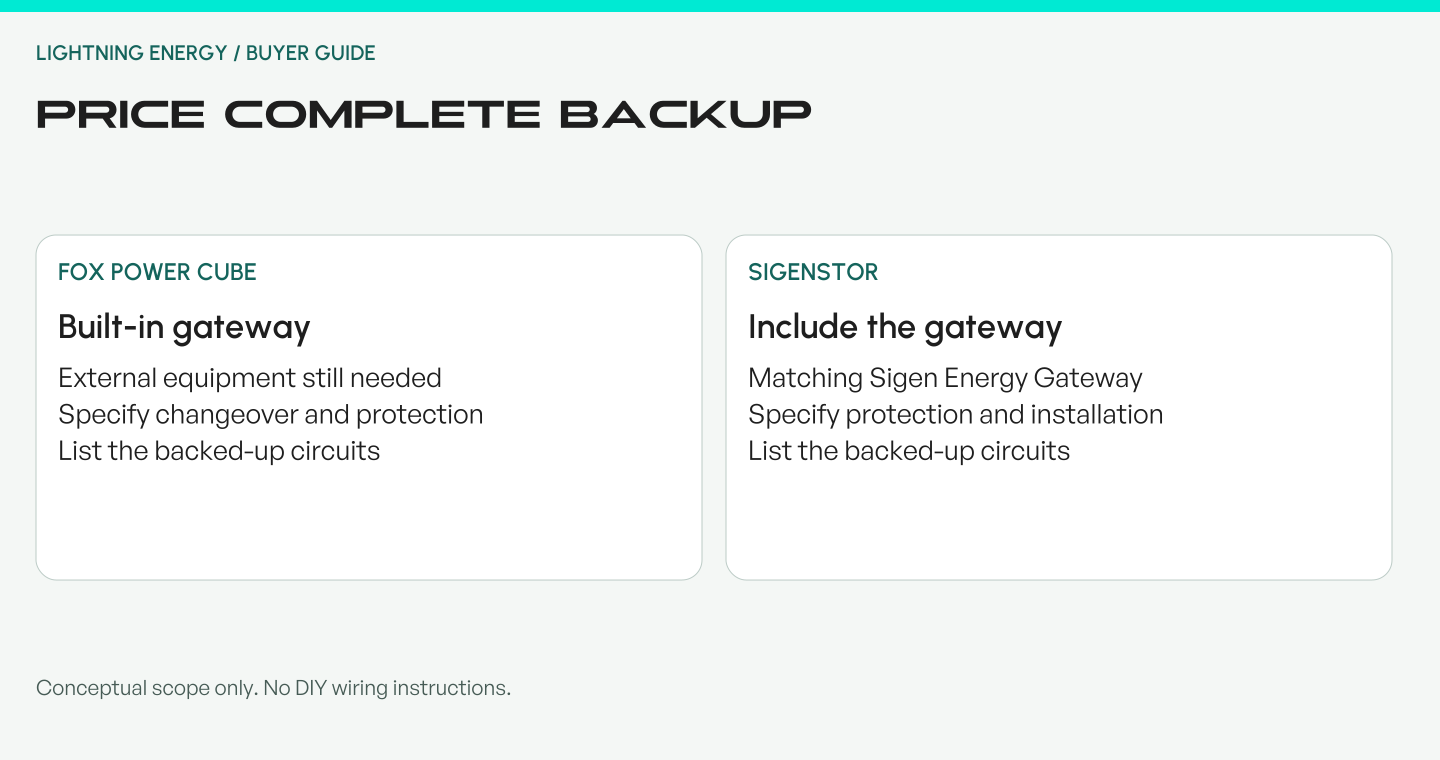
Fox describes a built-in gateway for Power Cube. Its Australian whole-home backup manual still requires external changeover equipment. The installer must specify the complete arrangement and which circuits it supplies.
For SigenStor backup, the matching Sigen Energy Gateway is part of the system design. A quote for a controller and battery stack alone leaves out an important part of the backup comparison.
Ask both suppliers for a circuit schedule, the supported starting loads and the work needed at the switchboard. Include protection, changeover equipment and commissioning in the installed price.
The selected Fox 5 kW model has a 40 A bypass rating in its model table. The 63 A figure advertised across the range applies to other variants. Neither bypass figure tells you how much battery power is available during an outage.
Both examples are single-phase. They do not establish that three-phase machinery, a three-phase ducted system or every circuit in a three-phase home will run in a blackout.
Use our essential circuits and whole-home backup guide to write the load list before comparing the two offers.
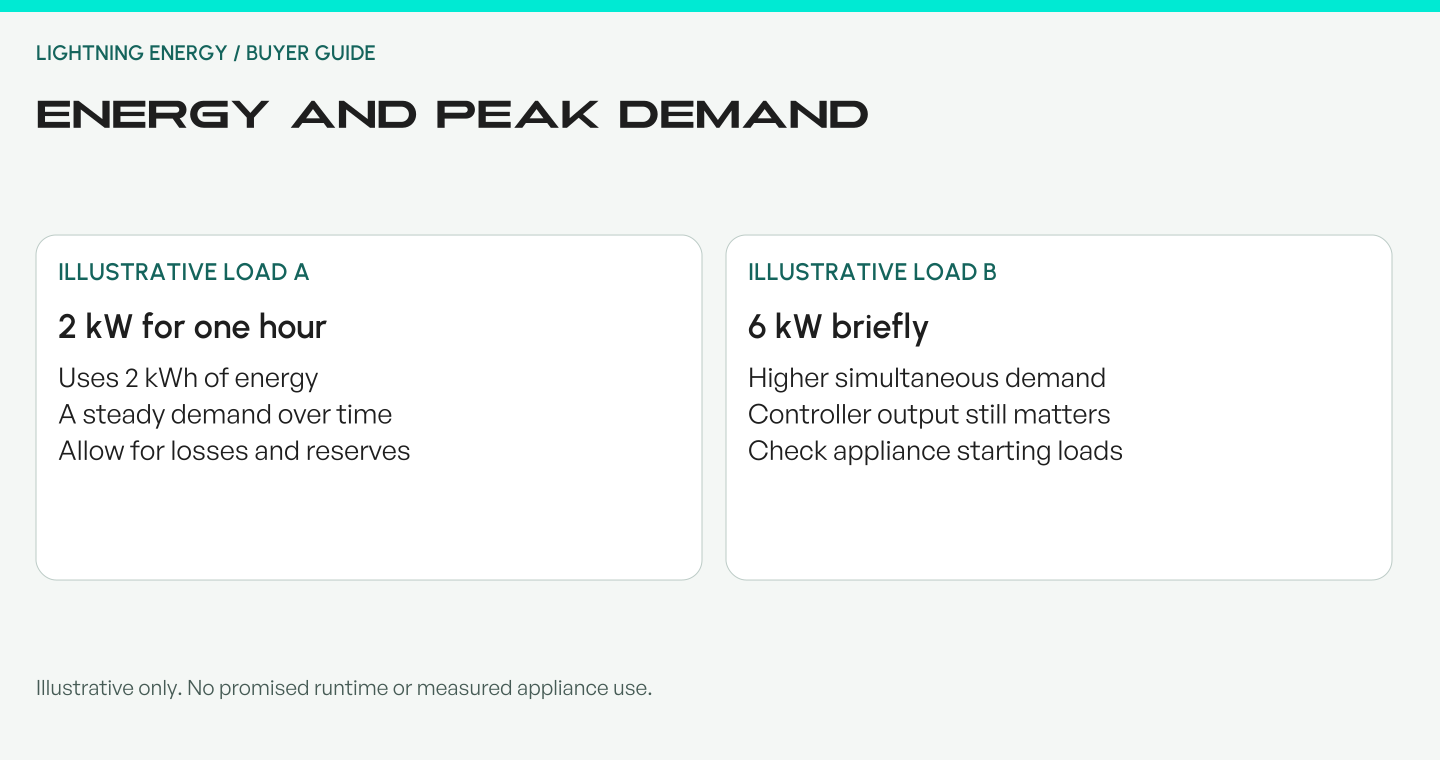
A kettle, induction cooktop and air conditioner can demand substantial power at the same time. A battery can hold enough energy for the evening yet reach the controller’s output limit when several appliances start together.
For illustration only, a steady 2 kW load uses 2 kWh each hour. A short 6 kW load asks for much more instantaneous output. That does not mean the two loads require the same inverter, even if their total energy use later matches.
Actual runtime depends on available charge, reserve settings, conversion losses and changing loads. We have not converted the advertised usable capacities into promised blackout hours.
We also avoid ranking motor-starting capability from headline peaks.
Sigenergy’s linked controller sheet and its 3–6S package give different short-duration peak figures.
Get the applicable dated specification for the equipment being supplied.
Fox’s Australian PQ1 datasheet lists configurations with two to nine EQ5500-S modules, from 10.92 to 49.14 kWh. This is the documented range, not a promise that any existing installation can be expanded without other changes.
The selected three-module Fox stack is listed at 570 mm wide, 380 mm deep and 934 mm high using the stated base height. These are equipment dimensions; installation clearances and access take additional space.
The Fox manual has a specific capacity-expansion procedure, including charge matching and conditions for stored new modules. A licensed installer should assess and perform the addition. Owners should not stack or connect modules themselves.
Sigenergy advertises module-level optimisation and support for mixing old and new batteries.
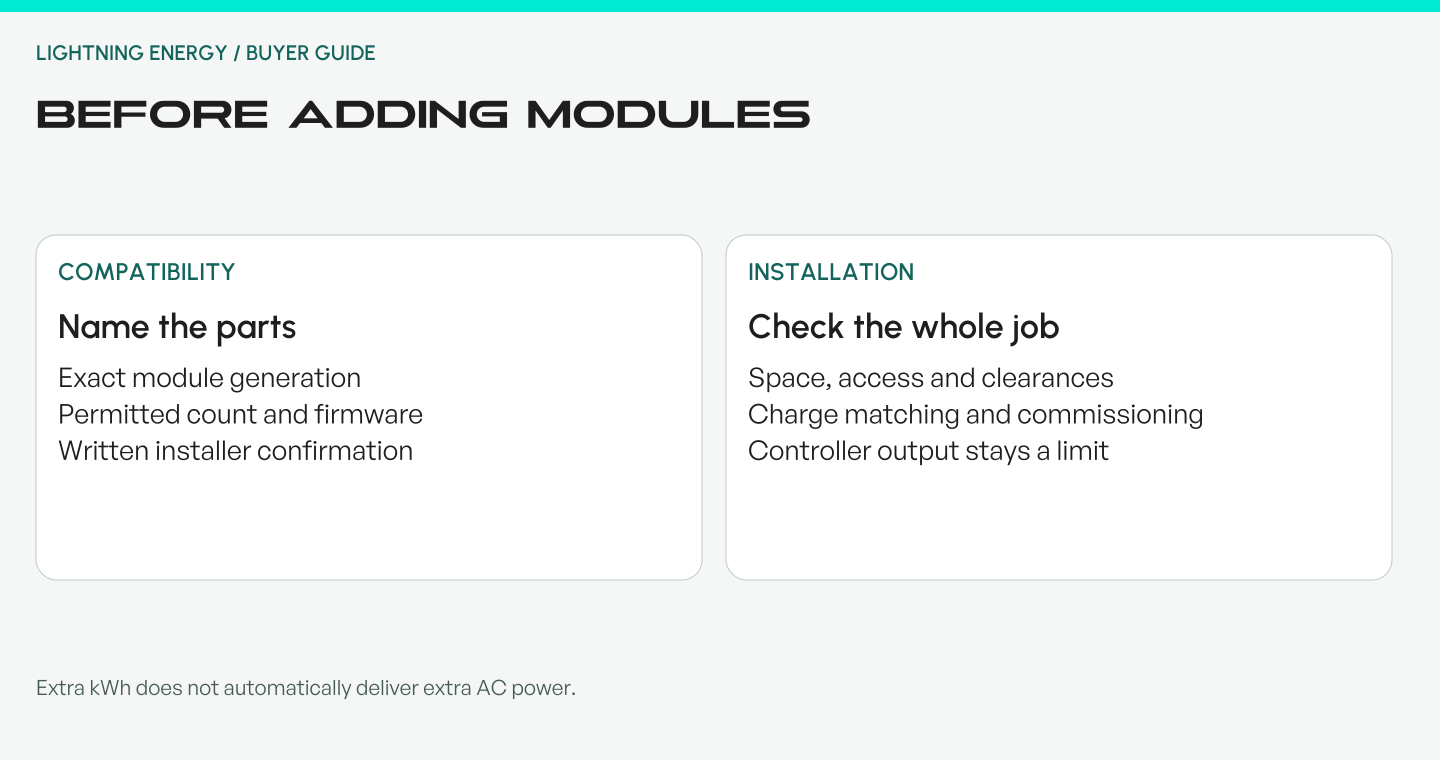
That does not remove the need to confirm the exact installed module generation, supported quantity, firmware and physical layout before ordering an addition.
For SigenStor, ask for the permitted expansion plan for EC 6.0 SP with BAT 8.0 in writing. Do not apply a maximum from a newer battery generation, a three-phase controller or a multi-system installation to this example.
Adding kWh does not automatically increase either controller’s AC output. If the future goal is a larger simultaneous backup load, ask whether the controller and other hardware also need changing.
Our guide to adding battery modules later covers the records to keep from the first installation.
Ask for the Australian warranty applicable to every supplied component and the party handling claims. Product cover, capacity retention, throughput limits, internet conditions and labour costs are separate questions.
This article does not rank warranty strength from a headline number of years. Keep the dated policy supplied with the equipment, proof of purchase and commissioning records, and request written expansion conditions.
The Clean Energy Regulator’s Sigenergy recall notice identifies certain single-phase 8, 10 and 12 kW controllers.
Those are not the 6 kW controller used here.
Check the actual model and serial number against current instructions before purchase.
A register listing is also not a guarantee of retailer stock, network permission or an individual household’s rebate eligibility. Confirm those separately for the installation date.
Power Cube offers an integrated gateway architecture and a documented EQ5500-S capacity ladder. Its appeal depends on the complete backup installation, the chosen inverter rating and whether the stack fits the available space.
SigenStor offers a separately specified gateway and a modular system architecture.
In this example, its nominal controller output is higher, while the usable storage is slightly lower.
Compare the full installed scope before judging the difference.
If optional EV DC charging is part of a SigenStor quote, price and assess it separately. It is not included in the example above, and future vehicle-to-home capability should not be assumed.
See the broader Fox Power Cube Australian guide.
Bring both equipment schedules and recent electricity bills to a Lightning Energy quote assessment.
Fox references: Australian PQ1 datasheet, version 6.0, 13 October 2026.
Power Cube Australian manual: backup scope and capacity expansion requirements.
Sigenergy references: Australian controller datasheet.
Also checked: SigenStor, Energy Gateway.
Also see the CEC battery register.
Safety reference: CER Sigenergy recall notice.
Cover photograph: Fox ESS Australia installation, shown as brand context.
It depicts an H3 Smart and EQ4800 installation, not the Power Cube configuration compared here.
Interior graphics explain the selected systems; no installation tests are claimed.
Available times
Book a consultation and we'll map solar, storage, hot water, and the rebates around your bills and your goals.
Question 1 of 6
