
Is Home EV Charging Safe? Australian Charger, Circuit and Weather Checks
Check the charger, circuit, outdoor rating and cable arrangement before charging an EV at home. Know when damage or flood exposure means you must stop.
Check the charger, circuit, outdoor rating and cable arrangement before charging an EV at home. Know when damage or flood exposure means you must stop.

You've bought the EV, or you're close.
The headlines make the car sound like the risky part.
Source and editorial check: 27 November 2026. This guide uses published information; it is not a hands-on test or a report of a customer installation.
A quiet overnight charge at home should not feel like a gamble.
It does not have to.
Safe charging depends on the vehicle, compatible equipment, the electrical installation and how you use it.
The circuit, charger and cable deserve a proper assessment.
EV battery fires make the news because they look dramatic, and because they are harder work for firefighters than a petrol-car fire when they do happen.
The government’s EV fire-safety fact sheet explains that thermal runaway can require a difficult emergency response.
Fire and Rescue NSW also notes that a damaged high-voltage battery may ignite hours, days or even weeks after the first incident.
That is why the stories stick.
It is not a picture of everyday home charging.
The same fact sheet, and the Australian Government's energy.gov.au EV facts page, say EV battery fires are rare. energy.gov.au also says EVs are much less likely to catch fire than petrol and diesel vehicles.
Neither page is a promise that a fire can never happen.
Rare, and well managed, is the right way to read it.
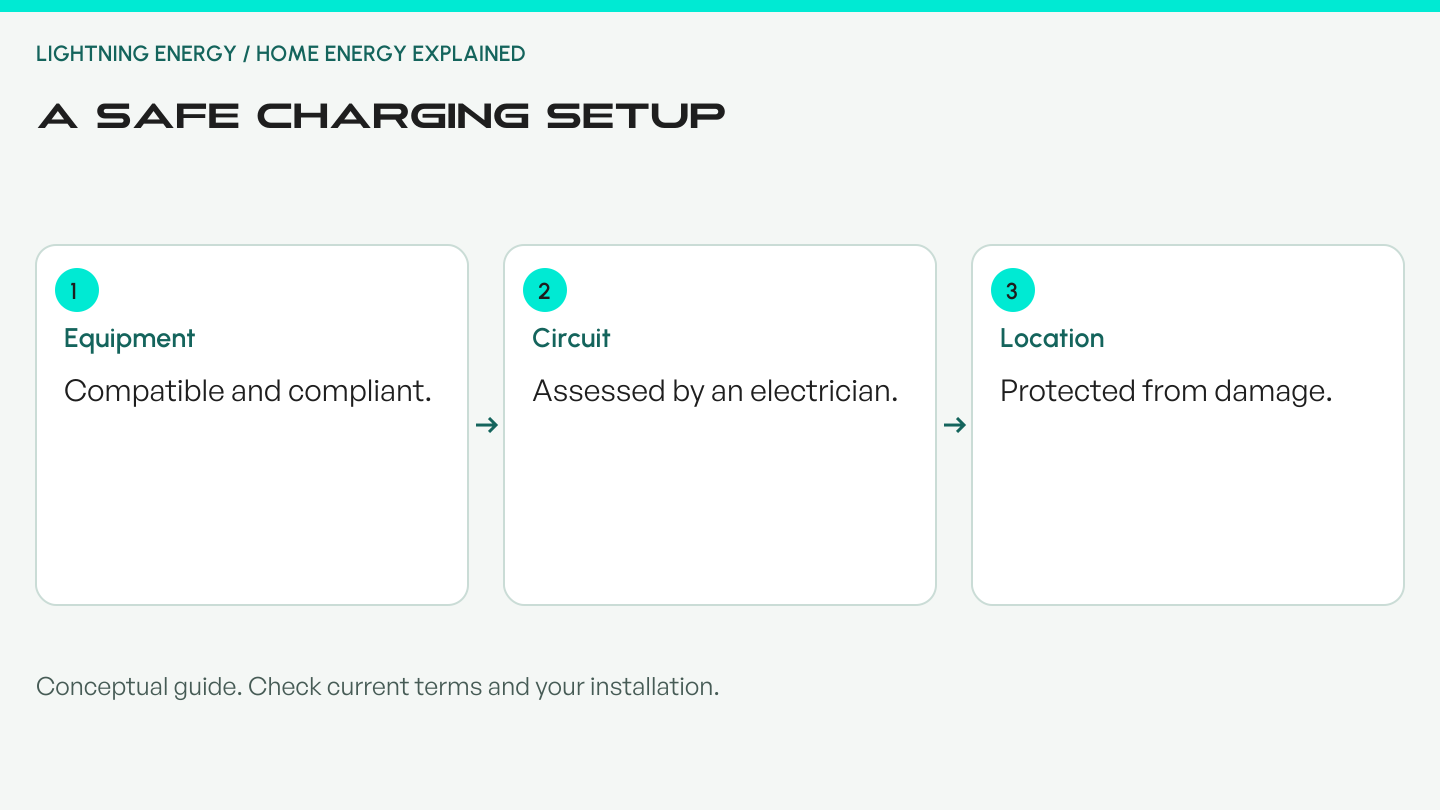
Outdoor charging equipment must suit its location and be used within the manufacturer’s instructions.
The Electric Vehicle Council installation guideline discusses weather protection and the relevant wiring guidance.
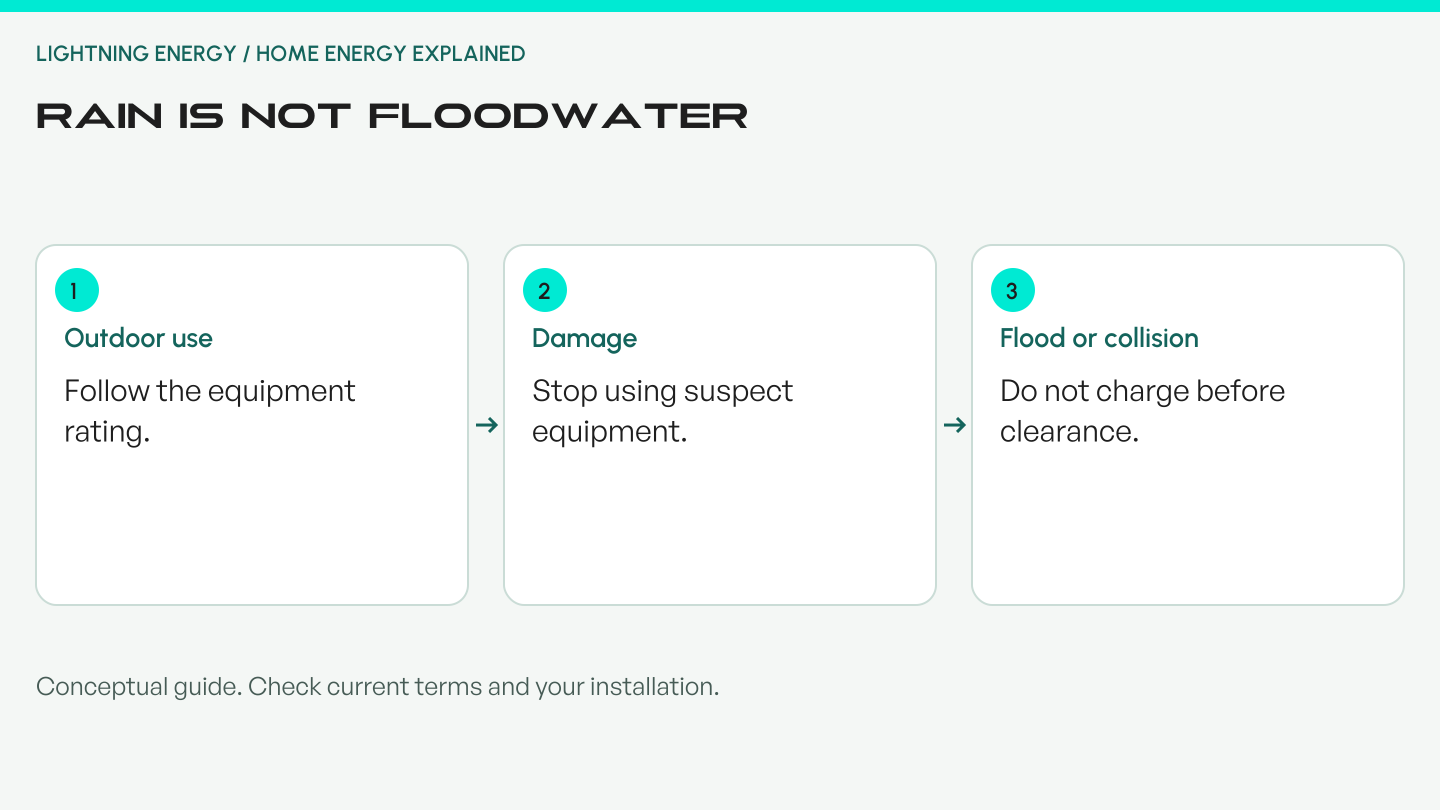
An IP rating alone is not permission to use damaged equipment or charge in floodwater.
Floodwater is a different problem.
Fire and Rescue NSW says you should not charge an EV that has been immersed in floodwater, or involved in a collision or hit by road debris, until a qualified technician has inspected and cleared it.
If the car has been through a flood or a fire, get that advice before you plug it back in.
Check both the vehicle and charging setup.
Wet conditions, damaged connectors, flood exposure and unsuitable equipment all deserve attention.
A compatible portable Mode 2 charger can be used with a suitable power point under its manufacturer’s instructions.
It does not require the user to be an electrician.
For regular charging, have a licensed electrician assess the outlet and circuit.
Victorian Government guidance recommends checking the installation rather than assuming an old shared circuit can support prolonged charging.
Do not stretch the reach with an ordinary household extension lead or a double adapter.
Those fittings are not a proper workaround when the cable will not reach the car.
Energy Safe Victoria advises against piggybacking adapters, and against using ordinary extension leads in wet areas unless they are designed for that purpose.
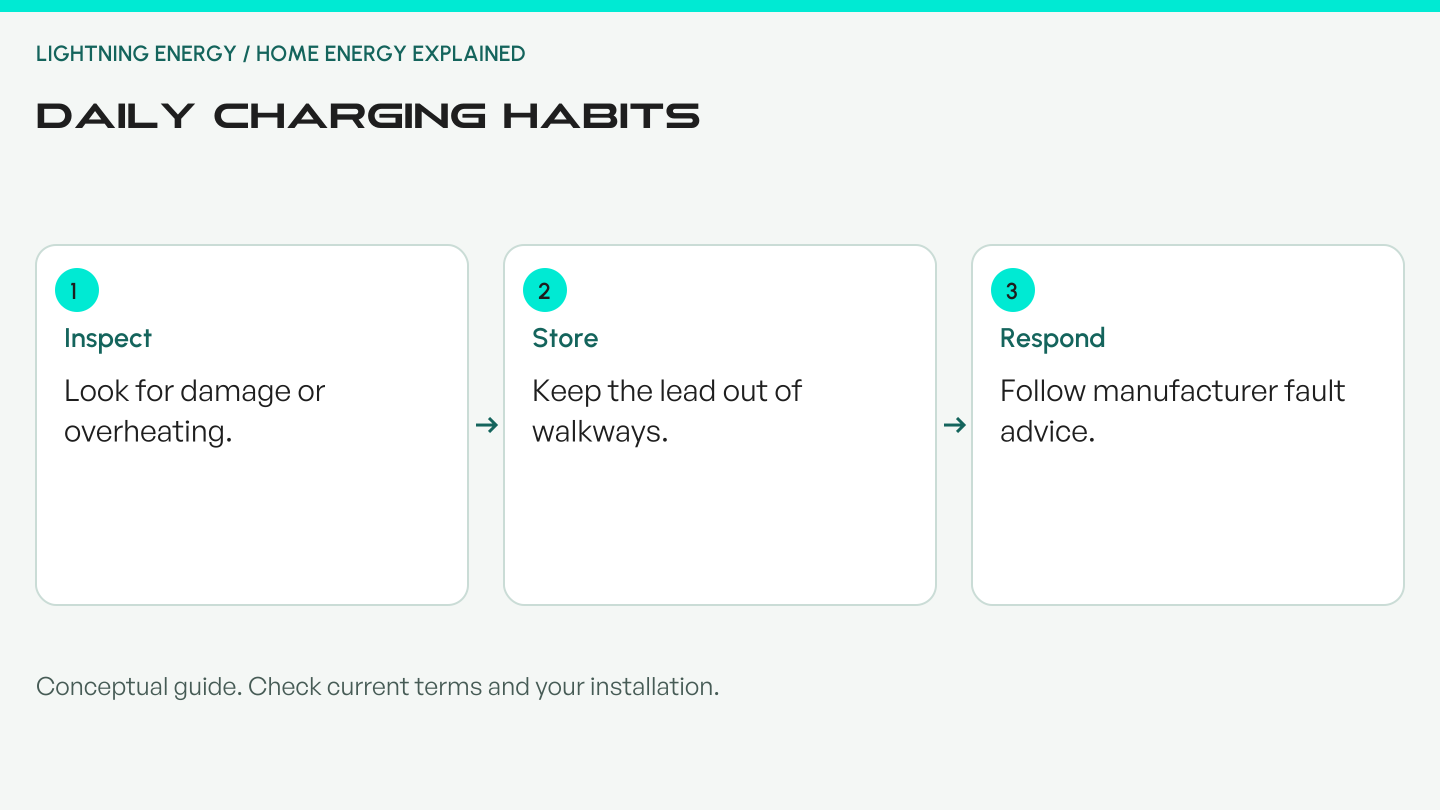
A damaged cable, a hot or discoloured power point, or a lead across the path you walk at night, is something to fix, not something to live with.
A fixed wall charger has to be installed by a licensed electrician.
Look for the Regulatory Compliance Mark (RCM) on the charger.
The Vehicle Emissions Star Rating fact sheet says you should only install electrically compliant home charging equipment that carries that mark.
Here is what a proper installer or quote shows before the charger goes on the wall.
Use them to compare offers, and to get the job done once.
A proper quote starts with the board you already have.
It shows whether there is space and capacity for a charger circuit, and whether other planned loads, such as a home battery, a heat pump or a second car, belong in the same plan.
Our post on whether your switchboard has room for an all-electric home is a related read.
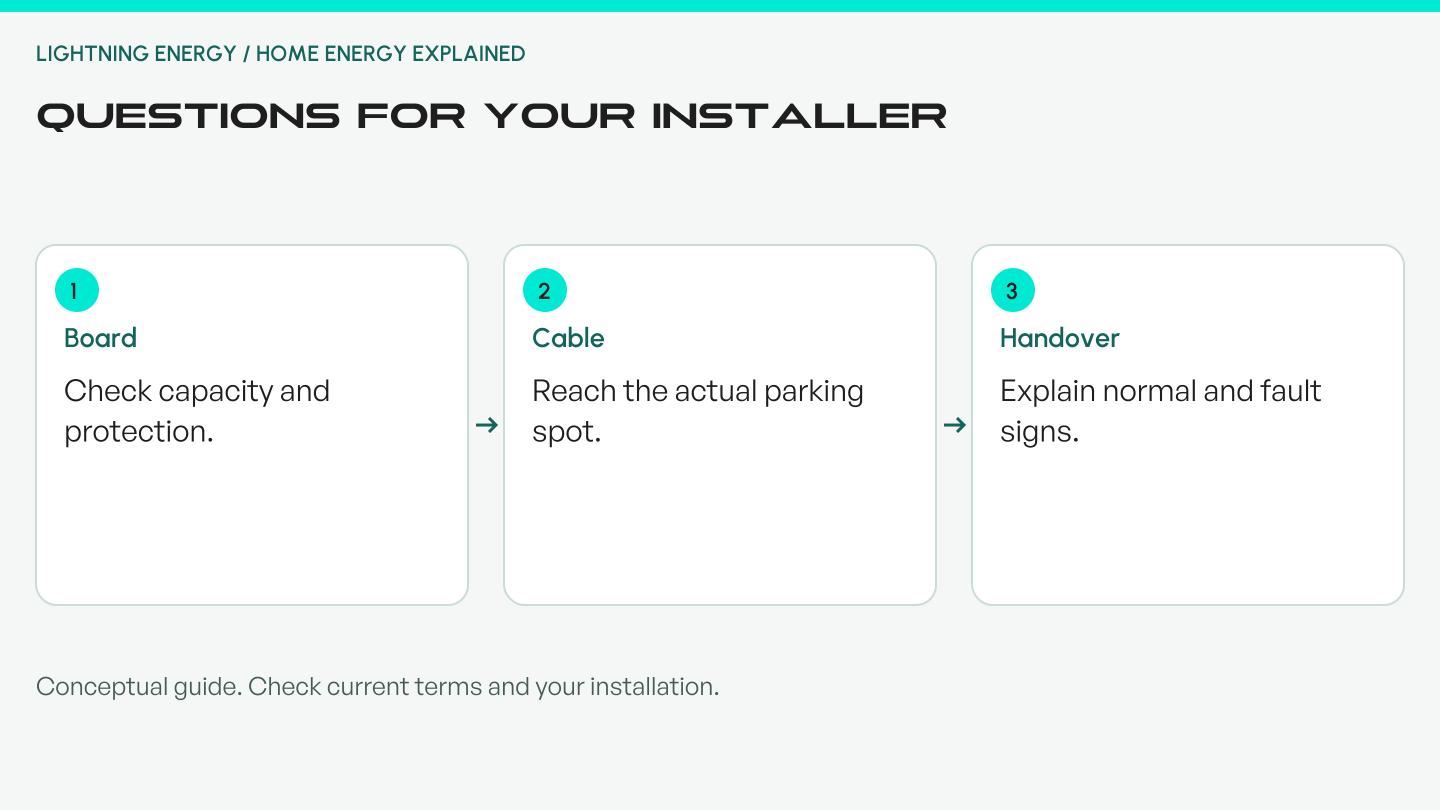
Wiring-rules guidance in AS/NZS 3000, and the Electric Vehicle Council's installation guideline, is that a wall charger should be on its own circuit, with a residual current device (RCD, or safety switch) of the type the charger requires.
No other outlets or appliances should be hanging off that circuit.
The electrician sizes the cable and protection to the rules and the manufacturer's instructions.
A proper quote names a compliant charger and a mounting position that reaches the charge port in the way you actually park, including when you reverse in.
Cable reach is a daily habit, not a brochure measurement.
Our guide to where a home EV charger should go covers that in more detail.
If you are choosing between charger sizes, start with what 7 kW and 22 kW actually mean for a home.
A proper install gives the cable a hook or holder, keeps it off the ground when it is not in use, and does not leave it as a trip hazard across the path.
It also leaves you a way to check the cable for damage.
Fire and Rescue NSW recommends a smoke alarm or a heat alarm in a private garage where an EV is regularly parked or charged.
A proper quote, or the setup that follows it, shows how you will tell the charger or the car when to charge.
Solar in the middle of the day, or off-peak at night, is the straightforward way to run the car without adding to the evening peak.
Victoria's energy department makes the same point: charge when power is cheaper, or from your own solar.
Our post on EV charging and home battery priorities is a starting point if solar or a battery is already in the plan.
If you are fitting a fixed charger, check with your insurer whether it needs to be noted on the policy.
Cover varies, and that is a question for your insurer, not a claim about any particular policy.
Follow the vehicle and charger instructions, keep equipment in good condition and respond to warnings.
Stop using a damaged or overheating charger and arrange qualified help.
A suitable installation and clear handover make everyday charging easier to manage.
Sources are linked beside the relevant claims. Electrical work and equipment selection should follow current state requirements and manufacturer instructions.
Cover: existing Lightning Energy site photography used for product or solar context. It does not identify a customer or installation location.
Available times
Book a consultation and we'll map solar, storage, hot water, and the rebates around your bills and your goals.
Question 1 of 6