
Melbourne Rental Air Conditioning: Plan for the March 2027 Rules and VEU Discounts
Melbourne landlords: check the March 2027 heating and cooling triggers, existing-system rules, efficiency evidence and VEU support before arranging an upgrade.
Melbourne landlords: check the March 2027 heating and cooling triggers, existing-system rules, efficiency evidence and VEU support before arranging an upgrade.

Melbourne rental providers should plan heating and cooling upgrades before March 2027, but the rules do not require every functioning air conditioner to be replaced on the same day.
The trigger depends on the existing equipment and the rental agreement.
Build an equipment record now, identify the applicable requirement, then obtain a compliant design and a separate VEU assessment. This avoids ordering a system before understanding what the property actually needs.
Rules and sources checked on 22 November 2026. This guide explains the decision process; eligibility and the final installation scope need to be confirmed for your property.
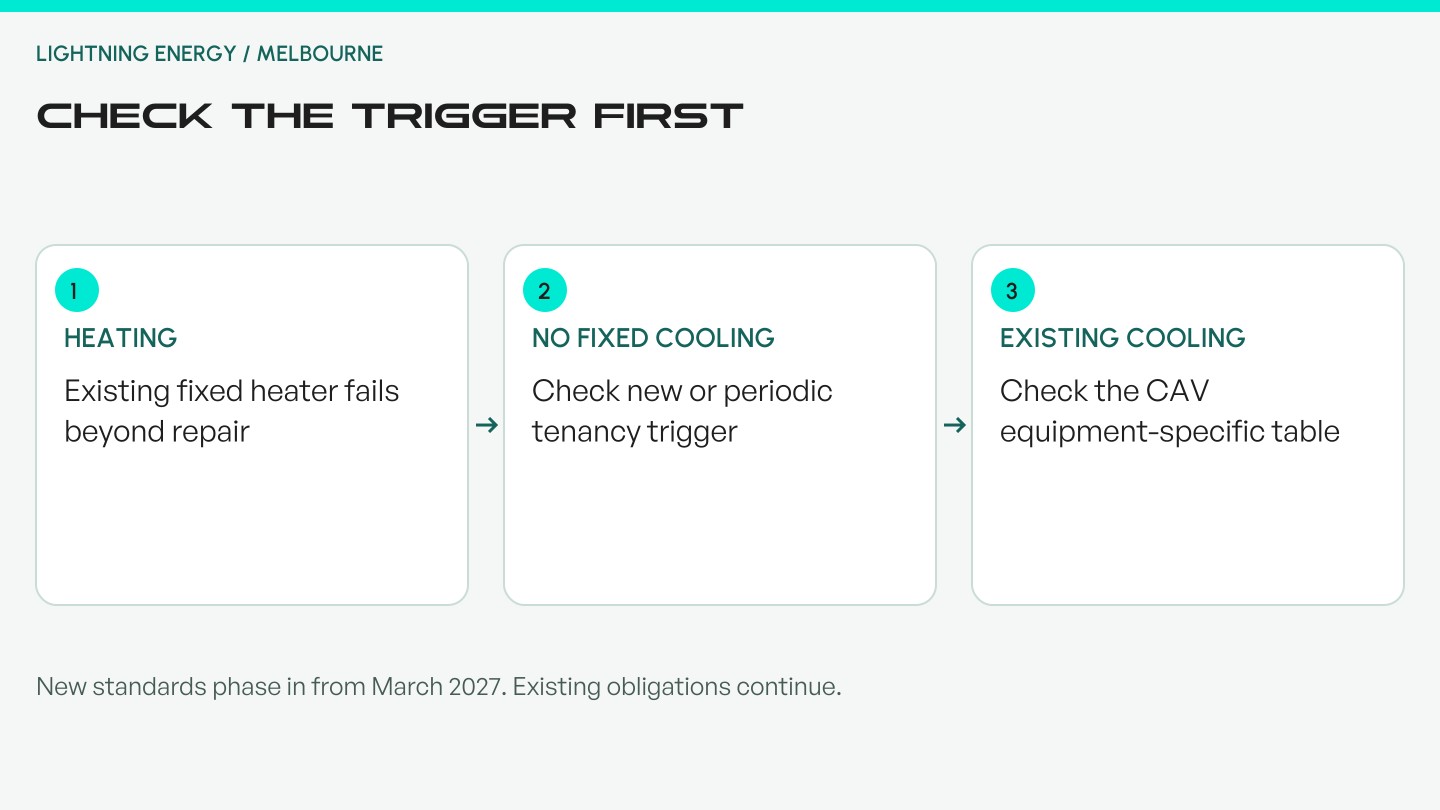
Consumer Affairs Victoria’s guidance says the new standards phase in from 1 March 2027.
Heating replacement is triggered when an existing fixed heater fails and cannot be repaired; an otherwise compliant functioning heater need not be replaced immediately.
For a property without fixed cooling, the cooling requirement applies at a new agreement or conversion to periodic tenancy from March 2027.
Cooling requirements extend across rental properties from July 2030, subject to the applicable rules and exemptions.
See the CAV cooling table.
It addresses properties that already have fixed cooling.
It distinguishes their end-of-life replacement requirements from the no-cooler pathway.
Record the equipment type and condition rather than assuming a new lease always means a new appliance. If the situation is unclear, ask the property manager to check the current CAV guidance against the actual tenancy.
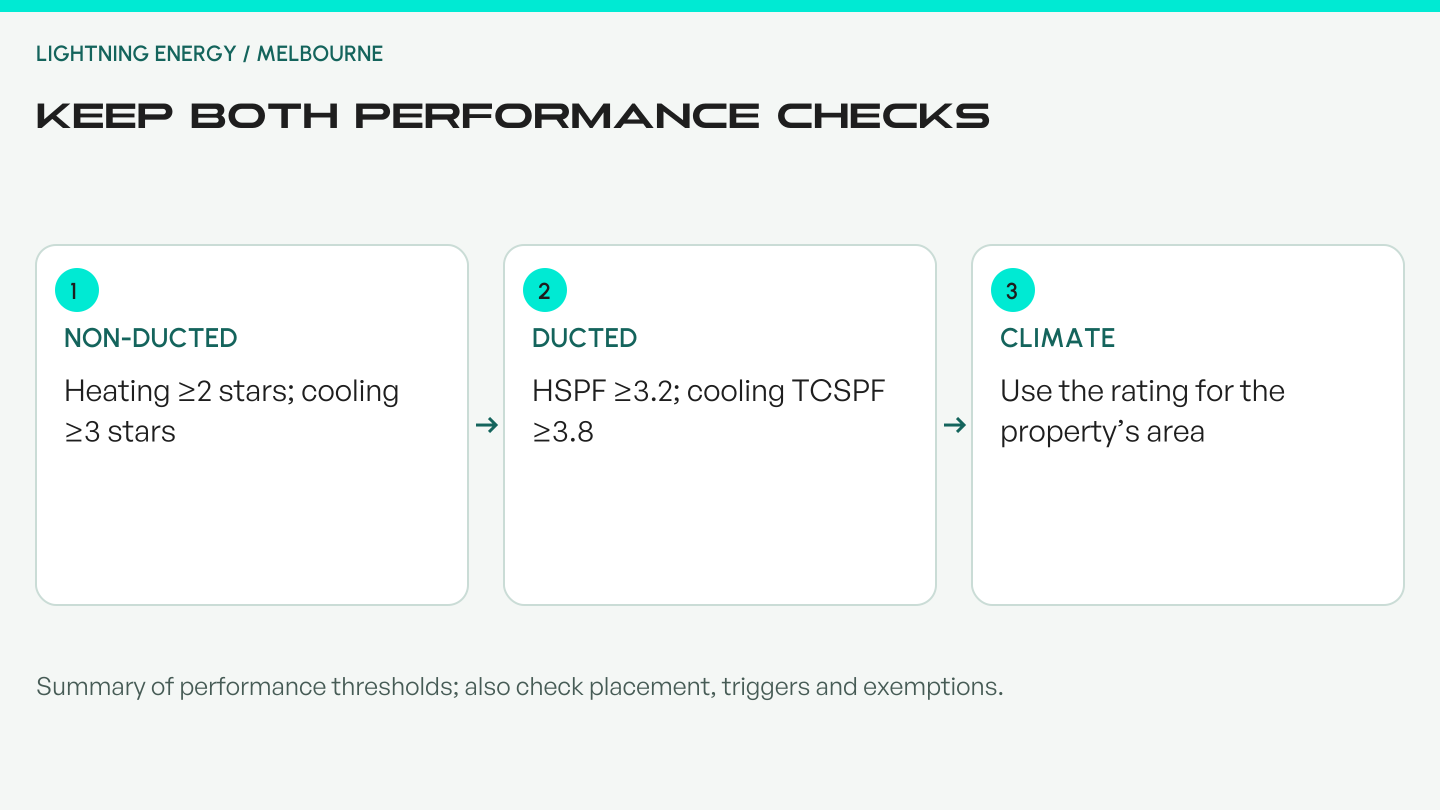
The CAV guidance specifies climate-appropriate performance. For new non-ducted equipment under the standards, the thresholds are at least two heating stars and three cooling stars for the relevant climate area.
Ducted equipment uses seasonal performance factors: heating HSPF of at least 3.2 and cooling TCSPF of at least 3.8. The installer should identify the evidence for the exact equipment supplied.
Do not accept a model-family name as the entire compliance record. Keep the indoor and outdoor model numbers and the relevant rating or product documentation.
A reverse-cycle system may satisfy both heating and cooling requirements. Confirm both performance tests and that the main living area is properly served, rather than assuming any reverse-cycle unit automatically qualifies.
The main-living-area requirement does not mean that every bedroom will be cooled by a unit installed elsewhere. State clearly which rooms the installation is designed to serve.
A landlord may choose broader coverage, but compare that optional scope separately from the required upgrade. This makes the decision clearer for the owner, tenant and property manager.
Ask about controls, noise and maintenance access. A compliant model still needs a suitable installation location and a practical handover.
For apartments or heritage properties, investigate permissions early. Do not assume an exemption applies simply because approval is inconvenient; retain the evidence required for any claimed exemption.
Victoria’s rental-home guidance describes upgrade support.
The amount depends on the existing appliance and the approved replacement.
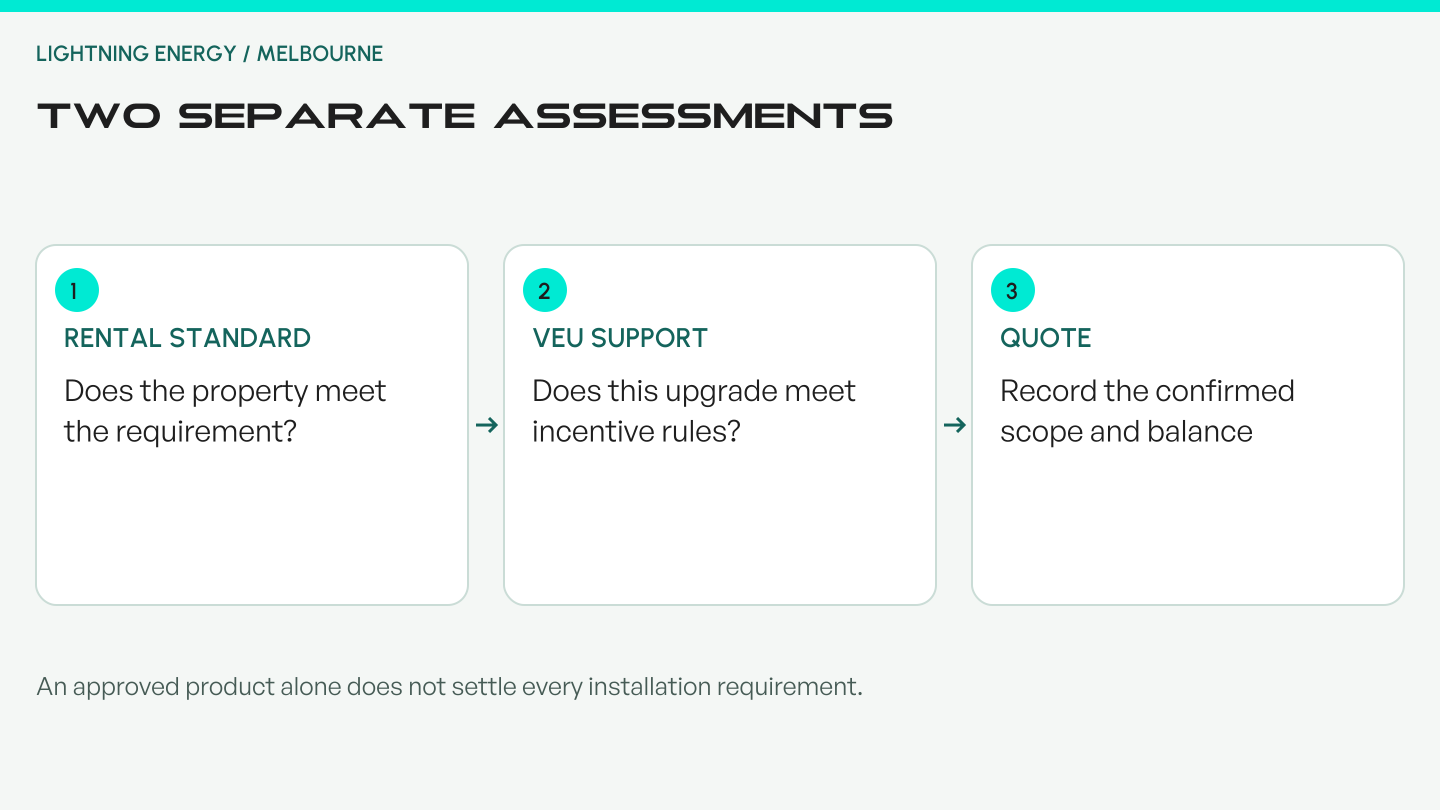
Ask the provider to assess the property before work, including removal and decommissioning where required. Keep the incentive separate from the installation total and any optional room upgrades.
Landlord compliance duties and rebate approval are different processes. A model meeting the rental standard does not, by itself, prove that the complete installation is eligible for an incentive.
If the quote assumes an installation date, record what happens if access or approvals cause a delay. The final offer should make any price-variation conditions clear.
Create an appliance register with the model, location, condition and service history. Add the tenancy milestones that may trigger a cooling upgrade and set a date to review the property.
Ask the property manager to coordinate lawful access and notices. Tell the installer which areas remain occupied and which electrical interruptions need planning.
For a breakdown, obtain a diagnosis explaining whether the unit can be repaired. Keep the service report with the decision to repair or replace rather than relying only on a verbal recommendation.
The new future standards do not suspend existing repair and safety obligations. Deal with a present fault through the applicable rental process rather than waiting for March.
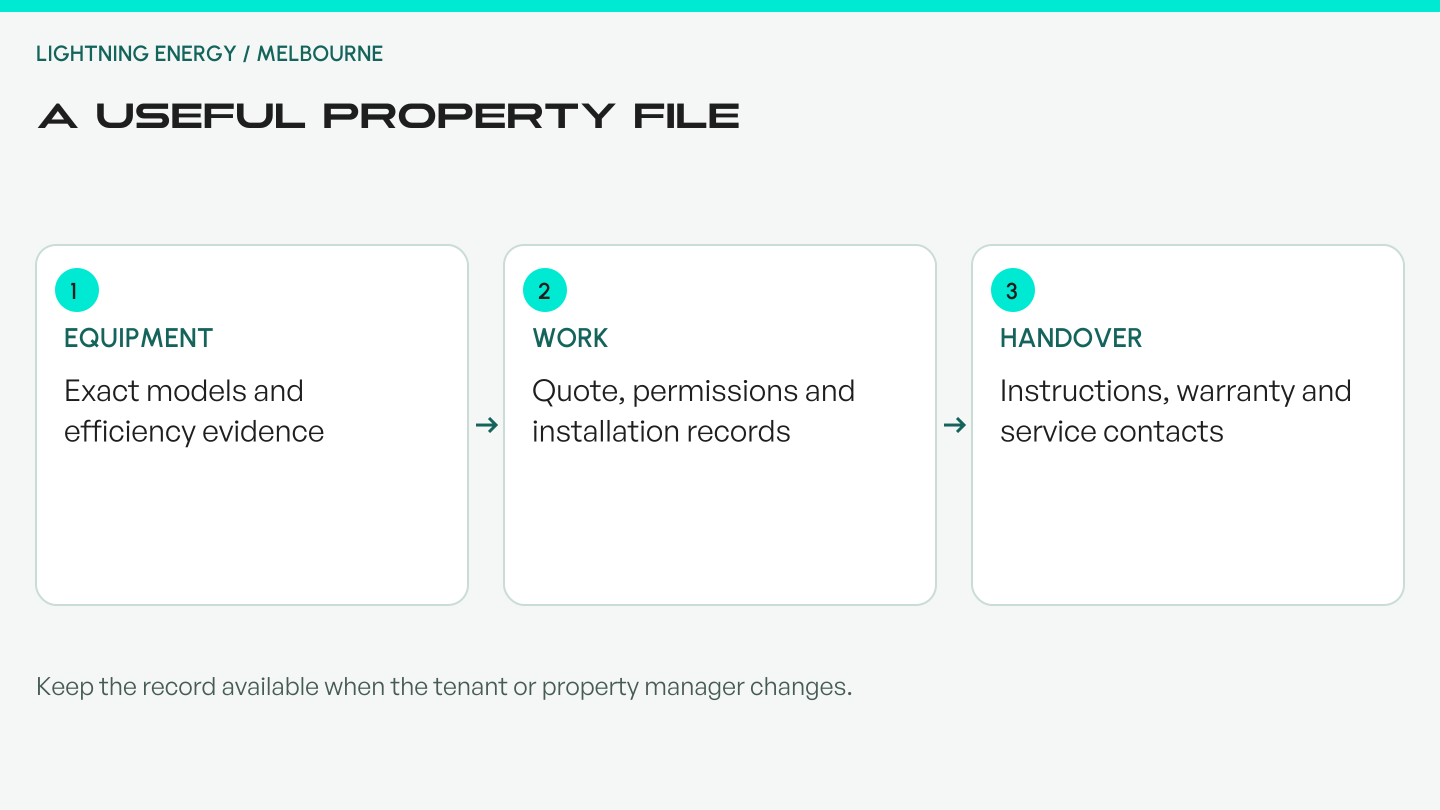
Keep the accepted quote, model schedule, efficiency evidence, installation and electrical records, warranty information and operating instructions. Add the rebate documentation and any permission or exemption evidence.
Ask the installer to show the tenant normal operation and filter care. Clarify who arranges servicing and how faults are reported.
A concise record reduces confusion when the tenancy changes or a different property manager takes over. It also makes future replacement decisions easier to assess.
No. The heating change is generally triggered when an existing fixed heater fails beyond repair. Existing minimum standards still apply; check the property’s actual equipment and obligations.
It may, if the system meets both relevant performance requirements and serves the main living area. Keep the exact model and rating evidence.
Air conditioning in a Victorian rental.
Melbourne apartment approvals.
VEU eligibility and quote checks.
CAV minimum energy efficiency standards.
Victorian rental-home upgrade support.
Cover: existing Lightning Energy website photography, used as installation or home-energy context. The pictured property is not claimed to be in the suburb discussed or to have received a particular incentive.
Diagrams are conceptual guides.
Available times
Book a consultation and we'll map solar, storage, hot water, and the rebates around your bills and your goals.
Question 1 of 6