
SAJ HS3 vs GoodWe ESA: Two All-in-One Batteries Compared for Australia
Compare SAJ HS3 and GoodWe ESA in Australia: 10 kWh configurations, 6 kW output, backup, dimensions, approval checks and the actual warranty conditions.
Compare SAJ HS3 and GoodWe ESA in Australia: 10 kWh configurations, 6 kW output, backup, dimensions, approval checks and the actual warranty conditions.

SAJ HS3 and GoodWe ESA both bring solar conversion and modular battery storage into a compact home-energy system. Choosing between them means checking the exact Australian equipment, backup design and warranty conditions.
This comparison uses Australian manufacturer documents checked on 22 November 2026. It is desk research, not a hands-on test, a stock confirmation or an installed-price ranking.
The SAJ example is HS3-6K-S2-W-P2-AU with two BU3-5.0-TV1-PRO-AU modules. SAJ’s Australian datasheet lists 10 kWh usable storage and 6 kW rated on-grid output for this single-phase configuration.
The GoodWe example is GW6K-EHA-G20 with two GW5.1-BAT-D-G20 modules. Its Australian datasheet gives 10 kWh usable storage, from 10.24 kWh nominal energy, and 6 kW nominal on-grid output.
Matching usable storage and nominal inverter output makes the starting comparison fairer. It does not make the systems interchangeable: their installation dimensions, operating limits and warranty tests still differ.
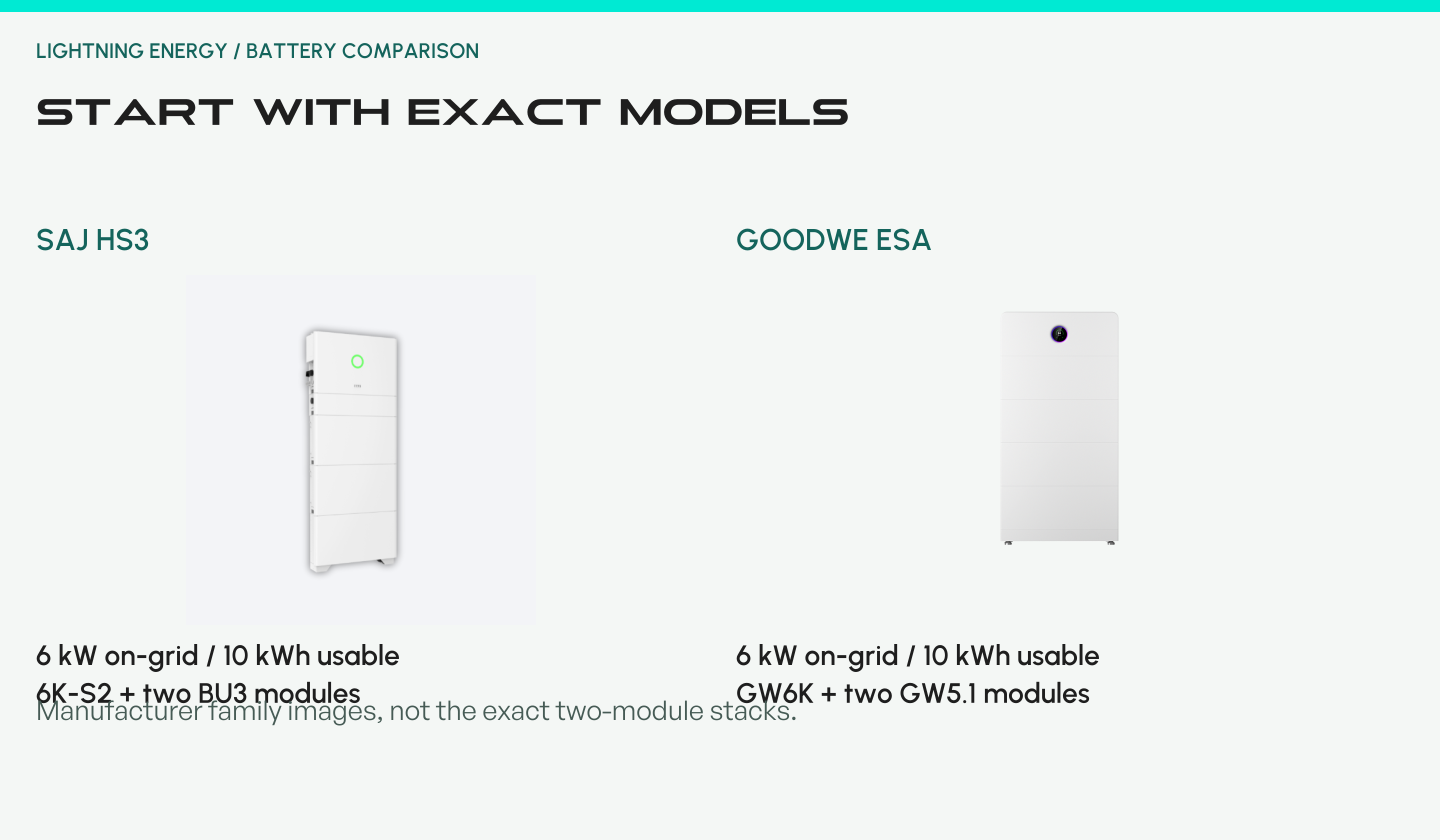
Our current CEC search found the GoodWe GW6K-EHA-G20 inverter and GW5.1-BAT-D-G20 battery module. We did not find the exact SAJ-branded HS3 example in the battery register.
The register returned similar HS3 names under AMBRION, with an AUS suffix. Those entries must not be treated as approval for a SAJ-labelled AU model. Brand, model suffix and the equipment actually supplied matter.
For SAJ, request the current matching approval entry before committing to a rebate-dependent installation. The comparison below describes SAJ’s Australian documentation; it does not establish approval or local stock for that example.
For either brand, the installer must check current approvals, network requirements and household eligibility for the installation date. A manufacturer datasheet alone cannot settle these questions.
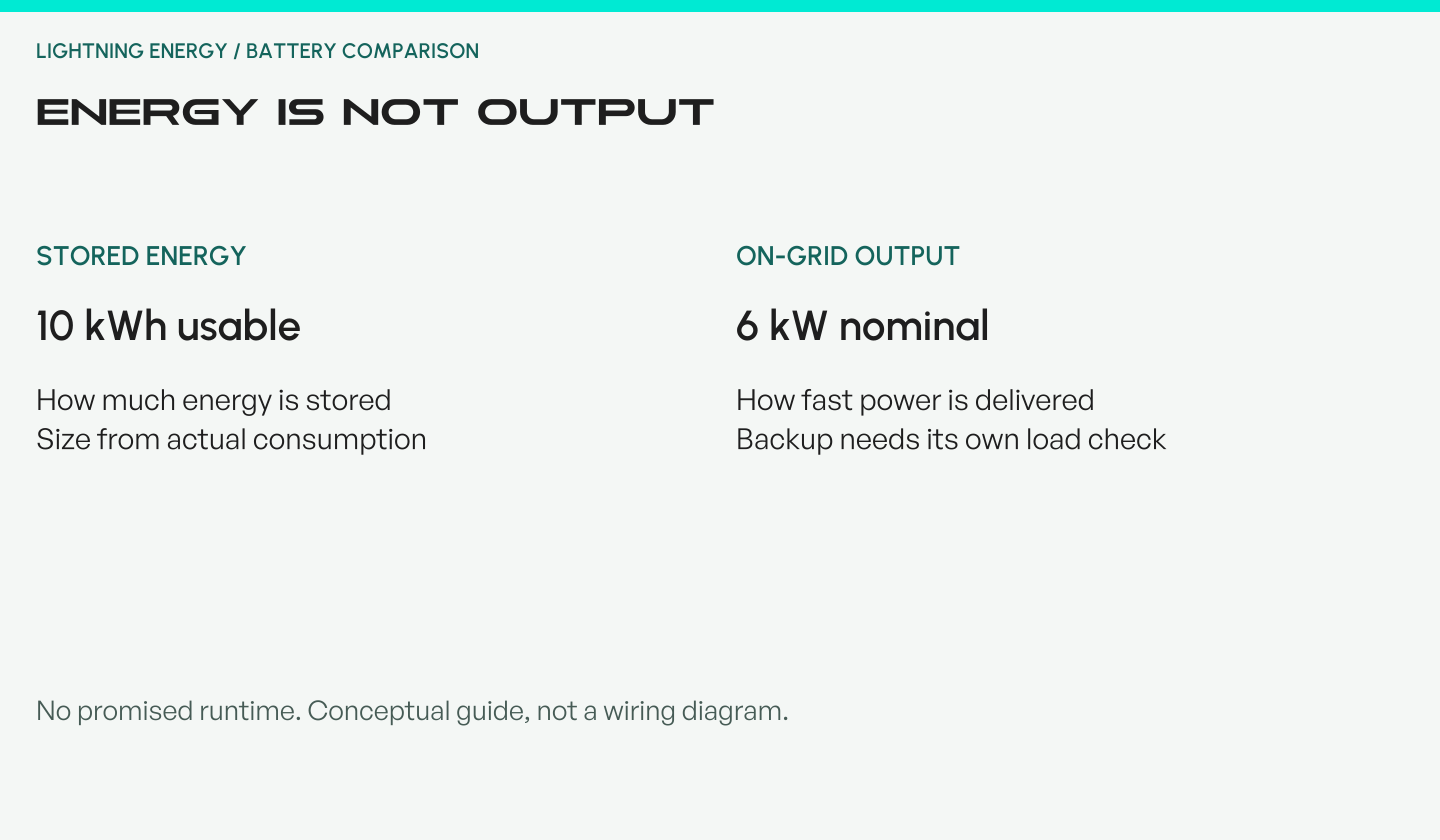
A 10 kWh battery figure describes energy. The 6 kW inverter figure describes active power. The first helps size storage for the evening; the second helps assess appliances operating at the same time.
SAJ specifies 6,000 W rated backup output for this model. GoodWe specifies 6,000 VA nominal backup apparent power. Watts and volt-amperes are not interchangeable for every appliance load.
GoodWe’s 6 kW inverter table lists maximum battery charging and discharging powers of 9 kW and 6.6 kW respectively. These DC-side limits are not a promise of 9 kW grid charging or 6.6 kW continuous AC backup.
SAJ specifies a 380–500 V battery operating range, with maximum charge and discharge currents of 15.8 A and 16.8 A for the 6 kW model. A variable voltage and a current limit do not give one fixed operating power.
Ask the installer to confirm the actual charge and discharge limits for the selected stack, settings and operating conditions. Temperature, available charge and the connected loads can affect delivery.
Use interval data before deciding that 10 kWh is the right size. Our battery sizing guide explains the process.
A larger stack does not automatically increase the inverter’s AC output. Equally, an inverter’s brief peak rating is not its continuous output and cannot guarantee that a particular motor will start.
Ask for the backed-up circuit list, required changeover equipment and switchboard work. Our blackout backup guide helps frame those questions.
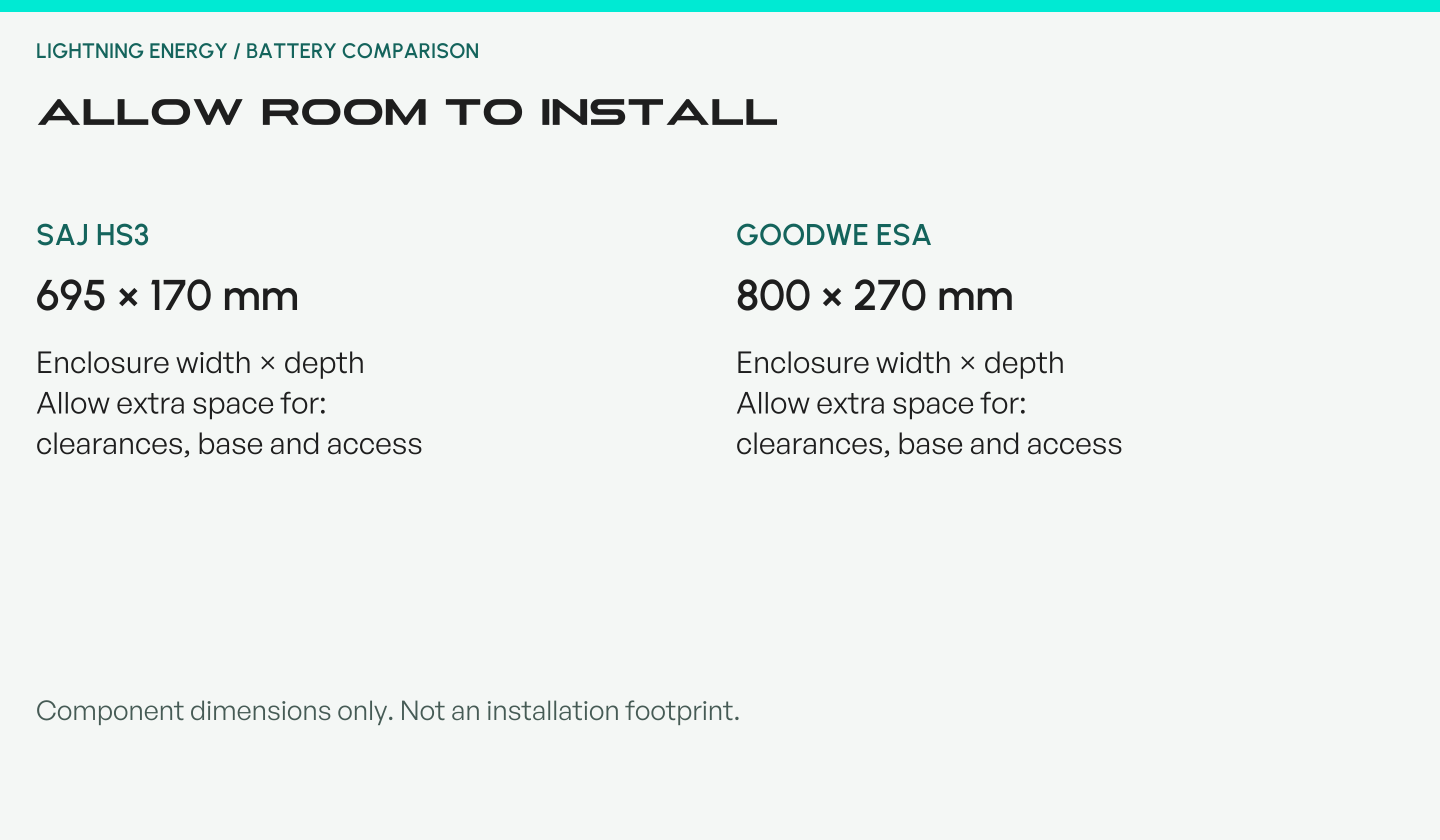
SAJ lists the inverter enclosure at 695 mm wide and 170 mm deep, with the same width and depth for its battery modules. GoodWe lists 800 mm width and 270 mm depth for the selected inverter and modules.
On those enclosure dimensions, SAJ is narrower and shallower. That is useful for a tight site, but it does not prove the complete installation fits. Bases, mounting arrangements, clearances and access still need assessment.
Ask for a dimensioned site plan rather than approving a location from a product photograph. Both future expansion and access for replacement should be included in the plan.
Before adding modules later, confirm the compatible generation, supported quantity and commissioning procedure.
Keep the equipment schedule and use our battery expansion checklist.
SAJ’s Australian HS3/AS3 policy provides a standard 10-year product warranty, starting at the earlier of first installation or six months after production. Meters and other accessories have two-year standard cover.
Its battery performance promise is 60% of nominal energy until the earliest of 10 years from commissioning, 126 months from shipment, or 6,000 charge-discharge cycles, subject to the policy’s test conditions.
SAJ requires registration and an internet connection for full cover. Its policy says offline or unregistered systems retain at least 5.5 years from shipment; contact the distributor if an internet outage lasts a month or more.
The policy offers a paid five-year extension. Do not describe 15 years as the standard warranty or assume an extension has been purchased without its certificate.
GoodWe’s Australian inverter warranty, revision 6.0 dated 11 November 2026, lists 10-year cover for the single-phase ESA 3–10 kW range. An older ESA model’s warranty should not be substituted.
The applicable Lynx D G2 battery policy provides 10-year product cover and a separate performance promise: 70% of usable energy for 10 years or the minimum throughput, whichever comes first.
For these modules, GoodWe specifies 3 MWh throughput per usable kWh. That corresponds to 30 MWh for the selected 10 kWh stack. The performance terms also specify one full cycle per day.
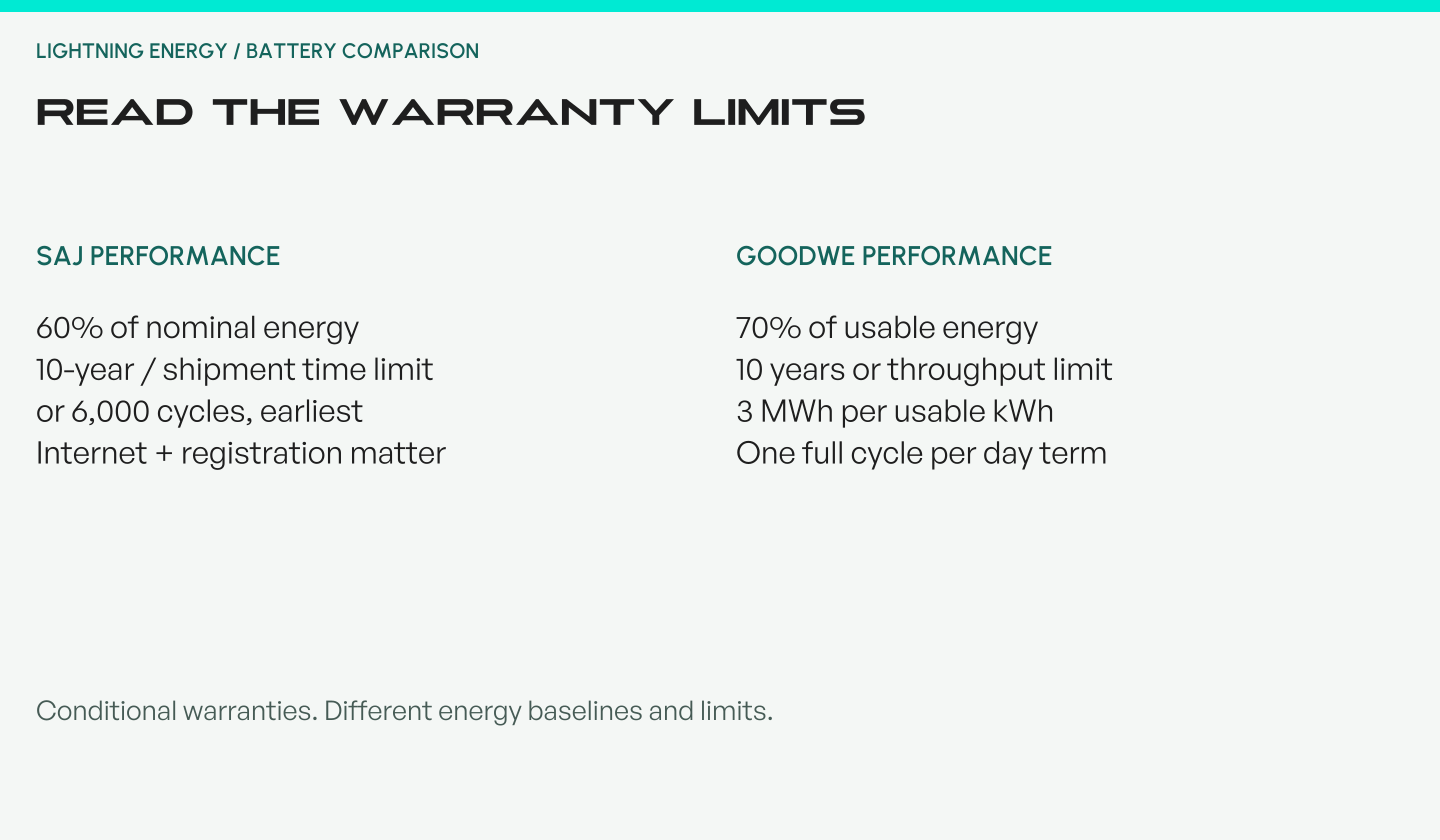
The percentages use different baselines and limits. They are minimum contractual promises under stated conditions, not forecasts of how either battery will perform in your home.
Ask who handles a claim, what evidence is needed and which labour or transport costs are covered. Keep purchase, serial-number and commissioning records. Both policies recognise Australian Consumer Law rights.
SAJ’s slim enclosure is worth investigating where space is constrained. First resolve the exact Australian approval, supplied model and local support arrangements; a similarly named system does not answer those questions.
GoodWe’s selected inverter and module have matching register entries in our check. Its wider, deeper enclosure still needs a site assessment, and its warranty requires more than comparing a percentage and a number of years.
Neither example includes a promised vehicle-to-home or vehicle-to-grid capability.
SAJ’s broader family marketing uses inconsistent AC/DC charger descriptions; ask for the exact Australian accessory documentation before including EV functions.
We have not assigned a price winner without comparable installed offers. Compare the same usable capacity, backup circuits, electrical work, monitoring and support scope, with any incentive assumptions shown separately.
See our GoodWe ESA overview, then bring the equipment schedules and interval data to a Lightning Energy quote assessment.
SAJ Australian single-phase HS3 datasheet.
SAJ HS3/AS3 Australian warranty, linked from SAJ’s global warranty index.
GoodWe Australian ESA datasheet, version 2.1, 1 November 2026.
GoodWe Australian warranty downloads: inverter revision 6.0 and Lynx D G2 battery revision 1.1 were checked for this comparison.
CEC batteries and CEC inverters, checked 22 November 2026.
Cover: existing Lightning Energy website rooftop-solar photograph, used as home-energy context. Product images: SAJ and GoodWe official websites, illustrating their product families. No customer installation or hands-on testing is claimed.
Available times
Book a consultation and we'll map solar, storage, hot water, and the rebates around your bills and your goals.
Question 1 of 6
