
Tesla Powerwall 3P Australia: What the 15 kW Datasheet Really Says
Tesla Powerwall 3P has an Australian datasheet. Understand its qualified 15 kW output, DC Expansion capacity, backup design and still-unconfirmed launch timing.
Tesla Powerwall 3P has an Australian datasheet. Understand its qualified 15 kW output, DC Expansion capacity, backup design and still-unconfirmed launch timing.

Tesla's Australian Powerwall 3P documentation gives three-phase households something more useful than a teaser: a basis for asking better design questions.
The headline output deserves attention, but so do the footnotes. A 15 kW label does not mean the battery will deliver 15 kW from stored energy in every condition.
This is a desk-researched follow-up checked on 3 November 2026. We have not installed or tested Powerwall 3P. Our earlier Australian launch guide covers the broader announcement.
Tesla's Australian support page still says Powerwall 3P is not available here and gives no release date or price. Published technical documents are not a delivery commitment.
Luke has received an inside-source expectation of an Australian arrival by the end of 2026. That is unconfirmed information, not an announcement from Tesla or a promised installation date.
If an existing battery has failed, do not make your household's backup plan depend on that expectation. Compare a suitable system available now with the practical cost of waiting.
The AU/NZ datasheet qualifies 15 kW operation: it requires sufficient solar and ambient temperature at or below 25°C. Without solar, or above that temperature, output is limited to up to 11.5 kW.
Further temperature derating can apply. Your configured output and network approval also matter. Ask for the rating that applies to your proposed installation, not just the largest number in a brochure.
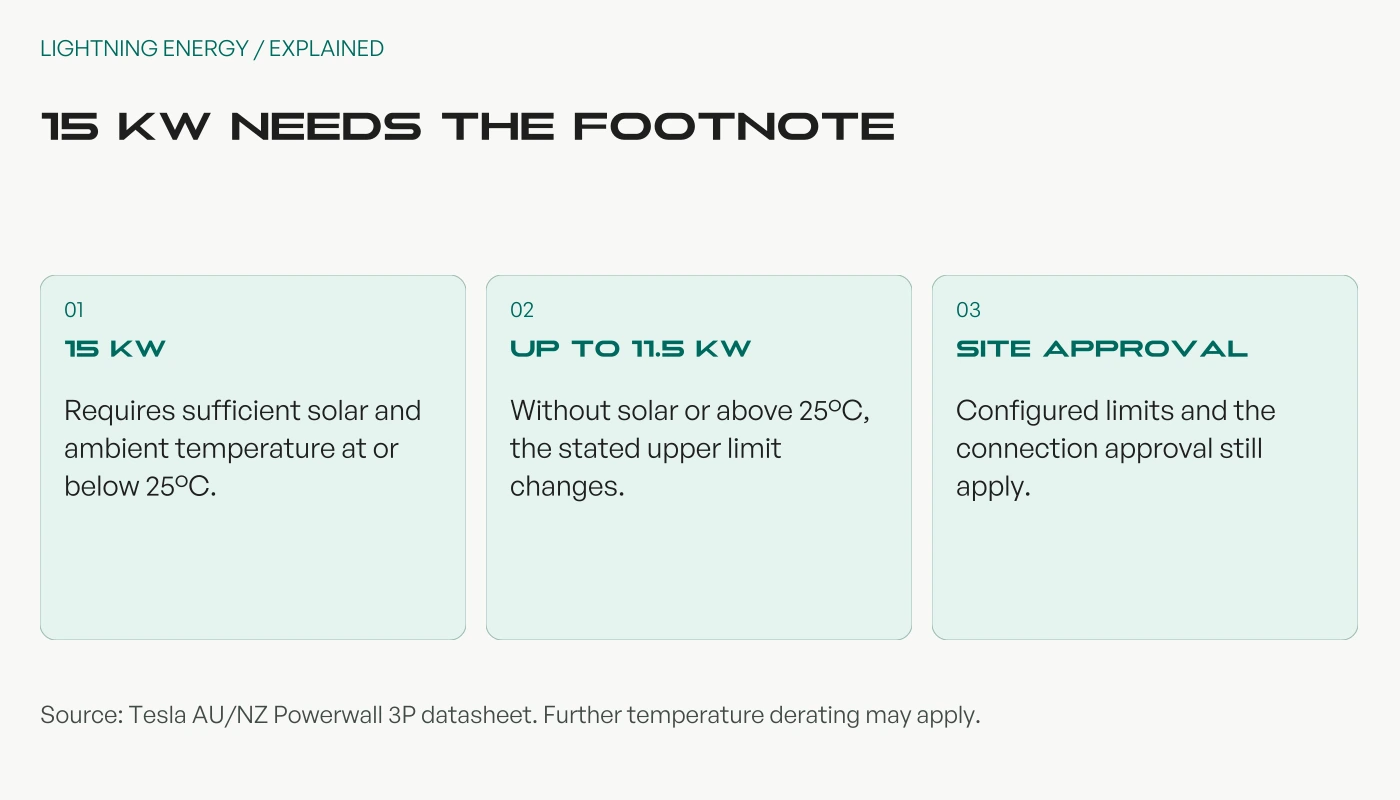
A useful quote should distinguish daytime operation with solar from an evening outage. The energy source and operating conditions change, even though the equipment on the wall looks the same.
For a clearer starting point, read our explanation of battery kW versus kWh.
The datasheet lists 13.5 kWh of usable AC energy for the host and support for up to three 13.5 kWh Expansion units. That gives up to 54 kWh with one Powerwall 3P host.
Expansion units add storage without adding their own AC inverter. More capacity can extend running time; it does not simply multiply the home's available output power.
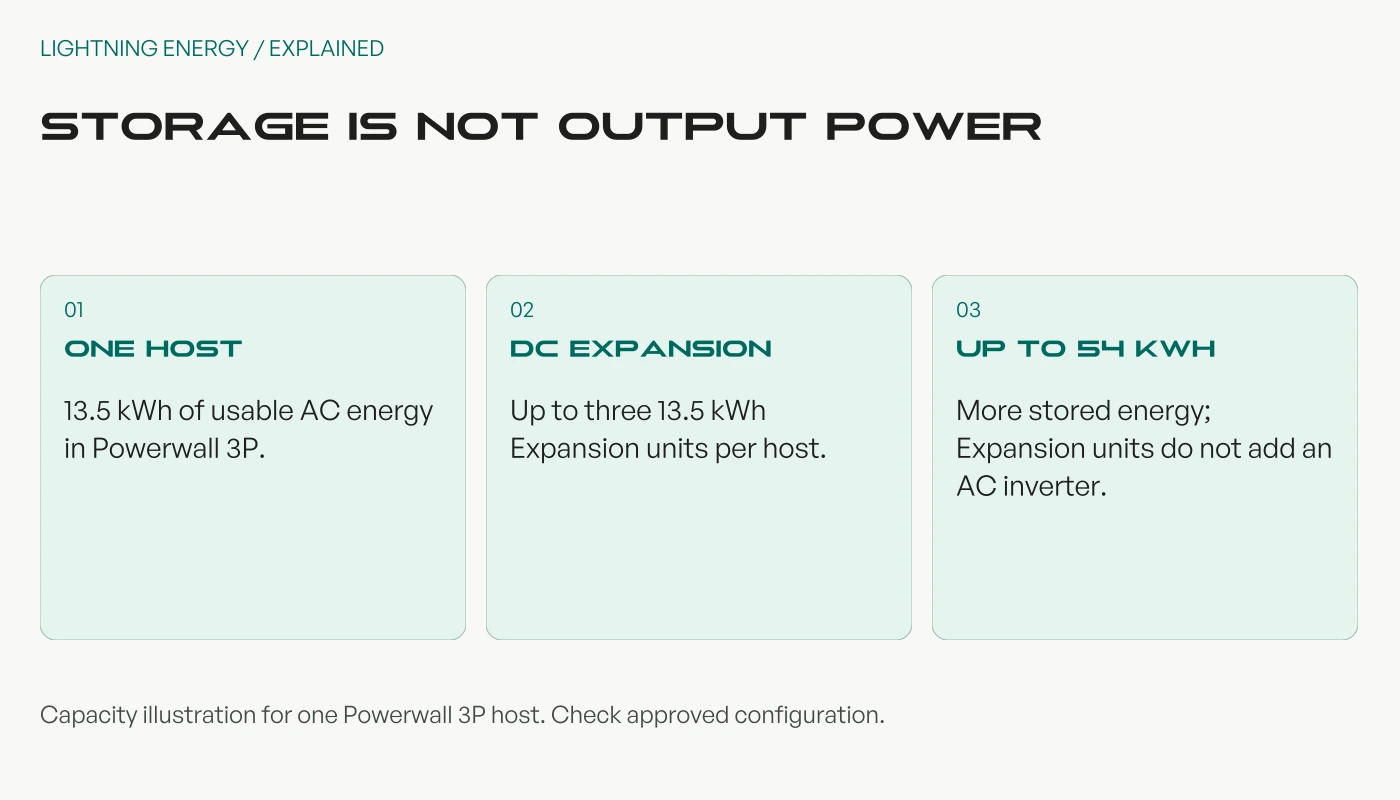
Start with the energy your household uses after solar production falls. Then examine whether the system can regularly refill that capacity from the available solar or an appropriate electricity plan.
A large battery left mostly unused is not automatically a better purchase. Equally, a small battery supporting a large overnight load may leave you importing electricity sooner than expected.
Our Tesla Powerwall product guide explains how the current Powerwall 3 and DC Expansion options differ from the upcoming 3P.
Powerwall 3P is designed for three-phase supply, and Tesla documents Backup Gateway 2 support. That does not remove the need to check individual loads and the installed backup arrangement.
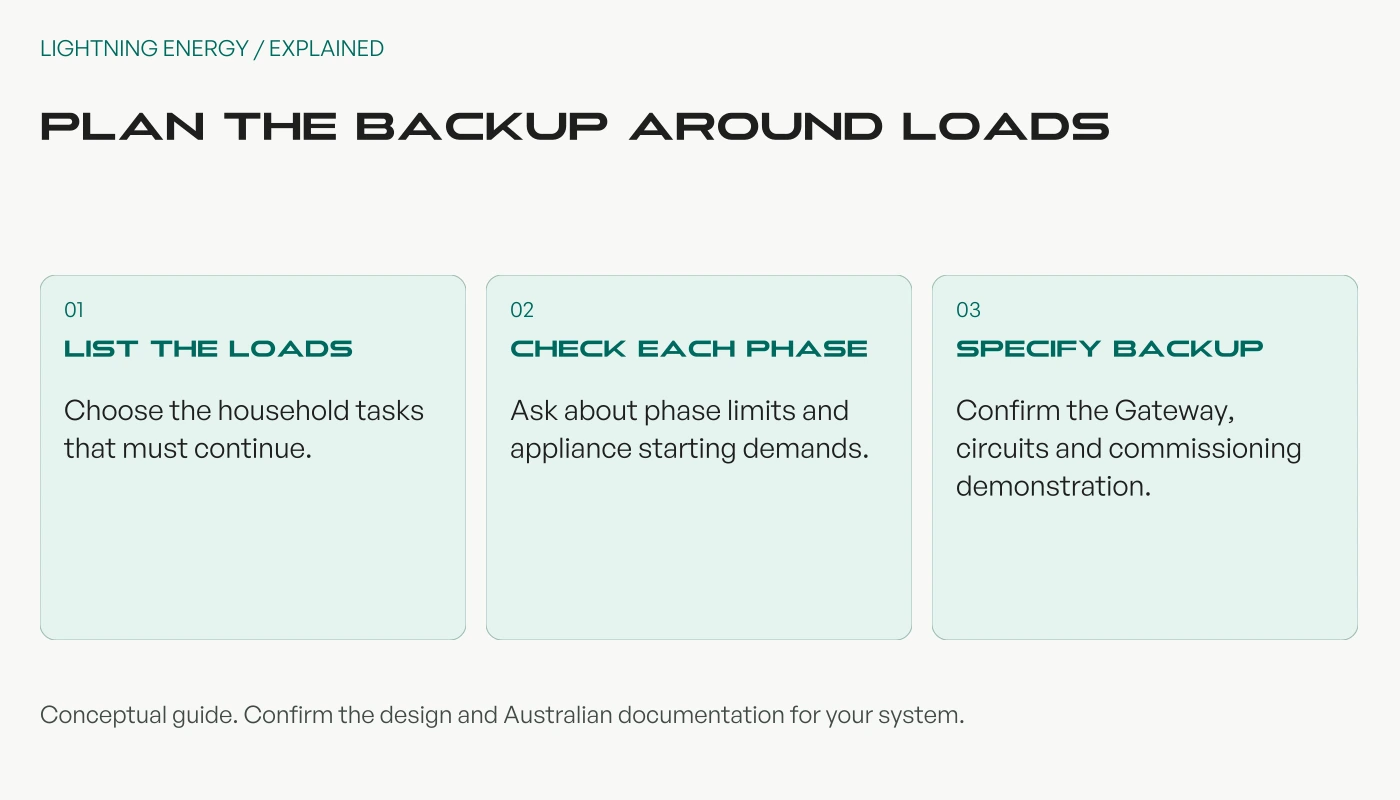
Ask your designer to account for cooking, heating, pumps and any other large loads. An appliance's starting demand can matter as much as its normal running demand.
Agree which tasks should continue in an outage and which can wait. Charging an EV during a prolonged outage, for example, competes with other household uses of the stored energy.
Use our blackout backup planning guide to prepare that conversation. This is a planning exercise, not an instruction to alter your switchboard.
Tesla explicitly says Powerwall 3P is not compatible with Powerwall 2 or Powerwall 3. Do not confuse this with Tesla's separate support for certain mixed Powerwall 2 and Powerwall 3 systems.
An existing Tesla owner needs a written system-level proposal. A shared app or familiar product name does not establish that two generations can operate together in the intended configuration.
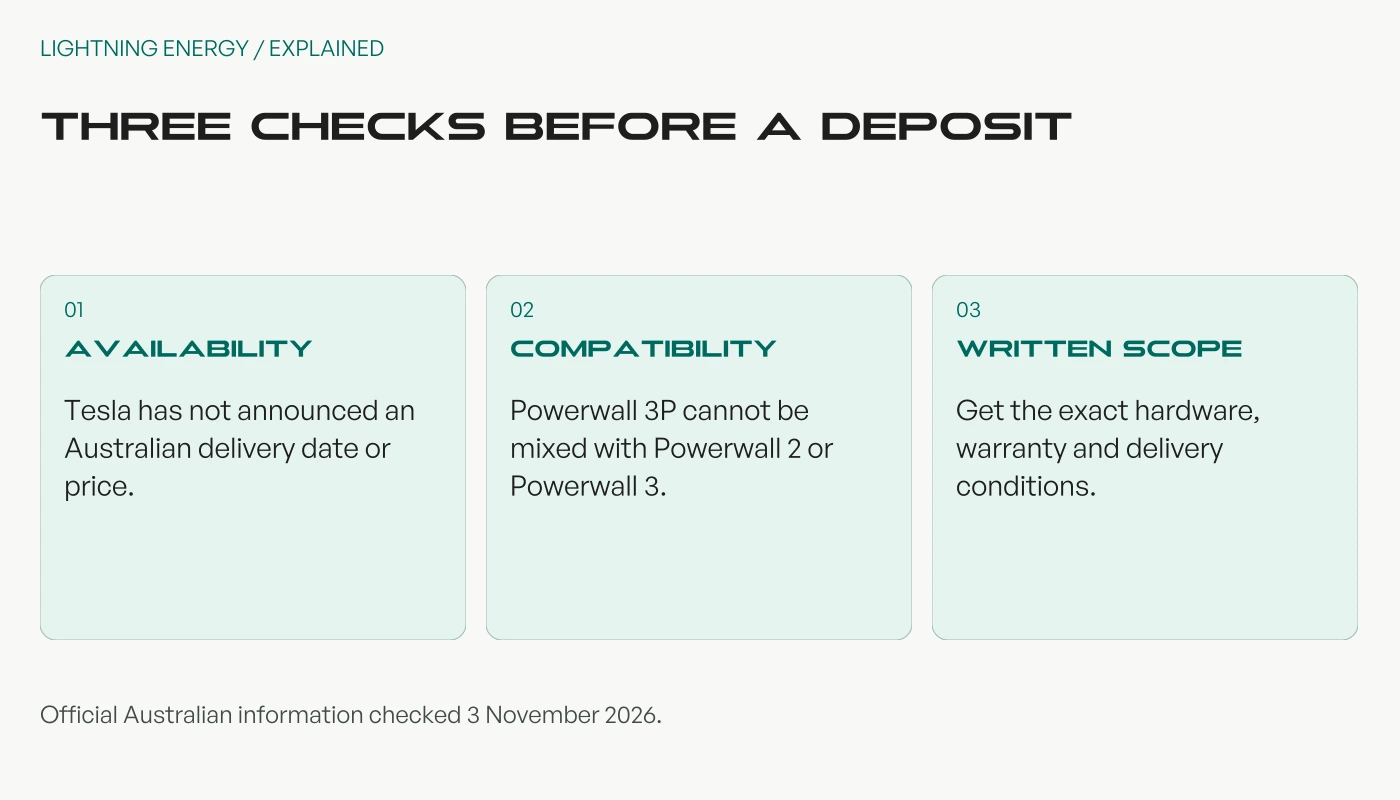
Tesla's Australian warranty includes Powerwall 3P, with a ten-year term and 70% retained energy capacity at the end of that term. Application, connectivity and other conditions still matter.
Read the complete warranty supplied with the eventual Australian offer. Keep the equipment schedule, installation records and any registration information with your household documents.
There is no verified Australian price to compare yet. When quotes arrive, compare the same storage, backup scope and installation work. An equipment-only headline and a complete installed system are different offers.
Powerwall 3P is worth following if you need a new three-phase battery system. Its practical value will depend on the final Australian offer and the design for your home.
The productive next step is to collect usage data and a list of essential loads. That preparation remains useful whether you choose 3P later or another suitable battery sooner.
Available times
Book a consultation and we'll map solar, storage, hot water, and the rebates around your bills and your goals.
Question 1 of 6
